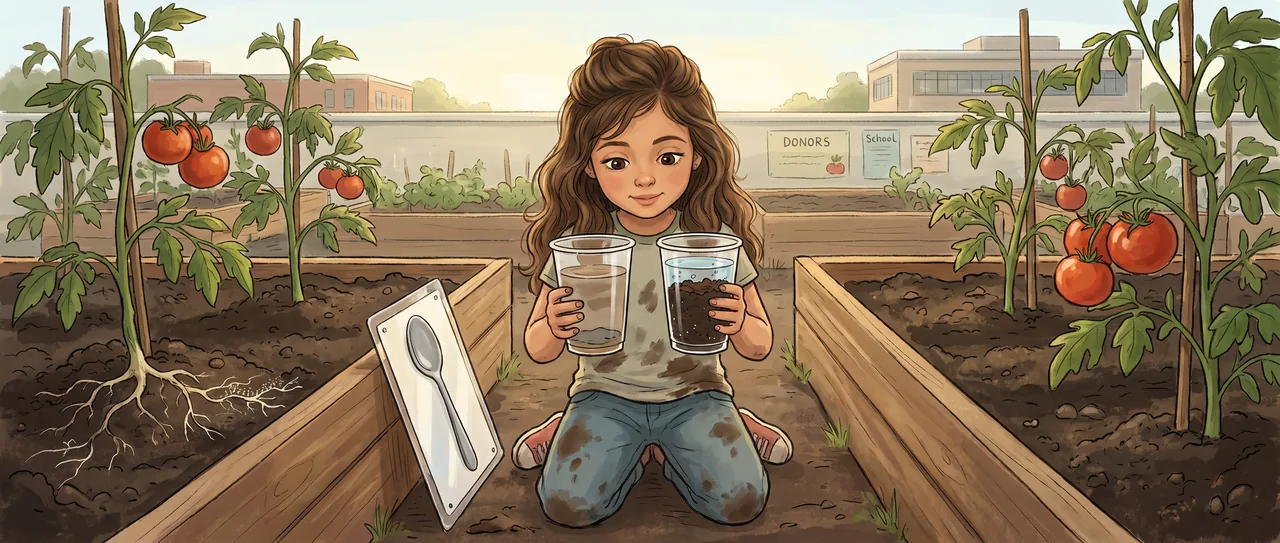
The Teaspoon Field
On the morning the tomatoes drowned, the soil was dry.
Maya found them folded over in the east bed, their leaves hanging like wet socks. The irrigation hose had run for twenty minutes. Water still shone in puddles between the stems.
She pushed one finger into the soil.
The top was slick. Under that, the dirt was pale and powdery, as if the water had only pretended to go in.
Across the path, the west bed stood straight. Same tomatoes. Same hose. Same gray morning. The soil there was dark and lumpy, and when Maya touched it, it gave a little, like cake.
The rooftop farm manager hurried past with a crate of donation brochures tucked under one arm and a tablet under the other.
“Donors arrive in an hour,” she said. “If the east bed looks awful, we’ll swap in the backup seedlings and open a new bag of sterile mix.”
“Sterile?” Maya asked.
“Clean,” the manager said. “Predictable. No weeds, no fungus, no surprises.”
Maya looked at the bent tomatoes. They did not look rescued by clean.
“They got the same fertilizer?” she asked.
“Exact same,” the manager said. “Nitrogen, phosphorus, potassium. The numbers match.”
Maya pulled her finger out of the east bed. A gray paste coated her knuckle. In the west bed, black crumbs clung under her nail.
“The numbers match,” Maya said. “The dirt doesn’t.”
The manager had already turned toward the elevator. “If you can make the east bed presentable without making a mud disaster, do it. Do not flood anything. Do not bring worms onto the walkway. And do not touch the donor table.”
The elevator doors closed on her last sentence.
Maya did touch the donor table, but only to borrow two clear cups and a spoon.
She filled one cup with soil from the east bed. It slid off the spoon in a dead gray clump. She filled the other from the west bed. That soil broke into crumbs, and one crumb stuck to the spoon until she tapped it loose.
She added the same amount of water to each cup.
The east cup turned cloudy at once. The clump sagged, then collapsed into a flat smear at the bottom. The water above it went brown and thin.
The west cup stayed strange. The crumbs darkened, but most of them held together. Tiny bubbles rose from the spaces between them. Water slipped down, not away.
Maya leaned closer.
The west cup smelled like rain on leaves.
The east cup smelled like a wet sidewalk.
She found the laminated soil card clipped to the tool shelf. The card was supposed to be for visitors. It showed a giant photograph of a teaspoon, with arrows pointing to invisible things.
A teaspoon of healthy farm soil can contain up to one billion bacteria, the card said, representing as many as ten thousand species. Maya read it twice, not because the words were hard, but because the spoon in her hand suddenly felt much heavier.
One billion was a number people used when they had given up counting. Ten thousand species in a spoonful meant the west bed was not dirt with tomatoes in it. It was a crowd so large it could not fit inside her head, all under her fingernail, under every root, under the path where adults stepped while talking about brochures.
The east bed had the right numbers on a fertilizer bag.
The west bed had a city.
Maya went to the storage bins. The labels were written in the manager’s neat block letters.
EAST BED: field soil, tilled, screened, mineral fertilizer added.
WEST BED: compost, leaf mold, old clover cover crop, no till.
There was one more bin, shoved behind the rain barrels. It was not neatly labeled. Someone had written, mostly rubbed off by weather, Edge Pile.
Maya lifted the lid.
Inside was the farm’s least respectable soil. It had shredded stems, curled leaves, dark crumbs, and a beetle that immediately ducked away from daylight. Fine white threads ran through one corner like hair caught in a brush.
Maya smiled.
“Of course you’re back here,” she said.
The elevator opened. The manager stepped out with a stack of badges swinging from her wrist.
“Please tell me the beetle is not part of the presentation,” she said.
“The east bed is not thirsty,” Maya said. “It can’t drink.”
The manager blinked. “Soil does not drink.”
“This one does.” Maya held up the west cup. “The crumbs leave spaces. The water goes between. The east one turns to paste on top and dust underneath.”
“That’s texture,” the manager said. “We can add perlite later.”
“It’s not only texture.” Maya pointed at the soil card. “The west bed has things making the crumbs. Living things. Lots of different ones.”
The manager glanced at the card. “We cannot put a billion bacteria on a donor schedule.”
“They’re already on the schedule,” Maya said. “We just didn’t invite them to the east bed.”
For a second, the manager looked like she might say no. Her eyes went to the elevator lights, then the puddled tomatoes, then the two cups on the donor table.
“What are you proposing?” she asked.
Maya had not gotten that far. Her ideas often arrived with missing middles. She looked at the bent tomatoes, the edge pile, the west bed, the spoon.
“Don’t replace the bed with sterile mix,” she said. “Cut little trenches beside the roots. Add compost from the edge pile. Cover the top with leaf mulch so it doesn’t crust. Run the water slower. Not more. Slower.”
“That will look messy.”
“The clean one is dying.”
The manager stared at the east bed.
Then she handed Maya the badge ribbons. “Keep these away from mud.”
Maya worked fast.
She did not dig up the whole bed. The soil card said tilling could break apart the places where soil life lived, and the west bed had not been tilled. So she made narrow slits with a hand trowel, tucked dark compost along the tomato roots, and pressed leaf mulch over the shiny gray crust. She pinched the irrigation valve until the hose stopped spitting and began to bead slowly.
By the time the donors arrived, the east bed still looked odd. It had crooked seedlings, dark seams, and leaves scattered like a forest floor.
The manager stood beside it with her donation smile ready.
“Our students are comparing soil systems,” she told the visitors. “Same crop, same water, same fertilizer, different soil communities.”
Maya stood behind the rain barrel, mud on both knees.
A visitor asked if the messy bed was an accident.
“No,” the manager said, and only her left eye twitched. “It is the point.”
For the next week, Maya checked the east bed before class.
On the first day, the puddles vanished, but the tomatoes still sagged.
On the second day, the top did not seal into gray shine after watering.
On the fourth day, one plant lifted its newest leaves.
On the seventh day, the manager found Maya crouched between the beds with two cups again.
“I sent samples to the lab,” the manager said, holding up her tablet. “The field soil came back with much lower microbial diversity than the compost bed. The note says some modern farming practices have reduced soil microbial diversity by around forty percent compared with more diverse soils.”
Maya took the tablet. The screen showed a graph with bars like city skylines. The west bed’s skyline rose in uneven towers. The east bed’s skyline had gaps.
Below the graph was a list of names. Not people names. Long, folded, slippery names. Bacteria, fungi, creatures with jobs no one on the roof had assigned them.
The list kept going when Maya swiped.
And going.
And going.
The manager looked over her shoulder. “We should make a sign. Something catchy. Maybe, Healthy Soil Is Alive.”
Maya handed back the tablet. “Make the letters small,” she said.
“Why?”
“So there’s room for the names.”
The manager opened her mouth, closed it, and looked at the east bed.
Maya knelt at the bed and tipped a teaspoon of the dark, crumbly soil beside the nearest tomato stem. When she parted the mulch with one finger, a white thread lay across a pale root and disappeared into the black.
Read the interactive version, listen to the narration, and earn a gold star →
A science-verified short story for curious kids · Curiosity Land