The Stone That Was Not There
By noon, Maya had made seven hundred Martian rocks, and every single one was wrong.
Some looked like potatoes. Some looked like melted shoes. One had a shadow on both sides, as if Mars had borrowed a second sun and forgotten to tell anyone.
The museum lab smelled like warm plastic and floor polish. On the wall, a blue poster said, Make a photograph that never happened.
That was why Maya had come.
The instructor wanted everyone to begin with flowers.
"Flowers are friendly," the instructor said, tapping quickly at her tablet. A badge bounced against her sweater. She had the voice of someone who had said the same sentence nine times already and was trying to make the tenth sound fresh. "The sample project is very reliable. Petals, stems, bright colors. The model learns fast."
Maya had already opened the Mars folder.
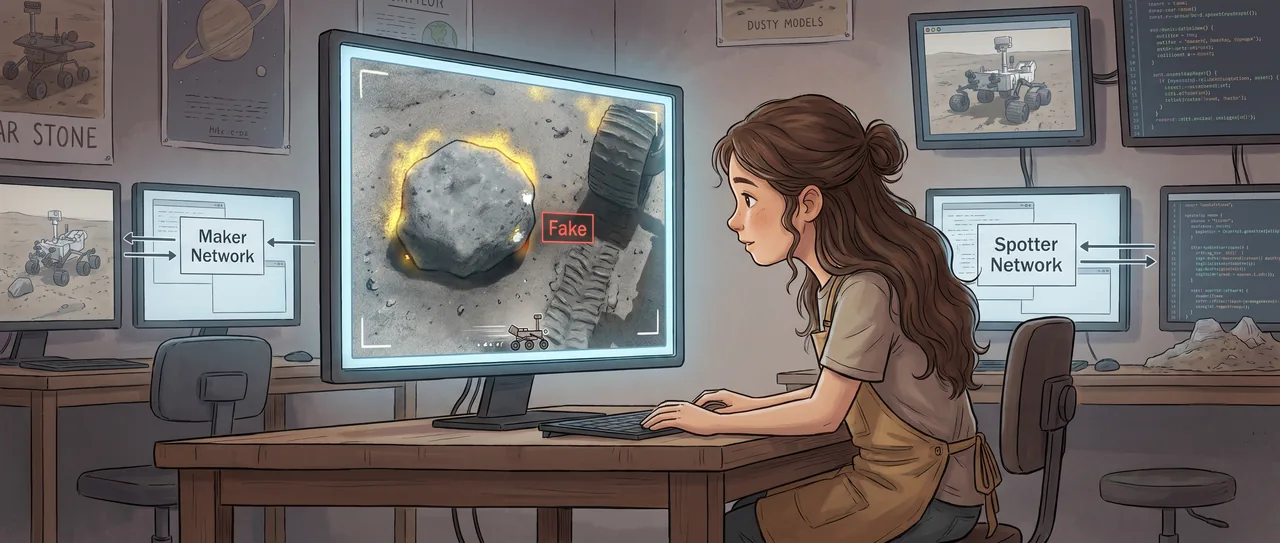
The screen showed two boxes. One was labeled Maker. One was labeled Spotter.
The Maker began with snow, not winter snow, but screen snow, gray and nervous. It pushed the snow into shapes. The Spotter looked at each shape beside real rover photographs and guessed: fake or real.
If the Spotter caught the fake, the Maker changed a little.
If the Maker fooled the Spotter, the Spotter changed a little.
They did not talk. Numbers passed between them. Tiny changes moved through layers Maya could not see, like footsteps behind a wall.
Maya liked the Spotter immediately.
The Spotter was rude in a useful way.
Fake, it said to the potato.
Fake, it said to the melted shoe.
Fake, it said to the two-shadow rock, with ninety-nine percent confidence.
"It is too good at saying no," Maya said.
The instructor leaned over for half a second. "That means your generator has room to improve. Try flowers if you get frustrated."
Maya did not try flowers.
She looked at the real Mars photographs instead.
They were not the way posters made Mars look. Not clean red deserts under heroic sunsets. The rover pictures were cramped and dusty. Pebbles cut across other pebbles. Wheel tracks made rows like stitched fabric. Some shadows were sharp. Some vanished into grit. The horizon sometimes tilted. The camera had caught glare, blur, little square crumbs from compression.
The real images were full of things a tidy person would delete.
Maya opened the training folder she had made and stared at her own mistake.
She had cleaned it.
She had chosen the nicest rocks, the centered rocks, the rocks that looked the most like rocks. She had thrown away the weird ones, the half rocks at the edge, the overbright dust, the pictures with rover metal poking in from the side.
No wonder the Maker was making potatoes. It had been shown a lie about what real looked like.
Maya dragged the rejected photographs back in.
The instructor passed behind her carrying a coil of orange cable.
"Careful with noisy data," she said. "Odd examples can confuse the model."
"Good," Maya said.
The instructor stopped. "Good?"
Maya was already sorting thumbnails. "It should be confused by the right things."
The instructor looked as if she wanted to answer, but someone near the printer called for help, and she hurried away with the cable dragging softly behind her.
Maya made three piles.
Edges.
Dust.
Things that looked fake but were real.
The last pile was the largest.
She fed the Spotter all of it.
The next round began badly. Worse than badly. The Maker produced a field of gray pancakes with little black pimples on them. The Spotter laughed without laughing. Fake, fake, fake.
Maya did not mind. A bad answer was still an answer. It had a shape.
She opened the Spotter view. The lab software showed heat colors over the images, yellow where the Spotter had stared hardest. On the fake pancakes, yellow burned around the pimples. On real photos, yellow gathered at broken edges, under overlapping stones, where dust softened a shadow.
"You like the wrong dots," Maya told the Spotter.
She added more real photographs where dust was not dots at all, but a powdery skin over everything. Then she ran the match again.
The Maker changed.
The pancakes became pebbles. The pebbles became stones. The stones sat badly at first, floating on top of the ground instead of pressing into it. The Spotter caught that. Maya saw yellow gather under the fake stones, at the place where contact should have been.
She found real pictures where rocks sank into dust with tiny collars around them.
The Maker changed again.
The new stones had collars.
Too many collars.
"Greedy," Maya said.
She gave the Spotter real images with bare stones, buried stones, cracked stones, stones with no collars at all.
The numbers on the screen slid toward each other.
Spotter accuracy, eighty-two percent.
Then seventy-one.
Then sixty-three.
The instructor came back with her sleeves pushed up.
"Still on Mars?"
Maya nodded.
"The flower group is printing already," the instructor said. She sounded pleased for the flower group and worried for Maya at the same time.
On Maya's screen, the Maker offered a new image.
A gray stone lay beside a shallow rover track. Dust gathered against one side. The shadow tucked under it, not too dark, not too neat. A bright fleck sat near the upper edge where the camera had caught something small.
Maya's hand stopped above the mouse.
She clicked real.
The answer flashed.
Fake.
For a moment, the lab grew very large without moving. The tables stayed tables. The printer stayed jammed. The flower pictures curled warmly in their tray. But between the Maker and the Spotter, something had happened that was not copying and was not drawing and was not guessing the way people guessed.
Two machines had argued over what counted as true in a photograph until one of them made a piece of Mars that no rover had seen.
Maya leaned closer.
The Spotter was not winning now. It was wobbling around fifty percent, half right, half wrong. Not because it had become useless. Because the fakes had walked into the same fog as the reals.
The instructor set down the orange cable.
"That one is generated?" she asked.
Maya clicked through the test grid. Real. Fake. Fake. Real. She got them wrong too. Not always. Enough.
The instructor laughed once, softly, not like a teacher being kind, but like a person who had opened the wrong door and found weather inside.
"You made the discriminator harder," she said.
"It made the Maker less lazy," Maya said.
On the screen, the Spotter highlighted the generated image. Yellow flickered over dust, contact, shadow, edge. All the places Maya had put back because they did not behave.
She thought of all the times someone had told her to stop picking at the part that did not fit. Here, the part that did not fit was where the whole machine learned to see.
A chime sounded from the front table.
"Five minutes," the instructor called to the room.
Maya did not print the image.
Printing felt too flat.
She opened the little rover simulator at the bottom of the lab software. It was meant for testing navigation on practice terrain. Usually it used real rover photographs. The help text said synthetic images could be useful when real examples were rare, expensive, or dangerous to collect.
Maya dragged her generated Mars patch into the simulator.
The program asked for a label.
She typed: test ground.
The screen redrew. Grainy dust spread under a pale sky. The stone appeared beside the track, ordinary and impossible to point at as either one.
Maya set the two small images on the table, one beside the other.
On the screen, the little rover turned its wheels and rolled toward the gray stone.
Read the interactive version, listen to the narration, and earn a gold star →
A science-verified short story for curious kids · Curiosity Land