The Polite Thunder Problem
The thunder machine failed by being too honest.
It was supposed to go flash, pause, boom.
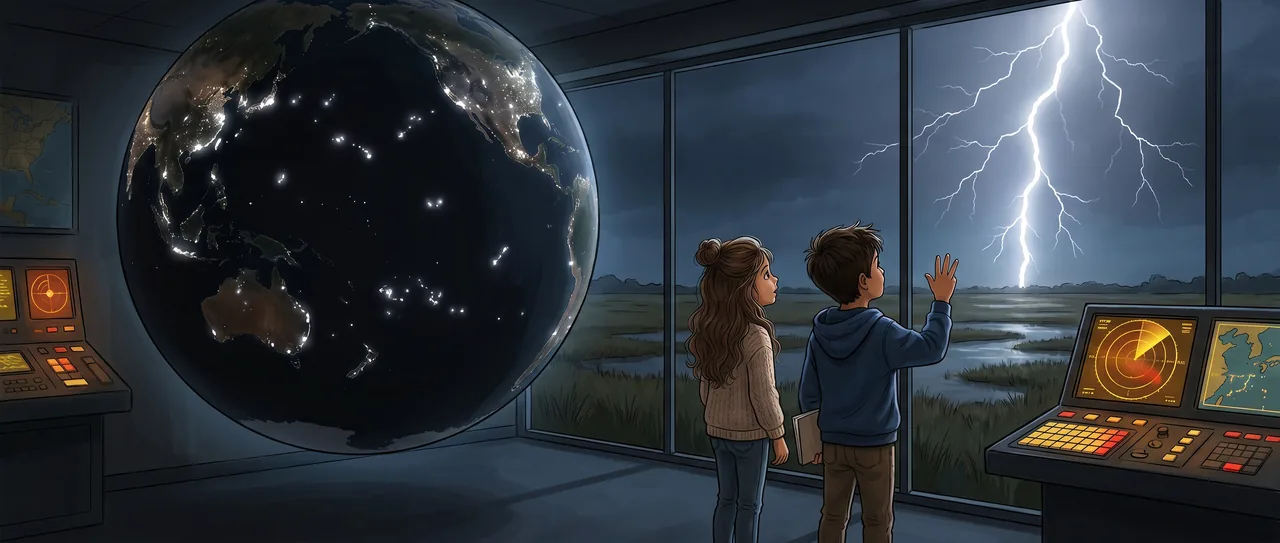
That was what the visitors expected. That was what the sign promised. A clean little storm in a dark room, with a glass wall facing the real black clouds over the marsh and a safer storm glowing on the screen.
Instead, the speakers went tik-tik-tik-tik-tik so quickly that the sound turned into a nervous zipper.
Dr. Rios bent over the console with half a sandwich in one hand and rainwater shining on her glasses. She was wearing one blue sock and one green sock. Maya had noticed at once and added it to the list of things that did not matter yet.
“No,” Dr. Rios said to the machine. “No, no, no. We are not doing this in front of the county council.”
Soren stood beside Maya with his paper notebook tucked under his elbow. The notebook had already made three adults smile in the way people smiled at museum fossils.
Dr. Rios pointed at the screen. A black globe spun there, sprinkled with tiny white sparks.
“It’s picking up noise,” she said. “Radio junk. Microwave ovens. Somebody’s garage door. I have eight minutes before people come in. Make it polite.”
Then she hurried away, chewing her sandwich and talking into a wrist microphone about the mayor, the livestream, and why no one had found the dry extension cords.
Maya leaned close to the console.
“Not noise,” she said.
Soren opened his notebook. “Probably noise.”
“The sparks are in storm shapes.”
“Storms can be noisy.”
Maya touched the glass above the Atlantic. Little points flashed in crooked bands. Another cluster jumped over central Africa. A string of sparks crawled through South America.
“Count,” she said.
Soren clicked his pen. The machine ticked too quickly. He tried making marks. After three seconds, his marks became a black scratch. He stopped and looked irritated, but not at Maya.
“Too many,” he said.
Maya reached for the settings menu. She did not ask permission because the machine had already asked for help by failing.
Soren read over her shoulder. “Event log.”
She opened it.
A column of times poured down the screen faster than rain on the glass wall.
Soren put his finger on the counter at the bottom.
“Last minute,” he said. “Five thousand eight hundred and ninety-two.”
Maya did not move.
Outside, the marsh grass flattened under a gust. Inside, the little globe kept sparking, everywhere at once.
Soren divided under his breath. “That is about ninety-eight every second.”
The thunder machine ticked and ticked and ticked.
Maya’s mouth opened, then shut. She had been thinking of the storm outside as the storm. The one with clouds pressing against the center’s glass. The one with visitors taking pictures. The one coming for them.
But the globe did not care about their window.
The whole Earth was flashing.
“Dr. Rios said make it polite,” Soren said.
Maya looked at the screen. “Maybe the mistake is polite.”
The first visitors came in early, shaking umbrellas, smelling like wet pavement. Dr. Rios appeared behind them, bright and breathless.
“Welcome to Sky Current Center,” she said. “Please enjoy the live lightning wall, which two of our youngest volunteers have definitely fixed.”
She gave Maya and Soren a smile with edges on it.
Soren whispered, “We have not fixed it.”
“We changed the problem,” Maya said.
She had turned off the zipper noise from the speakers. The room darkened. The globe filled the front wall, black oceans, thin outlines of continents, and white sparks blooming so quickly they seemed almost alive.
The visitors went quiet.
A small child near the front said, “Is that now?”
Soren answered before Dr. Rios could. “Yes. Each point is a detected lightning flash. The network hears the radio burst and places it on the globe.”
“Not hears like ears,” Maya said.
“Right,” Soren said. “Detects.”
A man in a raincoat laughed softly. “That many?”
Maya tapped the counter. “About one hundred every second.”
The man stopped laughing.
Dr. Rios lowered her sandwich hand.
On the wall, storms flickered over oceans where no one in the room had ever stood. White points appeared and vanished in the dark belts near the equator. A storm over land pulsed like something breathing under a blanket.
The child near the front pressed closer to the rope.
“Where is ours?” the child asked.
Maya dragged two fingers across the screen and spun the globe toward the coast. The local map opened. Their building appeared as a green dot beside the marsh. Around it, clouds glowed in radar colors, yellow, orange, red.
A white fork snapped across the real sky beyond the glass.
Everyone jumped except Maya, because she had already seen the light begin in the corner of her eye.
Soren’s pen moved. “One,” he said.
The room held its breath.
“Two,” he said.
“Three.”
Thunder cracked over the center so hard the glass wall shivered in its frame. Several visitors made small surprised noises. The floor gave the sound back through Maya’s shoes.
Maya pointed at the place outside where the flash had been. “Light gets here first.”
Soren nodded toward the speaker tower. “Sound has to cross the air.”
Dr. Rios stepped forward, recovering her open-house voice. “And what makes the sound?”
Maya did not look back. She put both hands in front of her, palms nearly touching, then flung them apart.
“The air gets shoved,” she said.
Soren added, Maya clapped once, sharp and flat. “That shove becomes thunder.”
The next flash lit the marsh white.
This time Soren did not count aloud. He held up fingers instead. One. Two. Three. Four.
The thunder rolled in lower, longer, like furniture being dragged across the sky.
Maya moved to the console. “Near storms should boom. Far storms should not.”
“Because we are not hearing thunder from Africa,” Soren said. “We are seeing detections.”
He found the audio setting and changed the label from GLOBAL THUNDER to GLOBAL FLASHES. Maya changed the speaker setting to LOCAL ACOUSTIC ONLY. When she pressed save, the machine gave one tidy chirp.
Dr. Rios looked at the new labels. Then at the crowd. Then at Maya and Soren.
“That,” she said, “is much less polite.”
Maya waited.
Dr. Rios smiled. “Good.”
The visitors spread through the room, but slowly, as if walking too fast might disturb the storms. Some watched the local radar. Some watched the world map. The little child stayed with the counter, trying to make their finger tap as fast as the number changed, failing, trying again.
Soren stood beside the screen with his notebook closed in both hands.
“Look,” Maya said.
A storm cluster in the middle of the Pacific had begun to pulse in a long curve. No city lights showed beneath it. No roads. No borders. Just ocean and cloud and flash after flash after flash.
Soren lifted one hand toward the glass but did not touch it.
Behind them, Dr. Rios began her official speech to the county council.
“Most of the time,” she said, “we teach lightning as something that happens to a place.”
A bright fork split the sky outside, and the room filled with white.
Maya and Soren faced the window.
Soren raised his fingers.
One.
Two.
Three.
The boom hit, and on the black wall behind them, white points kept blooming over the turning Earth.
Read the interactive version, listen to the narration, and earn a gold star →
A science-verified short story for curious kids · Curiosity Land