The Paths That Stayed
The first thing wrong with the brain was that it was too beautiful.
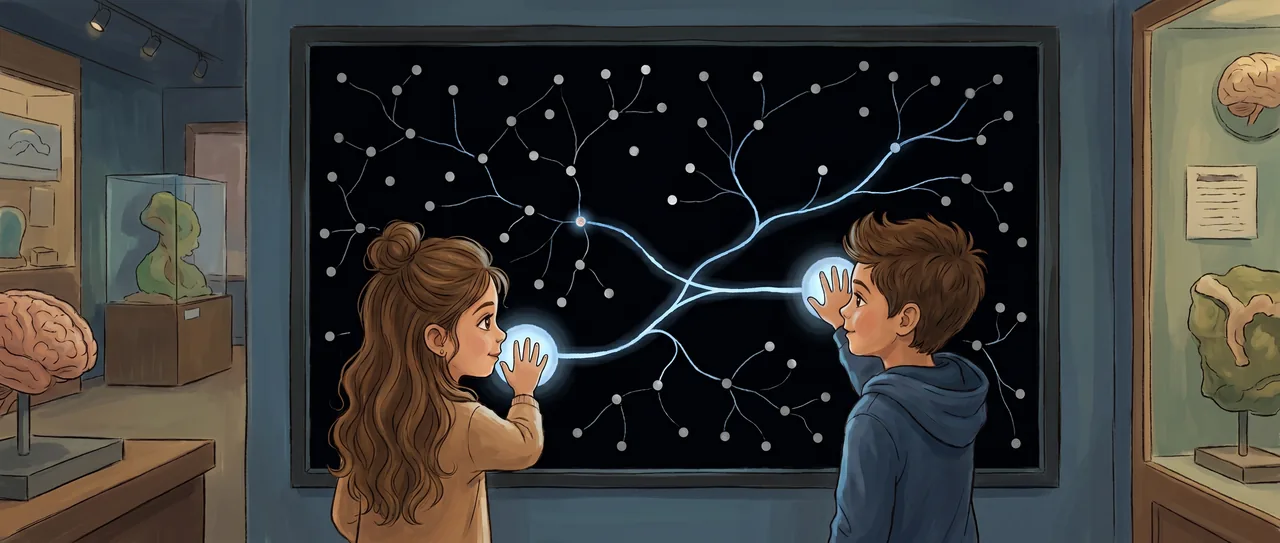
It covered one whole wall of the new museum room, a black glass brain full of silver dots and blue-white lines. Every dot touched every other dot. Every line glowed. It looked like a city seen from space, if the city had decided to build roads between all its windows.
The exhibit designer loved it.
"Sparkly," she said, standing on a ladder with a roll of tape in her teeth. "Parents stop for sparkly. Please tell me the start button works. The donor tour arrives in twelve minutes."
Soren pressed the green button.
A sign lit up under the glass: TEACH THE BRAIN.
Another sign lit: CHOOSE AN EXPERIENCE.
There were tiles for sounds, shapes, balance, words, touch, rhythm. Maya pressed SHAPES. A red triangle appeared at one side of the glass brain. Three possible answers appeared at the other side.
The whole brain flashed.
All three answers lit up: TRIANGLE, CIRCLE, BANANA.
"It said yes to banana," Maya said.
"Bananas can be triangle-adjacent," the designer said. She climbed down and squinted. "No. That is not ideal."
Soren pressed SOUNDS. The wall played a bell tone. The whole brain flashed again. It answered BELL, DRUM, WATER, BLUE, and MONDAY.
"It says yes to everything," Soren said.
The designer made a small sound in her throat. "It was working last night. Mostly. I changed one setting because the pruning stage looked sad. Lines disappearing. Very bare. People don't come to museums for bare." She shoved the tape into Maya's hand. "Can you make it less foggy? You two know the test menu. I have to keep the welcome arch from spelling WELCONE."
She hurried away, dragging a banner that said YOUR BRAIN IS BUILDING ITSELF.
Maya stared at the wall. The brain shimmered, pleased with all its wrong answers.
"Maybe more connections is not better," she said.
Soren had already opened the test drawer under the glass. It held a tablet, three cables, and a laminated sheet titled MODEL NOTES. He liked laminated sheets because people only laminated things they were afraid someone would ignore.
He read aloud. "This model is simplified. Real brains are living tissue. In early childhood, brains make many more synapses than they keep. From about age two through adolescence, into the twenties for some systems, weaker or less-used connections are reduced. Experience helps shape which circuits strengthen."
Maya leaned close to the glass. "It made every possible road."
"And kept them." Soren tapped the tablet. "Here. Preserve all connections. She turned it on."
"Turn it off."
He did.
The wall immediately dimmed, then stopped. A red message appeared.
NO EXPERIENCE HISTORY. PRUNING WITHOUT USE DATA NOT ALLOWED.
"Good," Soren said.
"Good?"
"If it cut without knowing what got used, that would be random. The model won't do that."
Maya looked toward the entrance. Workers rolled a cart of tiny paper brains past the doorway. Somewhere beyond them, the designer shouted, "There is no cone in welcome!"
"How much history does it need?" Maya asked.
Soren scrolled. "Enough repeated routes for the weights to separate."
"In eleven-year-old language."
"Use some paths more than others. Then prune."
Maya's hand was already over the tiles. "Then give it ours."
They started with rhythm because the rhythm tile had a pad big enough for two hands. Maya clapped twice, paused, clapped once. Soren repeated it exactly. The wall sent light through a snarl of lines. The second time, fewer lines brightened. The third time, one crooked path brightened faster than the rest.
They did balance next. Maya stood on the wobble plate and leaned left, right, left. Soren timed the response and made her do it again because the first trial had a hiccup. The brain wall found another route, low and looping.
"Again," Soren said.
"We have eight minutes."
"Then do it fast again."
They did shapes. They did bell and drum. They did touch, with cold metal and warm rubber. They did words, though Maya objected because the word tile wanted neat categories, and neat categories always acted innocent right before they trapped something interesting.
Then she saw the blank tile.
It sat at the bottom of the tablet menu, pale gray, unlabeled.
"That one," Maya said.
"It's for custom experiences," Soren said. "The designer probably hadn't chosen it yet."
"Good."
She opened the tile. The tablet asked for a name.
Maya typed: WHAT DOESN'T FIT.
Soren looked at her.
"That's not one sense," he said.
"Neither is Monday," Maya said.
He considered this. Then he connected the tablet to the wall.
The glass showed four things: a feather, a leaf, a moth, and a spoon.
Maya pressed the spoon before the choices finished loading.
A thin thread of light moved through the glass brain. It did not take the routes that rhythm or shapes had taken. It went up, sideways, back down, then through a tiny dot nobody had used yet.
"Again," Soren said, but his voice had changed.
This time the wall showed a shoe, a boot, a sandal, and a violin.
Maya pressed the violin. The same strange route brightened, stronger.
Soren made the tablet show its path weights. Numbers rose beside the crooked route.
"It doesn't care that the tile isn't official," he said.
Maya's fingers hovered over the next set before she touched anything. A cup, a bowl, a plate, a cloud.
She pressed cloud.
The tiny unused dot flashed like it had been waiting under the dark.
Soren pulled his notebook from his back pocket, then did not write. He looked at the notebook, at the glass, at Maya, at the notebook again.
"Paper," he said.
"What?"
"Make one for paper. The way I remember things. Not voice notes. Not the school tablet. Paper."
Maya grinned and shoved the tablet toward him.
He made a custom tile called HANDWRITING. The wall displayed a sentence on one side and a blank line on the other. Soren copied it onto a pad with a museum stylus. His letters were small and careful. The brain wall lit a path that crossed the word route, then left it, then crossed the touch route, then found its own way.
He did it again. And again.
The designer ran back in with one shoe untied and a strip of tape stuck to her sleeve.
"Why is there a tile called WHAT DOESN'T FIT?" she asked.
"It got used," Maya said.
"Why is there a tile called HANDWRITING?"
"Also used," Soren said.
The designer opened her mouth, closed it, and looked at the wall. The brain was not fog anymore. It was still crowded, still bright, but some routes had begun to win.
"Prune it," Maya said.
Soren checked the timer. "If we do, the dim paths go. The strong ones stay."
The designer winced. "Maybe just a little prune. A decorative prune."
"No," Maya said. "A brain one."
Soren pressed RUN DEVELOPMENT.
The wall went silent.
At first nothing happened. Then the blue-white lines began to fade. Not all at once. Not cleanly. Some vanished in the middle and left dark gaps. Some thinned until they were only threads. The all-to-all city lost roads, windows, bridges, whole shining neighborhoods.
Maya stepped closer.
The glass brain did not look emptier.
It looked possible.
The rhythm path remained. The balance loop remained. The shape and sound paths crossed and separated. The crooked route from WHAT DOESN'T FIT stayed bright, including the tiny dot that had been dark before Maya used it. Soren's handwriting path stayed too, stitched between seeing and moving and touch.
The designer whispered, "Oh."
The museum doors opened at the far end of the hall. Voices spilled in. Small shoes squeaked on the polished floor.
The welcome arch blinked on above the entrance. It spelled WELCOME correctly.
The designer looked at Maya and Soren. "What do I tell them?"
Maya put her finger on one pad. Soren put his on the other.
On the glass brain, two thin paths brightened side by side, split apart, crossed once, and kept going.
Read the interactive version, listen to the narration, and earn a gold star →
A science-verified short story for curious kids · Curiosity Land