The Mile Above Everest
By noon, the Mariana Trench had already swallowed Mount Everest three times.
Not the real mountain. A white plastic model of it, chipped at the summit because Maya had dropped it once and Soren had dropped it twice, though Soren said his had been a controlled test of balance.
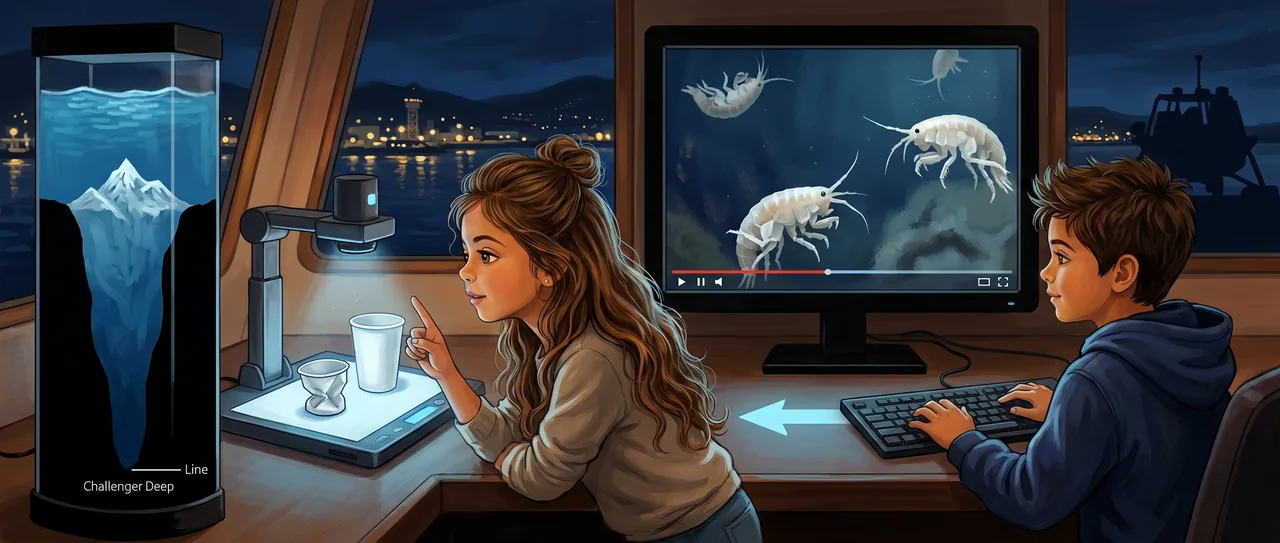
The model slid down inside a clear column of blue water painted on acrylic. At the bottom was a black line labeled Challenger Deep. The top of Everest stopped far below the surface mark.
The outreach director tapped the empty blue space above the tiny summit. She had a headset around her neck, a roll of tape on one wrist, and the look of someone who had been awake since yesterday.
“More than a mile of ocean still over it,” she said. “That is the gasp. Then we show the seafloor clip. Clean, dark, impossible. Thirty seconds. Done.”
Maya looked at the word clean on the schedule and made a face.
Soren had the returned lander footage open on the review screen. The lander itself sat in the bay behind them, all yellow frame and steel feet, smelling faintly of salt, machine oil, and old fish. Its glass spheres were stacked in a crate like giant clear eyes. Beside them lay a mesh bag that had held bait at the bottom of the world.
“The clip is not clean,” Soren said.
“That is why I have you two,” the outreach director said. “Find me the clean part. I have twelve classrooms calling in, one camera that hates me, and a microphone making whale noises.”
“It is an ocean ship,” Maya said.
“Not helpful whale noises,” the outreach director said, and hurried away.
Soren pressed play.
The screen filled with black water. Then white flecks rushed past the lens. Some drifted. Some twitched. Some vanished and came back larger. The whole picture crawled and flashed.
“Snow,” Soren said.
“No,” Maya said.
He paused it. “Marine snow is real. Bits of dead things falling from above.”
“Not like that.”
Soren did not argue. He moved the video back five seconds and played it again at half speed.
The flecks did not fall. They surged.
He wrote three arrows in his paper notebook, then crossed out two. “The current goes left. These go left, right, up, and at the camera.”
Maya leaned so close her breath fogged the edge of the monitor. “They are not in the water. They are coming to dinner.”
On the screen, one white shape struck the lens and stayed there long enough for legs to appear, jointed and busy. Then it kicked away.
“Shrimp?” Maya asked.
“Shrimp-ish,” Soren said. “Amphipods, maybe. The label on the bait bag said amphipod test.” The outreach director swept back past them, wrestling a coil of cable.
“Please tell me you found thirty seconds that do not look like a blizzard in a closet,” she said.
“It is animals,” Maya said.
The outreach director stopped for half a breath. “Wonderful. Also unreadable. The audience needs to see something.”
“They are seeing something,” Soren said.
“They are seeing confusion,” she said. “I need one clear idea. Deepest trench. Mountain fits inside. Huge pressure. Life is hard. Science is amazing. Then the closing slide.”
Maya’s eyes went to the foam cups drying on a towel.
Before the lander had gone down, the crew had tied a sleeve of white foam cups to its frame. Students from six schools had drawn rockets and jellyfish on them. Now the cups were the size of thimbles. The drawings had shrunk, dark and crowded, as if the cups had tried to remember being larger and failed.
Maya picked one up. It weighed almost nothing.
“This went down with the camera?” she asked.
“To the bottom and back,” the outreach director said. “Pressure demonstration. Very popular.”
Soren held the tiny cup beside an untouched one from the supply box. The big cup looked silly next to it, soft and full of trapped air.
“The air spaces got squeezed,” he said.
“About a thousand times the pressure up here,” the outreach director said, already moving again. “Careful with those. The third graders made them.”
Maya put the little cup in front of the monitor. On the screen, the amphipods kept battering the lens like impatient commas.
“Foam shrinks,” she said. “Glass spheres come back. Metal comes back. Animals come over for bait.”
Soren looked from the cup to the lander to the white swarm on the screen.
“The wrong thing in the wrong place is the point,” he said.
Maya smiled. “There.”
They did not find a cleaner clip.
They made the messy one worse.
Soren slowed it until each amphipod crossing became a separate event. He marked the current with a pale blue arrow. Maya taped the shrunken cup beside the full-sized cup under the camera. She put the Everest model back in the trench column, not at the bottom but standing on the black line, its summit lost under painted blue water.
“More than a mile above the mountain,” she said. “Then this.”
She pointed to the screen, where the white animals arrived out of blackness.
“What about fish?” Soren asked.
Maya searched the folder names. Most were numbers, dates, depth marks. One said slope survey. Another said mud core. Another said bait return.
Soren opened the mud core file. It was not video, only microscope images from a sample jar sealed in the lab. Gray grains. Clear slime threads. Tiny bright dots clustered on particles from the trench floor.
“Maya,” he said.
She looked once and stopped moving.
The amphipods were easy. They had legs. They had hunger. They looked like something alive if you gave your eyes time.
The microbes did not look like much at all. Dust. Pinpricks. Little almost-nothings on pieces of mud that had been under almost eleven kilometers of water.
Soren placed the image after the amphipods in their sequence.
“Will they see them?” Maya asked.
“Only if we make them wait,” he said.
The broadcast began with the microphone still making occasional whale noises.
The outreach director stood in front of the camera and welcomed the classrooms. Behind her, a screen showed the blue trench column. She lifted the little Everest and held it up for scale.
“This is Mount Everest,” she said. “If we placed it inside the deepest part of the Mariana Trench, the summit would still be covered by more than a mile of water.”
She lowered the mountain into the column.
On the review monitor, tiny classroom windows showed children leaning toward their cameras.
The outreach director turned for the next slide, but the remote did nothing. She clicked it again. Nothing.
Her jaw tightened.
Soren had the backup keyboard already under his hands. Maya had one finger above the space bar.
“Go,” Soren said.
Maya pressed it.
The messy clip filled the big screen.
For two seconds, it looked like static.
For five seconds, it looked like snow.
Then Soren’s blue arrow appeared, pointing left with the current. One white fleck swam against it. Another grew legs against the glass. Another vanished into the bait bag and came out carrying a strand.
The classroom windows changed. Heads moved closer. One child’s mouth made a round shape with no sound.
Maya set the shrunken foam cup under the document camera beside the ordinary one. The camera showed both cups huge on the screen.
“This one rode down with the lander,” she said. “Same place as the video.”
Soren switched to the glass sphere in its crate. “This carried equipment back. People built it to survive the pressure.”
Maya touched the paused amphipod on the screen. “This did not get built by people.”
The outreach director lowered the remote. She did not interrupt.
Soren changed to the microscope image.
The gray grains appeared. The bright dots waited on them.
Nobody spoke for a moment.
The microphone made one small whale noise.
Maya reached back without looking and tapped the trench column, just above Everest’s buried summit. Her finger left a wet print on the acrylic.
Soren opened the last folder from the slope survey.
The next file opened without a title.
On the monitor, a pale fish drifted into the beam and spread its fins like small white hands.
Read the interactive version, listen to the narration, and earn a gold star →
A science-verified short story for curious kids · Curiosity Land