The Long Way Out
The sign was already painted when Maya saw the mistake.
It stood on the roof of the museum beside the white solar telescope, bright yellow with orange letters, the kind of sign adults thought children liked because it looked like cereal.
SUNLIGHT: FRESH FROM THE SUN IN EIGHT MINUTES.
Maya stopped so fast Soren bumped into her backpack.
"It's wrong," she said.
Soren pushed his glasses up. "Eight minutes is right. Eight minutes and about twenty seconds, depending on where Earth is."
"Not that part. Fresh."
Dr. Voss came out of the stairwell carrying a roll of tape in his teeth and three paper cups of screws stacked in one hand. He ran the observatory the way some people played drums, loudly, happily, and with things sometimes falling over.
"Excellent," he said around the tape. He pulled it from his mouth. "You found the sign. Opening crowd arrives in forty minutes. Your job is to stand near the telescope, keep anyone from touching the filter, and say the line."
"What line?" Soren asked.
Dr. Voss pointed to the sign. "Fresh from the sun in eight minutes. Short. Shiny. True enough."
Maya stared at the word fresh.
Dr. Voss noticed. "Maya, please do not make that face at my sign."
"Where was the light before the eight minutes?" she asked.
"In the sun," Dr. Voss said. "Which is why the sign says from the sun."
"Where in the sun?"
Dr. Voss looked at the stairwell as if another adult might appear and rescue him from precision. None did.
Soren opened his notebook. It was paper, with a soft black cover and pages that had gone furry at the corners. At school, people asked him why he carried something that could not update itself. Soren said because paper never tried to guess the end of his sentence.
"Core," he said. "Fusion makes gamma rays in the core. But they don't come straight out."
"Don't start the core thing," Dr. Voss said. "The core thing eats tours. Last week I said plasma and a grandfather asked me if his television was involved."
Maya walked around the sign. "Fresh is the wrong word."
"The paint is dry," Dr. Voss said. "The donors arrive in thirty-eight minutes. There is no wrong word today."
He hurried to the telescope mount, where a silver tracking motor was making a tiny unhappy clicking sound.
Soren wrote eight minutes, then under it, not fresh. He drew the sun as a circle and put a dot in the middle.
Maya leaned over his shoulder. "Make it ugly."
"The sun?"
"The path. Make it as ugly as it is."
Soren looked at the smooth line he had drawn from the dot to the edge of the sun. He crossed it out.
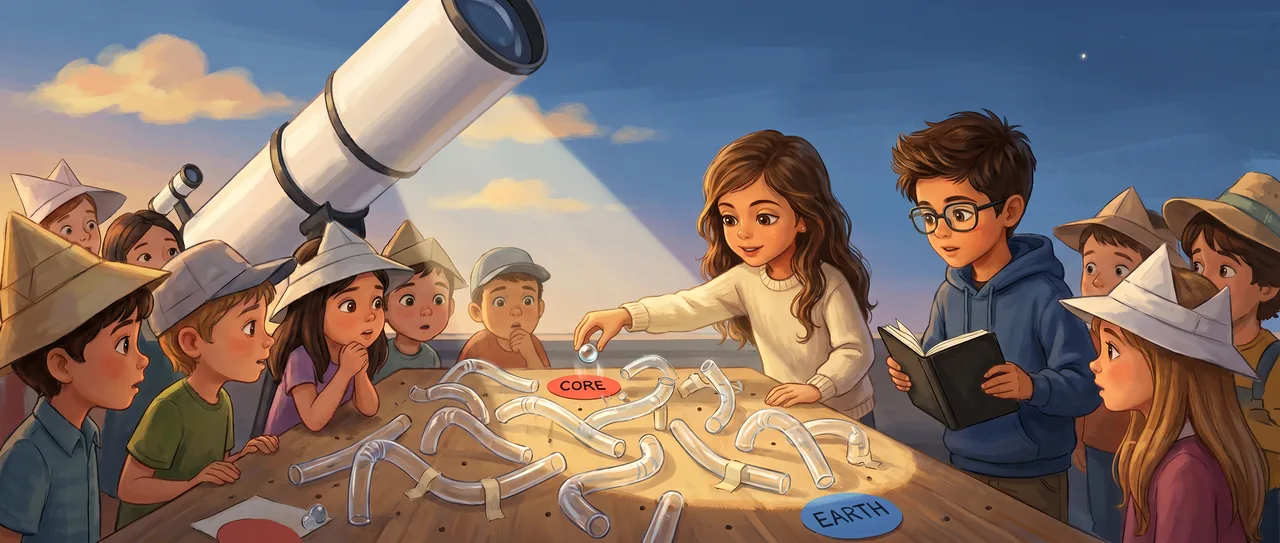
Beside the telescope was the demonstration table, covered with things Dr. Voss had not finished using: magnets, clear tubing, a bowl of glass beads, a sheet of pegboard, two flashlights, a prism, and a sandwich sealed in a bag that had a label reading DO NOT DEMONSTRATE WITH THIS.
Maya picked up the pegboard. It was full of holes in neat rows.
"Not enough," Soren said.
"For what?"
"For ugly."
He took the clear tubing and began cutting it into short pieces with the safety snips. Maya stuck the pieces through the pegboard holes at different angles. Some pointed left. Some right. Some straight back at the beginning.
"The inside of the sun isn't tubes," Soren said.
"I know. It's a fight."
"Dense plasma," Soren said. "Particles everywhere. A photon goes a tiny distance, hits something, gets absorbed, gets re-emitted. Not the same tidy photon, exactly. More like the energy gets passed along."
Maya dropped a glass bead into the top tube. It hit a slanted piece, bounced left, fell into another, rolled backward, and popped out the same side it had entered.
"Good," she said.
"That failed."
"Good."
Soren watched the bead lying on the table. Then he picked it up and dropped it again.
This time it rattled through seven tubes, vanished behind the board, clicked twice, and came out near the top.
Again.
The third time, it reached the middle.
Again.
The fourth time, it got stuck.
Maya shook the board once. The bead dropped all the way through, hit the table, and rolled into Dr. Voss's sandwich.
"Please do not invent a food-based sun," Dr. Voss called without turning around.
Soren was not listening. His page had filled with arrows, crossings-out, and the word again written five times. The pegboard looked like his notebook had learned how to stand up.
"It only gets out because it keeps not getting out," he said.
Maya grinned. "That's the line."
"That's a terrible line."
"It's a true line."
The roof door opened, and the first visitors spilled out: children with paper sun hats, parents with water bottles, one baby wearing sunglasses too large for its face. Dr. Voss straightened so quickly he nearly saluted the telescope.
"Places," he said. "Remember, short and shiny."
Maya stood in front of the yellow sign. Soren stood beside the pegboard maze, holding one glass bead pinched between two fingers.
A boy in a sun hat read the sign aloud. "Fresh from the sun in eight minutes."
Maya took the tape from Dr. Voss's supply box and stuck a strip across the word fresh.
Dr. Voss made a small sound, like a kettle beginning to boil.
Soren held up the bead. "This part is the eight minutes," he said, pointing from the telescope to the blue paper circle taped to the far side of the table. "Once light leaves the sun's surface, space is mostly empty. It can cross to Earth fast. About eight minutes."
He rolled the bead across the table. It clicked into the blue circle.
The boy nodded. That part was easy. Straight things often looked true.
Maya picked up another bead and placed it at the top of the pegboard, where they had taped a red paper circle marked CORE.
"But before light leaves the sun," she said, "it has to get out of the sun."
She let go.
The bead dropped, struck a tube, sprang sideways, vanished, returned, tapped, paused, dropped one row, bounced up two.
The crowd leaned in.
It did not look like a race. It looked like a thought trying to escape a noisy room.
"Light is fast," Soren said. "The inside of the sun is crowded. Photons don't just fly straight through it. They get absorbed and re-emitted again and again. The energy wanders outward. Scientists estimate that trip can take around one hundred thousand years."
The bead fell back out the top.
A little girl laughed. "It went the wrong way."
"Yes," Maya said.
She dropped it again.
This time it reached the lower half and trembled in a tube, bright with sun. Everyone waited. Even Dr. Voss stopped touching the telescope motor.
"One hundred thousand years," the boy said. "Like, before my school?"
"Before schools," Soren said.
"Before cities," Maya said.
"Before farms," Soren said.
The bead clicked lower.
Maya looked down at the sunbeam lying across the table. It had come through the telescope filter, thin and white and ordinary enough to put a hand through. A bright line on scratched plastic. Eight minutes from the surface. Older than every building she had ever entered.
The bead dropped out of the last tube and landed beside the blue Earth.
No one clapped at first. The silence was better.
Then the little girl lifted both hands and whispered, "Again."
Dr. Voss walked to the sign. He peeled off the taped-over word fresh. Some yellow paint came with it.
"All right," he said. "Not fresh. What do we put instead?"
Soren offered his notebook. Maya did not look at it.
"Sunlight," she said, "the long way out."
Dr. Voss wrote it on the sign in black marker. His handwriting was terrible and huge.
The crowd stayed until the sun slid behind the museum's weather mast and the telescope image faded. Parents checked the time. Children stole turns dropping beads. The baby with the sunglasses chewed the edge of a paper sun hat.
When the roof finally emptied, the western sky had turned the color of a peach pit. The first evening star showed above the air-conditioning vents.
The boy in the sun hat had stayed behind. He pointed at it.
"How long did that one take?" he asked.
Soren picked up the prism from the table. Maya lifted the prism toward the first star.
Read the interactive version, listen to the narration, and earn a gold star →
A science-verified short story for curious kids · Curiosity Land