The Forest Inside
The first thing Maya wanted was a cleaner room.
Cleaner walls. Cleaner sheets. Cleaner air. Cleaner everything.
The hospital room already smelled like lightning because the ceiling scrubbers washed the air every four minutes. A robot no taller than Maya's knee rolled in circles, shining violet light under the bed when nobody was standing there. The door had a yellow sign with a gloved hand on it.
Still, C. difficile had come back.
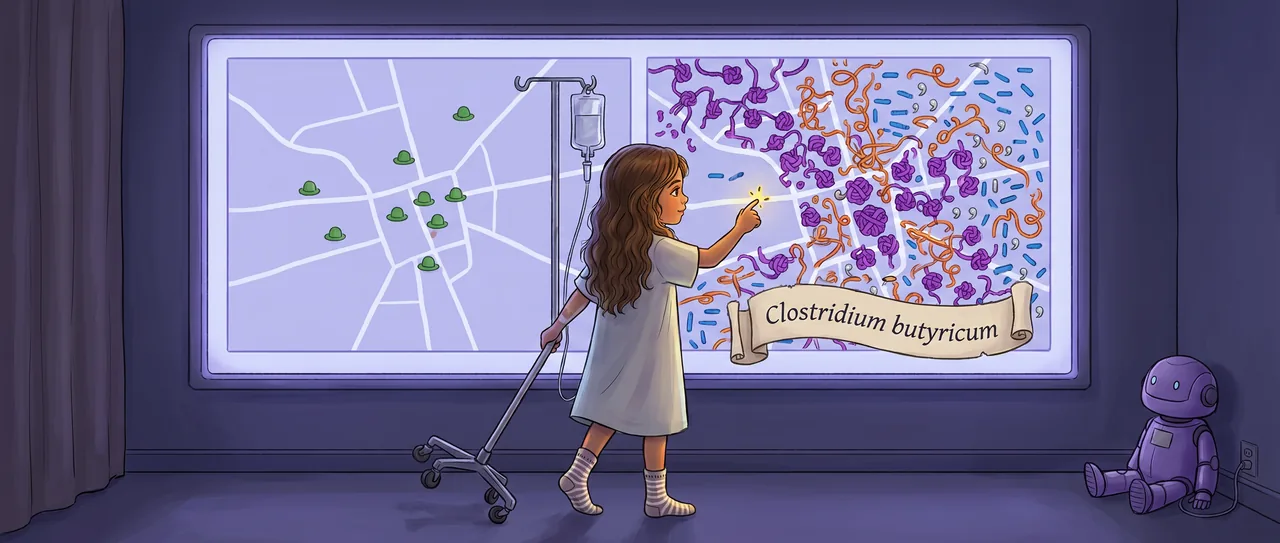
Maya sat with her knees tucked under the blanket and watched the metagenomics wall build a picture of her gut from yesterday's sample. It did not look like a gut. It looked like a city after everyone had moved away except one marching band in green hats.
The green hats were C. difficile.
Dr. Voss tapped the wall too quickly, the way adults tapped when they had already decided which parts mattered.
"Your antibiotics knocked it down again," she said. "But not enough. C diff makes spores. Spores can wait. Then they wake up. That is why this keeps happening."
Maya hated the green hats.
"Use stronger antibiotics," Maya said.
Dr. Voss made a face like she had tasted a lemon and admired it at the same time. She was small and sharp and carried three pens in her hair. One pen was clicking by itself because she kept forgetting it was in her fingers.
"We can try another course," Dr. Voss said. "Or we can restore the missing community. A fecal microbiota transplant. Screened donor material. Usually capsules now. No tubes unless we need them."
Maya stared at her.
"That means poop."
"It means bacteria from a healthy donor," Dr. Voss said. "Very carefully tested. Processed. Frozen. Counted. Checked for pathogens."
"Poop," Maya said.
Dr. Voss's pen clicked five times.
"Yes," she said. "Also, sometimes, a cure when antibiotics cannot do it."
Maya pulled the blanket to her chin. The green hats kept marching on the wall.
"I want the clean thing," Maya said.
Dr. Voss looked at the green hats, then at the clock, then at Maya. "Clean is not always the same as well."
Then her pager chimed, and she left before Maya could argue properly.
Maya did not sleep. The room hummed. The scrubbers breathed. The little violet robot waited in its dock like a beetle pretending to be furniture.
At three in the morning, the metagenomics wall dimmed but did not turn off. Maya slid out of bed, dragging her IV pole with her. The wall had a privacy mode. She was allowed to touch it because it was her data.
She pressed donor comparison.
A second city appeared beside hers.
Not clean. Not empty. Not tidy.
It was crowded.
Purple knots. Orange threads. Blue dashes. Silver commas. Names unrolled when she touched them, long and Latin and slippery. Bacteroides. Faecalibacterium. Roseburia. Things that sounded like spells somebody had filed in a hospital cabinet.
Maya pinched two fingers and spread them. The picture widened until the colors were not dots but neighborhoods. Some sat near the wall. Some floated in the middle. Some were rare enough that she had to search for them, tiny sparks almost hidden by the brighter kinds.
She tapped one small yellow spark.
A label appeared. Low abundance. Produces short-chain fatty acids.
Maya did not know what that meant, except that it was very small and apparently still had a job.
She tapped another.
Associated with colonization resistance.
Maya sounded it out under her breath.
"Resistance to being colonized," she said.
On her side, the green hats had all the streets.
By breakfast, Maya had a fever again.
By lunch, she was angry enough to ask for a walk.
The nurse said she could go as far as the sealed greenhouse if she wore gloves and did not touch anything. The hospital greenhouse was where they grew salad leaves for patients who could eat salad leaves, and where the Mars kids' program tested plants in red fake regolith that looked like powdered brick. Today, half the Mars tray was failing.
The leaves were pale and folded. The red dust was smooth around them, too smooth, like nobody lived there.
Mr. Iqbal, the greenhouse engineer, stood over the tray with both hands on his head. He had soil under one fingernail and a tablet under his elbow and did not notice Maya until she spoke.
"They look like my gut map," Maya said.
Mr. Iqbal jumped. "You are supposed to be in bed."
"I am in walking distance of bed. Why are they dying?"
"They are not dying. They are expressing disappointment." He sighed. "We sterilized the regolith mix. Perfectly sterile. Perfectly balanced minerals. Water correct. Light correct. Still sulking."
Maya looked at the other tray, the one with lettuce curling green and rude and alive.
"That dirt is lumpy," she said.
"That dirt has compost starter," Mr. Iqbal said. "Bacteria. Fungi. The usual crowd. Messy, but effective. The Mars tray is for testing how little biology we can start with."
Maya moved closer until her breath fogged the face shield.
Sterile red dust. Pale leaves.
Crowded lumpy dirt. Green leaves.
Her own empty city with green hats marching everywhere.
The donor city, busy and impolite and full of strangers doing jobs with names too long for breakfast.
Maya pointed at the failing tray. "Put some of that in."
"That defeats the purity of the test," Mr. Iqbal said.
"The purity is making them sick."
He opened his mouth. Closed it. Looked at the tray again.
"How much?" he asked.
Maya liked him better immediately.
They could not touch the real tray because experiments had rules. But Mr. Iqbal had spare cups, sterile regolith, seedlings, and a jar labeled compost inoculum. He let Maya stand behind the shield and tell him when to stop adding the brown liquid.
"Less," Maya said. "No. More than less. It cannot be a decoration."
Mr. Iqbal added three drops to one cup, ten to another, and a spoonful to a third. He labeled each cup. Maya watched the brown spread into the red grains, making tiny dark islands.
Her stomach cramped so hard she had to grip the rail.
Mr. Iqbal's face changed. "Back to bed. Now."
Maya went because her body had become a bad argument.
That evening, Dr. Voss came in with the clicky pen in her teeth and the new antibiotic order on her tablet.
"Wait," Maya said.
Dr. Voss lowered the tablet.
Maya pointed to the wall. "Show mine and the donor again. Not the simple view. The crowded one."
"You are feverish," Dr. Voss said.
"I am also correct. Show it."
The pen stopped clicking.
Dr. Voss put the tablet down and brought up the maps.
Maya stood in her socks. Her knees shook, but the cities held still.
"Antibiotics make fewer green hats," Maya said. "But they also make fewer everyone. So when the spores wake up, there is room."
Dr. Voss did not interrupt.
"The transplant is not adding one hero germ," Maya said. "It is putting the crowd back. The wall crowd. The ones with ugly names. The ones that take up streets and make things and use things and get in the way."
Dr. Voss's mouth twitched.
"That is not a bad summary," she said.
"I want the crowd," Maya said.
The capsules arrived the next morning in a white case cold enough to smoke when opened. Each capsule was smooth, sealed, and not brown. Maya appreciated that.
Dr. Voss checked Maya's wristband twice. Another doctor checked the code. The donor number stayed anonymous. The screening list was longer than Maya's arm.
Maya swallowed the capsules one by one with apple juice. They were ordinary to look at, which made them stranger.
For two days, nothing dramatic happened.
On the third morning, Maya woke hungry.
On the fifth, the green hats on the wall had thinned to scattered dots.
On the seventh, the donor colors had not become the donor map exactly. Maya's city was making its own arrangement. Purple near the bend. Orange in two neighborhoods. A spray of yellow sparks where there had been only empty gray.
Dr. Voss stood beside her, holding the silent pen.
"It is different from the donor," Maya said.
"It should be," Dr. Voss said. "It is yours."
Maya touched one of the tiny yellow sparks, the kind she would have missed before because it was not loud.
Downstairs, the greenhouse cups had changed. The sterile cup still held pale seedlings. The cup with three drops had one brave green leaf. The ten-drop cup was greener. The spoonful cup had a fuzz of mold at the edge and Mr. Iqbal making suspicious noises about balance.
"Can you bank a person's old gut bacteria before antibiotics?" Maya asked.
Dr. Voss looked at her sharply. Not annoyed sharply. Interested sharply.
"Some researchers are trying," she said.
"For hospitals?"
"For hospitals. For cancer treatment. Maybe for long spaceflights. Anywhere a person might need their inner ecosystem back."
Mr. Iqbal slid a fresh tray onto the bench. The label said simulated regolith, unplanted. Beside it waited a small bottle of compost starter, cloudy and brown, with living things too small to see.
Maya clipped the sleeve shut, fitted the dropper above the tray, and let one dark bead fall onto the red dust.
Read the interactive version, listen to the narration, and earn a gold star →
A science-verified short story for curious kids · Curiosity Land