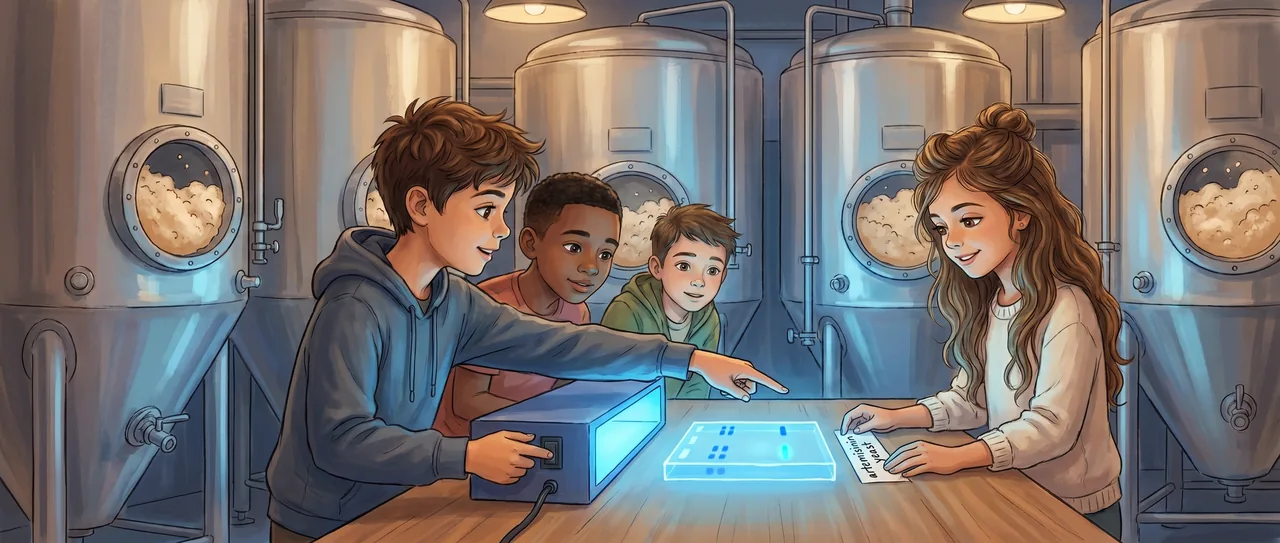
The Extra Line
The room smelled like bread, rain, and metal.
Maya pressed her nose close to the visitor glass. Below, stainless steel tanks stood in two rows, taller than the school bus that had brought them. Pipes climbed the walls. Valves blinked green. In one round window, tan foam rose and folded over itself, alive with tiny bubbles.
“That cannot be medicine,” Soren said.
“It is,” Maya said.
“It looks like dough having a bad idea.”
Maya grinned without looking away. “A useful bad idea.”
On the other side of the glass, the fermentation manager hurried past with a tablet under one arm and three plastic display blocks balanced in both hands. Her gray hair had escaped its clip in all directions. She was speaking into her wrist.
“No, not tank seven. Tank seven is fine. Tank four is sulking. Tanks can sulk if sensors can sulk.”
She reached the visitor room, hip-opened the door, and set the blocks on the table. One held a dried feathery leaf. One held a cream-colored smear sealed between clear plates. One held nothing visible at all, only a label space.
“Sweet wormwood,” she said, tapping the leaf. “Ordinary yeast. Engineered yeast DNA. The tour starts in thirty minutes. Please do not lick anything.”
Soren looked offended. “I was not going to.”
“You would be surprised,” the manager said.
Her tablet chirped. She glanced down, frowned, and turned too fast. The two clear DNA blocks slid together with a soft clack. Their paper labels popped off and fluttered to the floor.
Maya picked them up. One said ordinary yeast. One said artemisinin yeast.
Both blocks looked exactly empty.
The manager stared at them. “Oh, no.”
Soren bent until his eyes were level with the table. “Which is which?”
“That,” the manager said, “is the kind of question that becomes annoying right before visitors arrive.”
Maya held one block to the light. Nothing. No color. No shadow. No secret glow.
“You have a record?” Soren asked.
“Of course.” The manager tapped her tablet. It chirped again, less helpfully. “The database knows the sample numbers. The sample numbers were on the labels. The labels are on the floor. I am going to fire myself.”
A group of students pressed faces against the hallway window. One boy read the loose labels in Maya’s hand.
“Modified yeast?” he said. “So it is the messed-up one?”
Maya’s fingers closed around the labels.
The manager opened her mouth, but her wrist buzzed. She looked toward the tank room. “Tank four is now sulking loudly.”
“We can test them,” Soren said.
The manager looked at him as if he had offered to move a mountain with a spoon.
“We did PCR at the library lab,” Soren said. “Twice. Mine worked once.”
“Maya’s worked both times,” Maya said.
“Because you ignored the diagram less creatively.”
The manager looked from them to the clock. “The training bench is clean. The samples are dead and sealed, but there are matching extracted DNA tubes in the drawer. If you can find the plant-gene band before the tour reaches this room, you may save me from lying to children.”
She pointed with her tablet. “Do not touch the live cultures. Do not improvise with the centrifuge. If anything smokes, stop.”
Then she ran.
The training bench had a small thermocycler, a blue-light box, pipettes, gloves, and a laminated card titled FIND THE INSERT. Soren read it once. Then he read it again, lips moving.
Maya had already opened the drawer.
“Two DNA tubes,” she said. “A and B. Both yeast.”
“Master mix,” Soren said. “Primers for the yeast control gene. Primers for the plant pathway gene.”
“The plant one is the point.”
“The control is how we know the test worked.”
Maya handed him tubes. “You do the tiny drops. Your hands complain less.”
Soren set up four reactions. A with yeast control. B with yeast control. A with plant gene. B with plant gene. Maya watched the liquid jump into the pipette tip, smaller than a raindrop, smaller than an ant’s eye.
Above them, on a wall screen, the tour video had frozen on a photograph of sweet wormwood fields. Green rows ran to the horizon. The caption read: For centuries, people found artemisinin in Artemisia annua.
“Rare plant?” Maya asked.
“Not magic rare,” Soren said. “Supply rare. Weather rare. Harvest rare. Enough at the right time rare.”
Maya looked through the glass at the tanks again. Foam pressed against one porthole as if trying to listen.
The thermocycler clicked shut.
While it heated and cooled, the manager’s voice came faintly from the tank room. “I know you prefer pH six, but today we are all making compromises.”
Maya paced. She stopped at a poster showing arrows inside a yeast cell. Sugar went in. A chain of small molecules changed shape and changed again. One arrow was labeled artemisinic acid. Another, outside the cell, led to artemisinin.
“So the yeast does not make the final medicine?” she asked.
Soren came to stand beside her. “It makes the thing that is almost it.”
“Almost counts if the next step is known.”
“Almost counts if you do it on purpose.”
On the poster, one arrow had a tiny leaf symbol beside it.
Maya tapped it. “That part came from the plant.”
“Instructions for an enzyme,” Soren said. “Put into yeast.”
“Not pretending to be a plant.”
“No.”
“Still doing one plant thing.”
Soren looked back at the two clear blocks on the table. “If the boy asks again, the messed-up one is the one without the extra job.”
Maya smiled. “Maybe do not say it like that.”
The thermocycler beeped.
They loaded the gel together. Soren steadied the pipette. Maya counted wells under her breath. Ladder. A control. B control. A plant. B plant.
The gel ran for ten minutes. Blue dye crept through it like a tiny race held underground.
The first students entered the visitor room just as Soren carried the gel tray to the blue-light box. The manager came in behind them, breathless, hair fully loose now. She started to speak, saw Maya’s face, and stopped.
Soren switched on the light.
Bands appeared.
Two bright lines glowed where the yeast control should be. Good. Both samples were yeast.
In the plant-gene lanes, A had nothing.
B had a single bright band.
Maya put the artemisinin yeast label beside block B.
The boy from the hallway leaned over the table. “That one has an extra line.”
“Yes,” Soren said.
“So it is modified.”
Maya picked up the display block. It was still clear. Still apparently empty. Behind her, the tanks breathed and foamed.
“It has yeast instructions,” she said, “and one borrowed plant instruction. The extra line is why tank stuff can help make malaria medicine.”
The boy looked from the glowing gel to the porthole in the tank room. “That is bread yeast?”
“Cousin of bread yeast,” Soren said. “Trained by genes, not by yelling.”
The manager made a small sound that might have been a laugh trying not to interrupt.
The tour pressed closer. Maya held the block so the students could see that there was nothing to see.
“That empty-looking thing,” she said, “is not empty. It is a recipe small enough to hide in a cell.”
Soren pointed to the gel. “And there is the line that says the recipe got in.”
The manager turned off the frozen video. The screen went black, and the tanks reflected in it, tall and silver and full of a smell everyone knew from kitchens. One girl near the front whispered, “My grandmother makes rolls with yeast.” The manager cleared her throat. “This plant gave us the path. The yeast helps us make the supply steadier. Fields still matter. Chemistry still matters. Fermentation matters too.”
“What else can yeast learn?” the boy asked.
The manager opened her mouth, then closed it. Her tablet chirped. She ignored it.
“We have an empty teaching tank,” she said. “It needs a label.”
She took a blank magnetic strip from a drawer and set it on the table between Maya and Soren.
Maya stuck the blank label beneath the empty porthole, and Soren uncapped the marker.
Read the interactive version, listen to the narration, and earn a gold star →
A science-verified short story for curious kids · Curiosity Land