The Clocks Without Faces
At four in the afternoon, the cells said it was night.
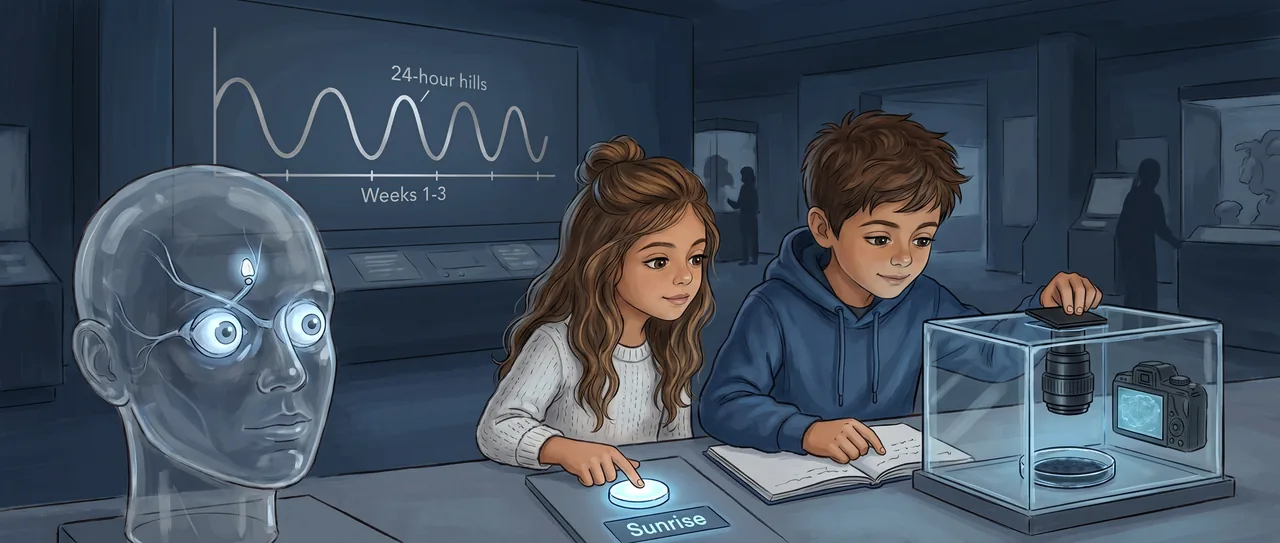
That was what the graph on the museum wall showed, anyway. A silver line rose and fell across the screen, one rounded hill after another. Under the screen sat a sealed glass box, and inside the box sat a dish no wider than Maya’s palm. A camera watched it in the dark.
The museum designer slapped the side of the control table.
"Sunrise button," he said. "Sunrise lights. The graph should wake up. That is the whole point. Children press the button, body clocks reset. Simple. Beautiful. Broken."
Maya pressed the sunrise button again because buttons were meant to be tried more than once.
Across the exhibit, a huge clear model of a human head filled with blue-white light. The light entered two glass eyes. It traveled along glowing threads that crossed beneath the brain. A tiny bead above the crossing blinked on.
The cell graph did nothing sudden.
Soren leaned closer to the screen. He had his paper notebook tucked under one arm, which the museum designer had already called "adorably antique." Soren had not answered him.
"It is still rising," Soren said.
"It should jump," the designer said.
"Living things do not usually jump because a sign says so," Maya said.
The designer looked at her as if she were another broken part of the exhibit.
Behind the glass wall, a scientist in a blue coat moved between benches. She was talking into a headset while holding a tray of tiny tubes. She had been called in because the museum wanted real cells for the opening. She had been given a script by the designer. She had not liked the script.
She tapped the glass with one knuckle and raised one finger. One minute.
Then she turned away to rescue something beeping on a bench.
The designer rubbed both hands over his face. "The donors arrive in half an hour. The trustees arrive after that. If the live part looks dead, I am replacing it with animation. Animation obeys."
Maya looked at the dish. It did not look dead. It looked like nothing at all, which was different.
On the screen, the silver line climbed by a hair.
Soren opened his notebook.
"What are you doing?" the designer asked.
"Finding out if it is wrong," Soren said.
He did not ask permission. He copied the times printed along the bottom of the graph. The screen showed three weeks of hills, one after another, a long silver row of breathing.
Maya stood back from the exhibit.
The head was all glass and light. The eyes were large enough to fit oranges. The glowing threads crossed underneath, and the tiny bead above them blinked whenever the sunrise button was pressed.
A label beneath the bead read: Suprachiasmatic nucleus. Master clock.
Maya said the words under her breath and disliked how they filled her mouth.
Soren counted softly. "One peak here. Next peak almost twenty-four hours later. Next one, same. Not exactly. A little off. But close."
"For three weeks?" Maya asked.
Soren flipped back a page and kept counting.
The designer made a helpless noise. "Yes, yes, circadian rhythm. That is the exhibit. Light tells the body what time it is. Button, light, clock, result."
Maya stepped closer to the sealed box. "But these cells are in a dish."
"Exactly," the designer said. "So they should be easy."
Maya shook her head. "No eyes."
The designer stopped moving.
Soren’s pencil stopped too.
The museum lights hummed above them. Somewhere in the exhibit hall, a floor polisher made a long sea-animal sound and then went quiet.
Maya pointed to the glass head. "Light goes there first. Retina. Then that tiny brain place. Then the rest."
Soren looked from the glowing eyes to the dish. "The dish has no retina."
"It has cells," Maya said.
"Cells with clocks," Soren said.
The scientist’s voice came through a speaker on the wall, tinny and rushed. "Please do not open the box."
"We are not opening it," Maya said.
"Good," the scientist said. "Also, if anyone is trying to reset those cells with the sunrise button, stop hurting my feelings."
The designer pointed at the speaker. "Then what am I supposed to show?"
There was a pause, a clink, and the scientist said, "The truth would be nice. I am currently losing an argument with a freezer, so someone else may need to make it pretty."
The speaker clicked off.
The designer stared at Maya and Soren.
"You heard her," Maya said.
"I heard that I am doomed," he said.
Soren turned his notebook around. He had drawn marks under each silver hill. The marks marched across the page with small uneven spaces between them.
"They are not following the room," he said. "They are following themselves."
The designer frowned. "Cells cannot tell time."
Soren looked up. "These are."
Maya put her face close to the label under the dish. The words were small, meant for adults who bent over things and nodded.
Human skin cells. Clock gene activity shown by bioluminescence. Culture synchronized before recording.
"Bioluminescence," Maya said. "They glow when the clock gene is active. The camera sees it."
"They glow?" the designer asked.
"Too faint for us," Soren said. "Not for the camera."
Maya touched the glass near the dish, not on the dish, because the scientist had sounded like someone who knew exactly how expensive mistakes were.
"They were started together," she said. "Like when someone claps before a song. Then they kept singing."
Soren added, "Not perfectly. Look. The peaks drift a little."
The designer looked at the graph for the first time as if it might not be insulting him.
"But the master clock," he said.
Maya walked to the huge glass head and pressed the sunrise button again. The eyes filled. The crossing threads lit. The bead blinked.
"Master does not mean only," she said.
Soren’s pencil moved once more. "Maybe conductor. Not drummer."
The designer was quiet.
Maya liked him better quiet.
Soren looked around the hall. There were signs stacked against the wall, still smelling of new plastic. One said: Light controls your body clock. Another said: Every cell keeps time.
The second sign was leaning backward behind a crate, as if someone had decided it was too strange for visitors.
Maya pulled it free.
"This one," she said.
The designer took it from her. "That was cut. Too complicated."
Soren pointed to the graph. "It is less complicated than pretending the button is magic."
The designer read the sign. His mouth moved around the words. Every cell keeps time. Light through the eyes helps the brain’s master clock keep the body together.
He looked at the glass head. He looked at the dish. He looked at the sunrise button.
"Together," he said.
Maya could see the exhibit rearranging inside him. Not becoming smaller. Becoming harder to fit on a sign.
The scientist came out from behind the glass wall at last, pulling off one glove with her teeth because both hands were full. She carried a small black cover.
"Who moved my rejected sign?" she asked.
"They did," the designer said.
The scientist read it, then looked at Maya and Soren. "Good. I lost that argument in a meeting."
"The cells are at night," Maya said.
"Their night," the scientist said. "They have been in that dish for weeks. No eyes. No brain. Still ticking. Your liver cells do it. Skin cells. Heart cells. The master clock gets light information from the retina and helps the crowd stay together, but the crowd is full of clocks."
Soren did not write that down. He looked at his own wrist, where he wore no watch.
Maya knew the school bell could say lunch when her stomach said not yet. She knew Soren could be wide awake when everyone else on a sleepover became soft and silly. She knew adults called that being difficult, as if time were a hallway and everyone had to walk it in the same line.
On the screen, the cells kept climbing toward their private midnight.
"We need the opening sequence," the designer said. His voice had changed. It was still worried, but now the worry had edges to hold. "Thirty seconds. Visitors come in. They press sunrise. What happens?"
Maya took the black cover from the scientist.
"First, darkness," she said.
Soren moved the sign beside the dish, not beside the glass head.
"Then eye light," he said.
The designer nodded slowly. "Then master clock. Then we show the cells already keeping time. Not jumping. Keeping."
"And trying to stay with the body," the scientist said.
"Do not say trying," Soren said. "Cells do not try."
The scientist smiled. "Fair."
The first visitors arrived early, because important adults always seemed to arrive either early or late and then blame clocks. Their shoes clicked in the hall outside. The designer straightened his jacket. The scientist stepped back, letting Maya and Soren stand by the controls.
"Ready?" Soren asked.
Maya put one finger on the sunrise button.
The doors opened.
Maya turned the knob until the auditorium lights softened to dawn. The eye in the acrylic face filled with blue-white light. Down inside the clear head, a grain-sized lamp winked on above the crossed optic nerves.
Soren slid the black cover off the cell camera.
On the screen, the tiny lights brightened, dimmed, and brightened again.
Read the interactive version, listen to the narration, and earn a gold star →
A science-verified short story for curious kids · Curiosity Land