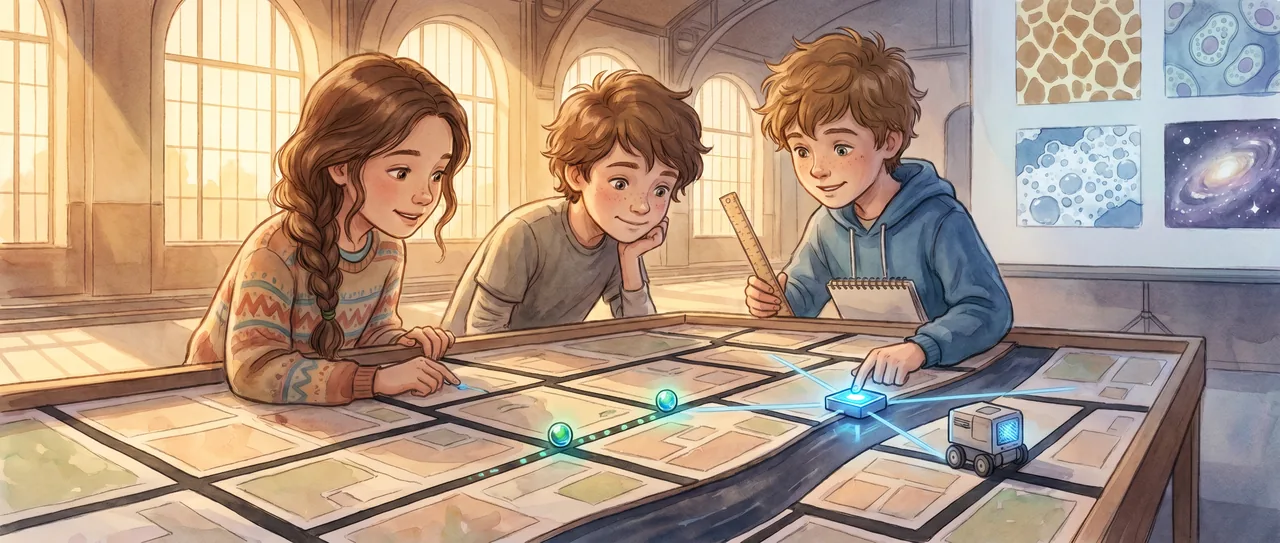
The Border Points
The first delivery robot got lost in front of the tiny hospital.
The second one tried to help and blocked the tiny bridge.
The third one drove very politely into a plastic fountain and stayed there, blinking green.
Dr. Vega clapped once, too loudly. “Beautiful. Almost beautiful. Nobody breathe near the table.”
Maya was already leaning over the model city. It filled half the old train station floor, with paper streets, wooden apartments, a blue ribbon river, and little round charging hubs that glowed when a robot reached them.
Soren stood beside her with a ruler in one hand and his paper notebook tucked under his elbow. The sign above the table said TOMORROW’S CITY, ROUTES, SIGNALS, AND SHARING SPACE.
Tomorrow’s city had a traffic jam made of three robots and a fountain.
“It’s the bridge,” Maya said.
“It’s not the bridge,” Soren said.
“It happened at the bridge.”
“It started before the bridge.”
Dr. Vega was busy smoothing her silver jacket. A news camera waited near the coffee kiosk. “The public demonstration begins in four minutes,” she said. “We are using square service districts today because squares are clean, clear, and impossible to misunderstand.”
Maya looked at the map. Six charging hubs sat across the city. Around them, Dr. Vega had taped neat square districts in different colors.
Maya did not like the squares. They looked too calm.
Soren put the ruler from the hospital to the red hub. Then from the hospital to the green hub. He made a small sound in his throat.
“What?” Maya asked.
“The hospital is in the red square,” he said, “but it’s closer to the green hub.”
Maya put her finger on the stuck robot. “So it obeyed the color and ignored the distance.”
“It obeyed the wrong map.”
Dr. Vega glanced over. “Please do not retape the city. The tape took me all morning.”
“It’s lying,” Maya said.
“The tape?” Dr. Vega asked.
“The city.”
Dr. Vega blinked. “That is a very dramatic review of municipal planning.”
Soren measured again, this time from the bridge to two hubs. “There are places where two hubs are tied.”
Maya followed his ruler with her eyes. “Where?”
Soren slid the ruler until both distances matched. “Here. And here. If you drew all the tied places between those two hubs, it would make a line.”
Maya’s finger hovered above the city. “A fence.”
“Not a fence. A decision line.”
Dr. Vega checked her wrist screen and winced. “Children, I appreciate the energy, but the grown-up disaster is scheduled for noon.”
Maya had already found a roll of thin black tape under the table.
Soren said, “We need the halfway lines between every pair of hubs, but only the parts that matter.”
“That is too many lines,” Maya said.
“Not if the other hubs cut them off.”
Maya grinned. “Good. Messy.”
They did not pull up Dr. Vega’s squares. They worked on top of them.
Soren anchored one end of string at the red hub and one at the green. Maya pinched the middle and marked the places where the distances matched. Soren checked with the ruler. Maya tore tape with her teeth until Dr. Vega made a strangled noise and handed her scissors.
Line by line, the clean square city disappeared under a web of bent-edged regions. The red hub did not own a square anymore. It owned a crooked little country wrapped around itself. The green hub reached across the river in one thin arm. The blue hub lost the hospital but gained three apartment blocks and the fountain.
“That can’t be right,” Dr. Vega said.
Maya pointed to the fountain robot. “It wanted blue the whole time.”
Soren set the ruler down along the robot’s path. “Blue is nearest.”
Dr. Vega looked from the ruler to the camera to the table. “Nearest is the rule?”
“For this,” Soren said.
“For everything on this table,” Maya said. “Every place chooses the closest dot.”
Soren added, “Except the borders. Borders are tied.”
Dr. Vega’s face changed in a way adults’ faces almost never did. It stopped protecting itself.
“All right,” she said. “One minute. Show me.”
The robots had little color sensors underneath. Dr. Vega’s program assigned them to the district color under their wheels. Maya retaped the fountain’s little plaza blue. Soren changed the hospital block to green. They worked fastest at the ugly places, the slivers and corners, because that was where the robots had argued with the map.
The station clock clicked to noon.
The camera light went on.
Dr. Vega smiled her public smile. “Welcome to Tomorrow’s City.”
Maya held her breath as Dr. Vega pressed START.
The fountain robot blinked, backed up, and rolled to the blue hub. The hospital robot went green, crossing no bridge at all. Another robot carried a tiny orange package along the river road, turned before the crowded plaza, and slid into the orange hub’s crooked little country.
No robot crashed.
No robot helped another robot crash.
The watching crowd made the soft sound people make when a thing works better than they expected.
Dr. Vega forgot her public smile. “Oh,” she said. “Oh, that is much better than squares.”
Soren watched the robots move from region to region. At one black tape line, a robot paused. Its green light flickered blue, then green again.
“It’s exactly on the border,” he said.
Maya bent so low her braid brushed a paper rooftop. “It can’t decide.”
“It’s tied,” Soren said.
On the other side of the table, a smaller display showed phone signals. The same six hubs became cell towers. Little glass beads were phones. Dr. Vega had meant to explain it later, but Maya was already dropping beads on the map.
A bead near the hospital glowed green. One by the fountain glowed blue. Soren placed one on the black tape line between them.
It glowed greenbluegreenblue so fast it looked like a tiny trapped star.
“Is that broken?” a younger kid asked from the crowd.
Soren looked at the bead. “No.”
Maya said, “It belongs to both until it moves.”
The younger kid put both hands on the table edge. “Can places do that?”
Maya did not answer right away.
She had always disliked the lunchroom tables at school. Not the people. The tables. Each one seemed to pull at her from a different direction, and the place between them felt like standing in an unfinished sentence. Soren had once sat on the floor by the recycling bins because the science club table was too loud and the chess table was too quiet. Nobody had known what to do with him there.
The bead kept flashing between colors.
Soren moved it one finger-width to the left. It turned green. One finger-width right. Blue. Back to the black tape. Greenbluegreenblue.
“The border is real,” he said.
Dr. Vega whispered, “Handoff zone.” Then louder, to the crowd, “Cellular networks do this. Phones switch towers when you move. The borders matter.”
Maya looked up sharply. “What else has borders like this?”
That was the wrong question to ask Dr. Vega if anyone wanted the demonstration to stay small.
She pushed a button. The back wall of the station lit up.
First came a giraffe’s side, all golden patches divided by pale lines. The pattern was not the city map, not exactly, but Maya’s eyes grabbed the family resemblance before her mouth found words.
“Spots with countries,” she said.
Then the wall became a close view of plant cells, packed together in uneven polygons. Then soap foam, bubbles pressed flat against bubbles. Then a black sky scattered with stars and galaxies, overlaid with thin lines that carved dark space around bright points.
Soren stopped moving.
The station noise thinned out around him. The same kind of question was sitting on animal skin, inside leaves, in foam, in the sky, and under the wheels of delivery robots. Not the same answer. Not a magic stamp. A way of asking where nearest became a shape.
Maya stepped closer to the wall until giraffe patches shone across her face.
“You used this for delivery,” she said.
“And cell towers,” Soren said.
Dr. Vega nodded. “And hospitals, schools, fire stations, warehouse routes, telescope data, computer graphics. Any time nearest matters, this kind of map may appear.”
Maya looked back at their table. A man with the camera asked Dr. Vega, “Did you plan the children’s version?”
Dr. Vega opened her mouth. Closed it. Smiled sideways. “No,” she said. “The children planned the city’s version.”
Soren picked up one unused glowing hub from the supply tray. It was smaller than a coin and blue at the edges.
“What happens if we add one?” he asked.
Dr. Vega’s fingers twitched toward her wrist screen, then stopped. “The map recomputes.”
“All of it?” Maya asked.
“Only the places that are closer to the new point than to any old point.”
Maya and Soren looked at the dark strip by the river where there were no hubs, no robots, no glass beads, and no tape lines yet.
Soren held out the new hub.
Maya pressed the new blue dot onto the dark space by the river.
Lines ran toward it from three directions.
Read the interactive version, listen to the narration, and earn a gold star →
A science-verified short story for curious kids · Curiosity Land