The Blank Bench
The companion said no at nine seventeen in the morning.
Maya had asked it a very small question. The question was about the old gray air filters from the storm bay, the ones nobody wanted because they smelled like wet stone and pennies. After electric rain, the filters grew tiny white crystals along only one edge. Not the whole square. Not the middle. Only the edge that faced the exhaust vent.
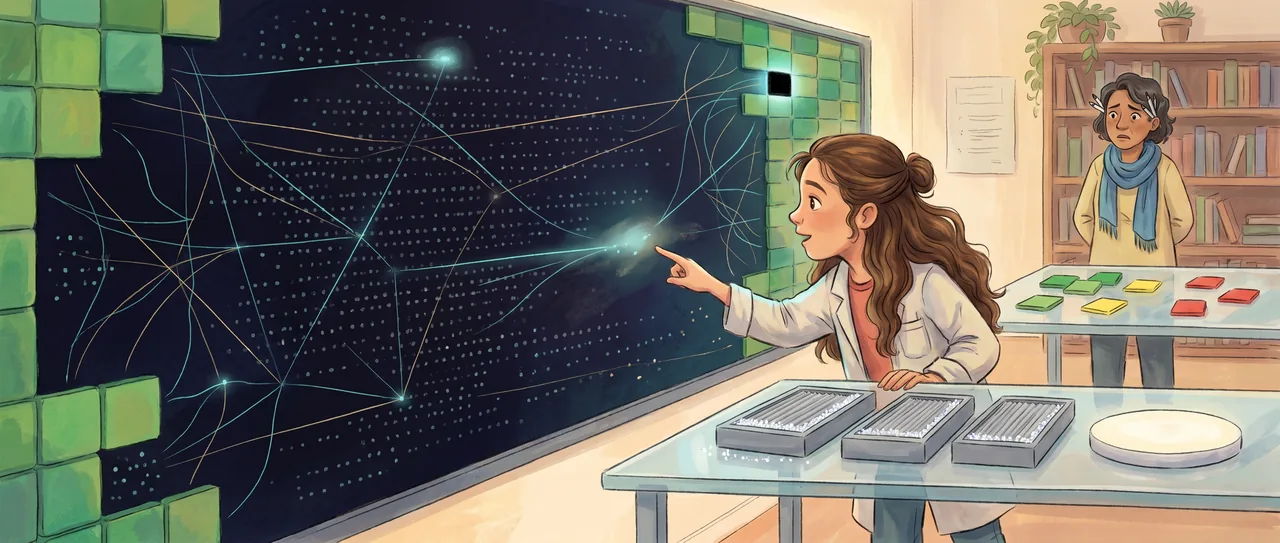
Maya had brought three filters in a sealed tray and set them on the glass table in the youth research library.
The companion hovered above the table as a circle of pale light. It was not a robot. It had no face, no wheels, no arms. It lived in the walls and in the table and in the soft voice that came from wherever Maya was looking.
"No field prediction available," the companion said. "Question outside indexed research areas."
Maya looked at the filters. "Try nearer."
"Nearest category introduces false confidence."
"Try messy."
"Messy is not a category."
Maya liked that answer and disliked it at the same time.
Across the room, the director was arranging colored tiles on the funding wall. He had a blue scarf, four styluses tucked behind one ear, and the anxious happiness of an adult about to show other adults something expensive.
"Maya," he called, without turning around. "The board arrives in six minutes. Please choose a green area. Green means the companion predicts importance within twenty years. Yellow means possible. Red means charming but unfundable." Maya held up the tray. "What color is this?"
The director glanced over. "Gray, apparently."
"I mean the question."
"Then make it green. The companion is trained on four centuries of discovery. It finds the neglected things before people notice them. That is the point of this library."
Maya tried.
She named the filter question atmospheric chemistry.
The companion said, "Low fit."
She named it mineral growth on synthetic fibers.
"Low fit."
She named it microbial weathering.
"Low fit."
She named it edge behavior in charged rain residue, which sounded important enough to get its own drawer.
"Phrase complexity increased. Fit did not."
Maya put both hands flat on the glass table. "You are being circular."
"I am being calibrated."
The director made a tiny wounded sound. "Please do not argue with the calibration in front of the board."
The doors at the far end of the library brightened. Visitors were arriving. Their shoes whispered on the floor. Their badges blinked.
Maya slid the filters closer to the companion's light. "You predict ignored areas."
"Yes."
"You predict which child finds the thing?"
"No."
"Which lab?"
"No."
"Why not?"
The companion paused. It almost never paused.
"Specific breakthroughs depend on questions not present in the training record at the time of prediction."
The director said, "Excellent, yes, uncertainty, very inspiring. Maya, green tile."
Maya did not move.
There were things that did not make sense yet, and this one had stepped directly into the room.
"Show me," she said.
The funding wall changed.
The green islands vanished. In their place came a dark field of old records, thousands and thousands of dim points. The companion drew thin lines between them. Some lines were bright and sensible. Astronomy to telescopes to planets. Electricity to wires to motors. Other lines bent in ways that looked wrong.
A smudge labeled strange bacterial repeats pulsed in one corner. Years later, lines shot out from it toward gene editing.
A stubborn radio hiss appeared above a roof-shaped diagram. Lines grew from it toward the earliest light of the universe.
A pattern of dots, sharp as frost, flashed and was stamped mistake, impossible, impossible, then became a new kind of crystal.
The room had been large before. Now it seemed to have no walls at all. The table, the filters, the director's colored tiles, the visitors with their blinking badges, all of it floated inside a map of questions that had once looked too small, too broken, or too annoying to keep.
Maya leaned closer. "Were those green at the beginning?"
"No," the companion said.
"Were they named correctly?"
"No."
"Were they in the wrong drawers?"
"Often."
The director had stopped moving tiles.
Maya pointed at the smudge that would become gene editing. "If someone had deleted that because it did not fit, could you predict it later?"
"No."
She pointed at the hiss from the roof. "If someone cleaned that noise too fast?"
"The record would be poorer."
"If all the weird edge questions get forced into green areas?"
The companion's light tightened to a smaller circle. On the wall, the bright future islands shrank. Not much. Enough.
"Forecast quality decreases when anomalous records are mislabeled as ordinary," it said.
One of the visitors whispered, "Oh."
The director recovered himself. "Wonderful demonstration. Very vivid. We love anomalies after lunch. For now, the budget categories are still the budget categories."
Maya looked at the wall. She looked at the filters. The crystals were so small they made the gray mesh look dusty. Three filters, same edge. Not random. Not yet anything.
"What did old labs call records before they had names?" she asked.
The companion answered at once. "Anomaly. Held for review. Unclassified specimen. Instrumental noise. Contamination. Curious result."
"Which of those kept the most future discoveries from disappearing?"
Another pause.
"Held for review."
Maya touched the lab table's request panel. It opened with rows of empty boxes.
The director saw what she was doing. "Maya, that panel is for allocating benches, not making philosophical points."
"Good," Maya said.
In the first box she typed HELD FOR REVIEW. In the second, she selected no field. In the third, she attached three scans of the storm bay filters.
The panel refused her.
"Requires prediction code," it said.
Maya did not look at the director. "Companion, does your model recommend any space for questions that cannot be coded yet?"
"Yes."
"How much?"
"One bench in twelve for maximum long-range discovery yield under youth-lab conditions."
The visitors stopped whispering.
The director's mouth opened, then shut. He looked at his green tiles as if they had betrayed him personally.
Maya typed ONE BENCH IN TWELVE into the prediction code box.
The panel accepted it.
At the back of the library, a drawer unlocked with a sound like a tiny bell. Above it, a square of wall that had been neither green nor yellow nor red lit up black.
"Black is not in the board packet," the director said faintly.
"It is now," Maya said.
She carried the tray to the unlocked drawer. Inside were a scanner, a clean hood, a microscope, and twelve blank labels. No project title waited for her. No cheerful path curved across the wall. The companion followed as a pale circle on the bench surface.
"I cannot predict whether you will make a breakthrough," it said.
"I did not ask that."
"I cannot predict whether this lab will matter."
"I did not ask that either."
"Select research question."
Maya lifted one filter with tweezers. The white crystals caught the overhead light along the exhaust-facing edge.
She did not choose atmospheric chemistry. She did not choose minerals, microbes, fibers, weather, or dust.
Maya slid the first gray filter under the scanner.
On the wall, among the green islands of the twenty-year map, a small black square opened and stayed black.
Read the interactive version, listen to the narration, and earn a gold star →
A science-verified short story for curious kids · Curiosity Land