The Almost Nothing Shelf
The molybdenum disulfide would not glow.
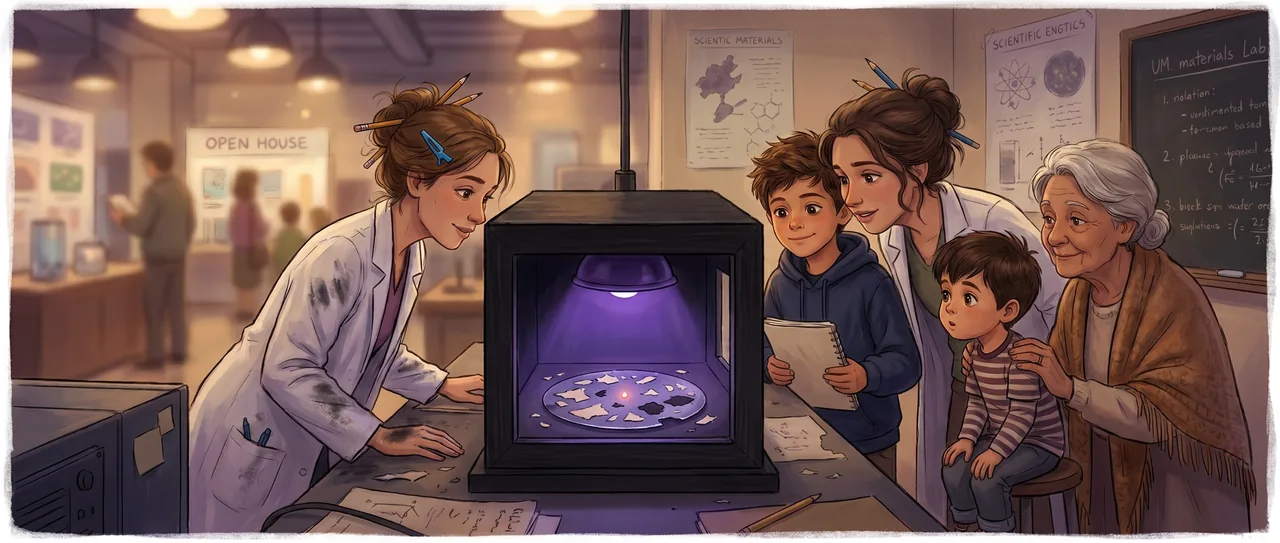
Dr. Vale tapped the side of the little black viewing box with one finger, as if the box had forgotten its lines. Inside, a violet lamp shone down on a glass slide. The flake on the slide sat there, yellow-gray and stubborn.
"It was glowing yesterday," she said. Her hair was caught in three pencils and one blue alligator clip. "Or something was glowing yesterday. I have fifty families arriving in twenty minutes, a printer jam, and a display called The New Flatland with exactly no flatland. Soren, can you label the safe slides while I go wrestle paper? Do not open the sealed drawer. Do not touch the vacuum pump. Do not believe the printer if it says it is fine."
"I can label," Soren said.
Dr. Vale hurried out, muttering at the printer in a way that made it sound like a large dishonest animal.
The lab did not look like a place where worlds changed. It looked like clean benches, plastic boxes, microscopes, tape dispensers, and a wall of magnetic squares arranged like a periodic table. But the squares were not elements.
Graphene, said one. Carbon. Conducts.
Hexagonal boron nitride, said another. Insulator. Atomically flat.
Molybdenum disulfide, said the square under Soren's hand. Semiconductor. Monolayer emits light.
Past that came names he had to move his lips to read. Tungsten diselenide. Niobium diselenide. Black phosphorus, stored away from air. Chromium triiodide, magnetic only under special conditions. Some squares had check marks. Some had question marks. Some were blank.
Soren liked the blank ones best.
On the bench were six slides in a row, each with a tiny label. Bulk crystal. Thick flake. Medium flake. Thin flake. Very thin flake. Maybe nothing.
Maybe nothing was written in Dr. Vale's slanted handwriting, with a frowny face after it.
Soren opened his paper notebook.
At the far table, two older students were setting out visitor badges. One of them saw the notebook and grinned.
"Paper?" she asked. "Like, from trees?"
"Mostly," Soren said.
"Retro."
"Useful," Soren said, and wrote: violet lamp works. Slide one, no glow.
He slid the bulk crystal into the viewing box. The violet light came on when he shut the lid. Nothing happened except a white speck of dust flashed near the edge.
He wrote it down.
Thick flake. Nothing.
Medium flake. A smear, maybe, but when he moved the slide, the smear stayed in the same place on the glass. Dust again.
Thin flake. Nothing.
Very thin flake. A dim orange wink appeared and vanished when he blinked.
Soren did not write wink. He opened the lid, turned the slide around, shut it, and looked again.
The wink returned, not on the scratch, not on the dust, but on a place so pale he could only see it by not looking straight at it. He tested it three more times. The orange speck stayed with the pale place.
He wrote: very thin, weak orange.
Then he put in Maybe nothing.
The viewing box filled with a clear, tiny, golden-red light.
Soren held very still.
The flake was nearly invisible under the room lights. Under violet, it answered.
He took it out and looked through the microscope. The slide was a landscape of torn islands. Thick flakes were dark and wrinkled. Medium ones were yellowish. Thin ones were pale blue-gray. The glowing place was almost not a place at all, a faint flat shape with edges like a broken window.
Dr. Vale's poster lay rolled beside the wall display. Soren unrolled one corner with his elbow.
When molybdenum disulfide is many layers thick, its electrons do not release light easily, the poster said. In a single layer, the energy levels change. Light comes out.
He had read sentences like that before. They had felt like someone saying, if you remove nearly everything, something appears.
Soren looked back at the glowing slide.
All morning, people had walked past the clear parts to point at the shiny crystals in the trays. The shiny crystals were quiet. The almost invisible place was the one speaking.
The printer made a grinding sound in the hallway.
"Do not eat the brochure," Dr. Vale told it.
Soren pulled the tray of unused safe crystals closer. Each crystal was mounted on a card. Graphite, for graphene. Boron nitride, white and smooth-looking. Molybdenum disulfide, dark silver. Tungsten diselenide, like a tiny piece of night. The sealed drawer stayed sealed.
Beside the tray were strips of clear tape and squares of silicon wafer with purple-gray oxide on top. Dr. Vale had shown him, before the printer emergency, how flakes showed faint colors on that surface if the thickness was right.
"You press, peel, fold, peel, fold, peel," she had said, too fast. "Like making a sandwich thinner until the sandwich becomes a map. Then press to the wafer. Most maps are terrible. Some are treasure."
She had not said he could make a new one.
She also had not said the old ones were enough.
Soren took the molybdenum disulfide card. He pressed the tape down once, firmly, with the flat of his thumb. When he lifted it, tiny dark flakes clung to the tape. He folded the tape on itself and pulled it apart. The flakes split and spread. He folded again. Peeled again. Each time, the black islands became gray islands, then pale islands, then almost none.
The older student with the badges came over.
"Dr. Vale said labels," she said.
"This is a label problem," Soren said.
"That is tape."
"The label says monolayer emits light. The slide says maybe nothing. Maybe nothing is the label for the useful part."
The student opened her mouth, closed it, then looked into the viewing box where the old Maybe nothing slide still glowed.
"Oh," she said. "I will keep people in the hallway for five minutes."
Soren pressed the tape onto a fresh wafer square and rubbed once with a clean cotton swab. He peeled it back slowly. Most of the flakes stayed on the tape. A few remained on the wafer, scattered like islands seen from very high up.
Under the microscope, the wafer looked empty at first. He changed the focus. A dark chunk. A yellow patch. A pale patch. A place so faint it disappeared when his eye got tired.
He scratched a tiny arrow on the paper frame around the wafer, not on the wafer itself. He lined the arrow with the viewing box window and shut the lid.
Violet light filled the box.
Nothing.
Soren breathed out through his nose. He turned the wafer a little. The dark chunk crossed the window. Nothing. The yellow patch. Nothing. The pale patch. A weak orange breath.
He moved the wafer until the almost-not-place slid under the violet light.
Gold appeared.
Not much gold. Not a flashlight. Not a sign. A speck, smaller than a freckle, steady as a star seen through a pinhole.
The hallway doors opened. Voices rolled in, parents and little kids and someone asking where the robot dogs were. Dr. Vale came back with one sleeve dusted in printer toner.
"Please tell me something here works," she said.
Soren pointed to the viewing box.
Dr. Vale bent down. Her tired face changed so quickly that Soren forgot to look away.
"You made a fresh monolayer?"
"I made many wrong thicknesses," Soren said. "One of them was thin enough. Maybe. The faintest places glow best. The thick places are not broken. They are just too much of themselves."
Dr. Vale stared at him, then at the wall of magnetic squares.
"Families," called the older student. "Incoming. Also, nobody has found the robot dogs."
Dr. Vale straightened. "Good. They can meet the materials that are not pretending to be dogs."
The first visitors crowded around the bench. A small boy tried to see over the edge. A grandmother leaned close to the wall display.
"Is it graphene?" someone asked.
"No," Soren said before Dr. Vale could answer.
The word no came out louder than he meant. Everyone looked at him. He kept one hand on the viewing box lid. Soren lifted the lid and placed the wafer inside. "The part that looks empty is the part to watch."
The violet lamp clicked on.
A ring of faces leaned toward the little window. The gold speck burned in the dark box, too small for applause, too bright to ignore.
"It is like a periodic table," the grandmother said softly.
Soren looked at the wall. Carbon, boron, nitrogen, molybdenum, sulfur, tungsten, selenium. Not just elements. Sheets. Stacks. Twists. Spacers. Layers that changed when they were alone and changed again when they touched.
The printer in the hall gave one defeated beep.
Dr. Vale laughed.
Soren took one blank magnetic square from the bottom of the wall and set it after molybdenum disulfide. The square had no name on it. Then he pressed a fresh strip of clear tape onto the next dark crystal.
Read the interactive version, listen to the narration, and earn a gold star →
A science-verified short story for curious kids · Curiosity Land