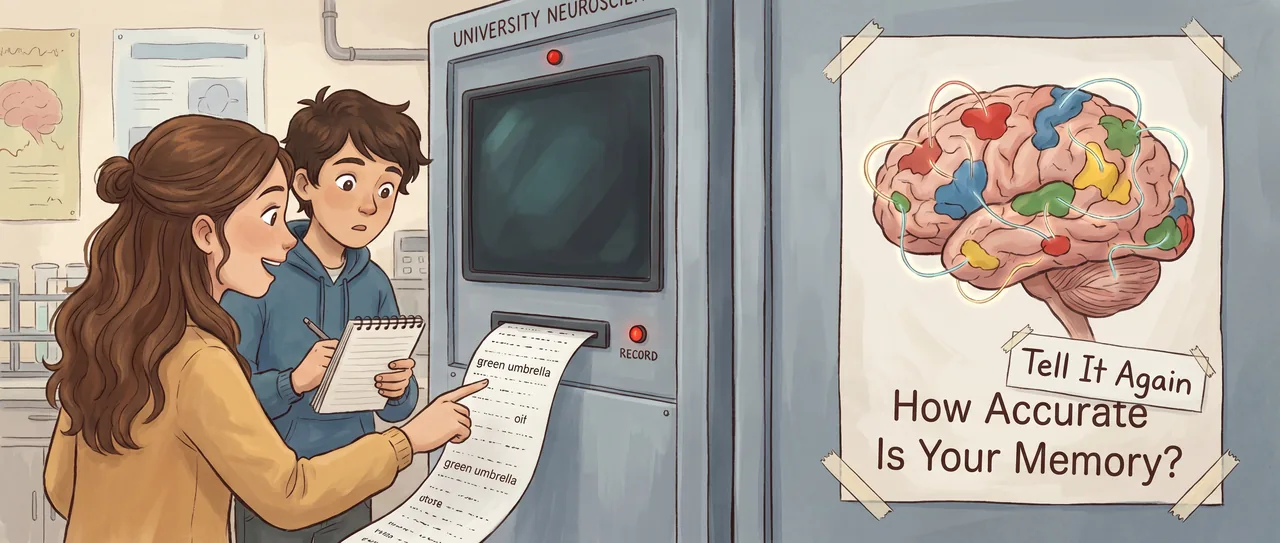
Tell It Again
The memory booth failed nine minutes before Brain Day opened.
It did not spark. It did not smoke. It failed politely, by making everyone sound untrustworthy.
Dr. Imani stood in front of the booth with a tablet in one hand and a screwdriver in the other. The tablet showed three columns of words. All three columns were supposed to match.
They did not.
"Same video," Dr. Imani said. "Same child. Same question. Three different answers. My booth is making soup. I cannot show soup to visiting families. Families like buttons and scores. They do not like soup."
Maya leaned close to the screen. "Soup has recipes."
Dr. Imani did not hear her. She was already kneeling behind the booth, where cables looped like sleeping snakes.
Soren stood beside the little black microphone. He had tested the booth yesterday, because Dr. Imani needed children who could follow directions and because he and Maya had been early. He still had the paper notebook in his pocket. He always had it. People at school asked why he did not just record notes on his wrist screen. He never had a good answer that sounded normal.
He pulled the notebook out.
Yesterday, after watching the practice video one time, he had written: blue door, yellow raincoat, silver bicycle, bell, dog bark, cup falls, no break, maybe oranges, impossible.
Maya looked over his shoulder. "There was a red scarf."
"I did not write scarf," Soren said.
"There was one. It moved in the wind."
"Maybe Dr. Imani was wearing her red scarf yesterday."
Maya turned toward the empty chair in the booth. "Play it again."
"The booth is closed," Dr. Imani said from behind the curtain. "Also, please do not touch the red cable. Or the blue cable. Actually, do not touch cables as a group. I am going to find the backup recorder. Two minutes."
She hurried out, still holding the screwdriver.
Maya and Soren looked at each other.
"She said cables," Maya said.
"Not the chair," Soren said.
The booth was made of three gray walls, one stool, one screen, and a microphone on a bendy neck. Above the screen was the old title, printed in cheerful letters: How Accurate Is Your Memory?
Soren pressed the start button.
The video showed a rainy street. A girl in a yellow raincoat ran past a blue door. A silver bicycle leaned against the wall. Somewhere offscreen, a dog barked. Something metal rang once. A white cup rolled from a step and stopped on its side.
The screen went dark.
"Tell what you remember," Maya said.
Soren faced the microphone. "A girl in a yellow raincoat ran past a blue door. There was a silver bicycle. A dog barked. A cup fell. I heard a bell."
The booth printed his words in column one.
Maya picked up one of the prompt cards Dr. Imani had left on the table. "What color was the umbrella?"
Soren frowned. "There was no umbrella."
"Say the whole memory again."
He did.
This time, the booth printed: A girl in a yellow raincoat ran past a blue door. There was a silver bicycle. A dog barked. A cup fell. Maybe there was a green umbrella near the door. I heard a bell.
Soren stared at the words.
"I did not mean to say that," he said.
"But you did," Maya said.
"Ask yours."
Maya sat on the stool. She shut her eyes before the video started, then opened them wide as it played. When the screen went dark, she said, "Girl. Yellow coat. Blue door. Bike. Dog. Cup. The sound was not a bell. It was thinner. Like a spoon on glass."
Column one filled.
Soren picked a different card. "Did the girl wave at the man in the doorway?"
"There was no man," Maya said quickly.
"Again."
Maya gripped the sides of the stool. "Girl in a yellow coat. Blue door. Bike. Dog. Cup. No man. Maybe someone was behind the glass. The sound was like a spoon."
The printer whispered out column two.
Maya got off the stool as if it had become hot.
"It puts things in," she said.
"We put things in," Soren said. He tapped the columns. "The prompt did not change the video. It changed the next telling."
Maya walked to the display wall Dr. Imani had not finished. There were magnetic labels scattered in a tray: sight, sound, place, feeling, smell, attention. Beside them was a bright picture of a brain, not with one glowing dot, but with little colored islands in many places. Thin lines connected them.
Maya moved the label place under the blue door. She put sound under dog bark and bell. Then she held smell, squinting.
"Oranges," Soren said.
"There were no oranges."
"I know. My hands smelled like orange slices yesterday. I wrote impossible."
Maya took the smell label and stuck it beside his notebook on the table.
Soren looked at the columns again. His notebook had not updated itself. It had not smoothed over the strange part. It had kept impossible exactly where he put it.
On the screen, his second telling still had the green umbrella.
Maya said, "The booth is not broken. The title is."
Soren looked up at How Accurate Is Your Memory?
"A score would make everyone look wrong," he said.
"But they are not wrong like broken," Maya said. "They are wrong like building."
Soren needed more steps. He always did. He turned the prompt cards over and lined them up. Umbrella. Man. Bell. Scarf. Then he lined up the new words in the transcripts beside the cards.
The new pieces were not random. They had fingerprints.
The lab doors opened down the hall. Voices spilled in, bright and echoing. Brain Day had begun.
Dr. Imani rushed back with a black recorder and a face full of apology. "I found one that works if nobody breathes near it. Why are the labels on the table? Why does the sign say..."
Maya had already pulled the old title down. Soren had used the blank back of a poster and a thick marker.
The new sign said: Tell It Again.
Dr. Imani read it. "That is not a score."
"Good," Maya said.
Soren showed her the columns. "The booth records each telling. Then the prompts show where some new pieces came from. It is not catching the memory sitting still. It is catching the memory being made again."
Dr. Imani opened her mouth. Closed it. Looked at the brain picture with all its colored islands.
"Families like buttons," she said weakly.
"There is still a button," Maya said.
The first visitors were already peeking around the doorway. One child pointed at the microphone.
"Is that for singing?" the child asked.
"Almost," Soren said.
Dr. Imani stepped aside. She did not leave, but she also did not take the stool. That mattered.
The first child watched the rainy street video. In the first telling, the dog was large. After a card asked about a puppy, the dog became small. A parent laughed, then stopped laughing when their own second telling added a black hat that had never been there.
More people came.
The booth filled with raincoats that changed shade, doors that gained handles, cups that broke in some tellings and rolled safely in others. A bell became a whistle. A bicycle became a scooter. Someone remembered the smell of wet stone, though the video had no smell at all. Someone remembered being there.
Soren kept lining up the prompt cards with the new words. Maya kept moving the magnetic labels, making paths from sight to sound to place to feeling and back again. At the end of the hour, Dr. Imani handed them a fresh stack of blank cards.
"If you two are going to ruin my simple exhibit," she said, "you may as well ruin it properly."
Maya grinned.
Soren wrote one card and clipped it below the microphone: Tell a real memory from before today.
Maya wrote another card and clipped it underneath: Come back tomorrow and tell it again.
A new visitor stepped into the booth.
Maya pressed the green record button, and the red light came on.
Read the interactive version, listen to the narration, and earn a gold star →
A science-verified short story for curious kids · Curiosity Land