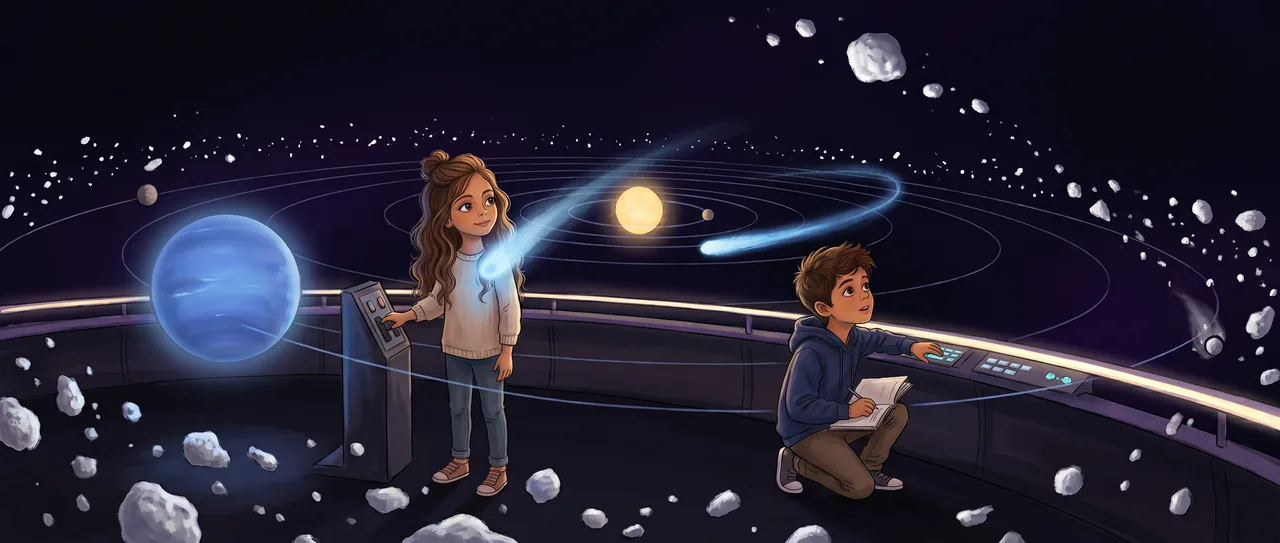
After Neptune
The comet would not come back.
It sailed once around the glowing sun in the middle of the museum floor, passed Jupiter, crossed Saturn’s dim gold orbit, and kept going until it struck the wall with a soft plastic tap.
Maya folded her arms.
“That is not a comet,” she said. “That is a quitter.”
Soren crouched beside the control rail with his paper notebook open on one knee. The simulator did not like paper. Every time he turned a page, the rail tried to scan it and asked if he wished to recycle an obsolete object.
“No,” Soren told the rail for the fourth time. “I wish to keep my obsolete object.”
The room was supposed to open in twenty minutes. The exhibit was called After Neptune. Visitors would walk past the eight bright planets and into a darkness full of small icy worlds. If the children got the model working, one of those worlds would be nudged inward, warmed by the sun, and become a short-period comet, the kind that returned in years or decades instead of vanishing for thousands of years.
So far, their comet had the manners of a thrown snowball.
The museum director’s voice crackled from the ceiling speaker.
“Please tell me the comet is looping.”
“It is making a strong personal choice,” Soren said.
A pause.
“I am choosing not to ask what that means,” said the director. “The opening group is already in the airlock. If the far edge still looks strange, hide it with stars. Visitors like stars.”
The speaker clicked off.
Maya looked up at the black ceiling.
“She wants wallpaper.”
“She wants the exhibit open,” Soren said. He tapped the control rail. “Reset to simple Kuiper Belt.”
Beyond Neptune, a thin ring of white lights appeared. It looked tidy. It looked polite. It looked wrong.
Maya stepped onto the dark floor and walked through it. The white dots parted around her shoes and re-formed behind her.
“Too even,” she said.
“It’s a belt,” Soren said.
“Belts have lumps. Nothing that old is this neat.”
Soren did not argue. He wrote, too even, then underlined it once.
Maya leaned close to a white point. Its label bloomed in the air.
Icy body. Diameter greater than one hundred kilometers.
“One hundred kilometers,” she said. “That dot is wider than a city.”
Soren touched the object-count slider and dragged it all the way right.
The room filled. White points crowded beyond Neptune until the blue planet looked lonely and small. They hung over Maya’s head, under Soren’s hands, behind Saturn’s rings, all of them far past the place where people usually stopped naming things.
The label on the rail blinked.
One hundred thousand displayed. Minimum estimated population for objects larger than one hundred kilometers.
Soren stopped writing.
“That is only the big ones,” he said.
Maya did not answer. She held out one finger. A point of light rested on her fingertip without weight. Somewhere in the same swarm, the simulator had to choose a future comet.
“Try Neptune harder,” she said.
Soren opened the gravity controls. Neptune brightened blue. Its path thickened. The nearest icy points trembled and shifted into gaps and bunches.
The comet candidate slid inward.
“Yes,” Maya said.
Then it missed Jupiter by too much, arced outward, and tapped the wall again.
“No,” Maya said.
Soren reduced Neptune. Then increased it. Then changed the starting tilt. The candidate either escaped, crashed into a giant planet, or wandered inward once and never returned. Each failure left a thin gray trail in the air, until the room looked scratched.
Maya watched the scratches.
“You are starting it too close,” she said.
“The Kuiper Belt starts beyond Neptune.”
“I know. But the comet path is not born polite. It gets shoved around first.”
Soren selected a more distant icy point, one with a stretched orbit. It wandered among the giants in the simulation, tugged first by Neptune, then Uranus, then Saturn. Jupiter caught it last, not with a hand, but with a bend in the path.
The white point swung around the sun. A faint tail opened behind it.
It came back.
Maya grinned at Soren.
Soren grinned at the comet.
The director’s voice returned.
“Tell me that was success.”
“It came back,” Soren said.
“Excellent. Lock the model.”
“We can’t,” Maya said.
There was a small silence from the ceiling.
“We can, in fact, lock the model,” the director said.
“The edge is still wrong.”
Soren had not looked at the edge yet. He turned the room outward, past Neptune, past the crowded white lights, to where the simulator’s belt thinned into dark.
It did not thin correctly. It faded like mist, smooth and lazy, until there were simply fewer dots.
Maya shook her head.
“Edges aren’t put there,” she said. “Edges are made.”
Soren flipped through his notebook. His handwriting filled the pages in narrow columns. Neptune resonances. Scattered objects. Comet source. Population estimate. Kuiper cliff?
He found the note he had copied from the exhibit archive that morning.
Some distant Kuiper Belt objects have orbits difficult to explain. A hypothetical planet far beyond Neptune has been proposed as one possible gravitational sculptor. Not discovered.
He read it aloud.
Maya’s eyes moved to the empty dark beyond the last dots.
“Put it in,” she said.
“We cannot put in a planet nobody has found.”
“Then don’t show the planet.”
The control rail had a locked menu called speculative forces. Soren touched it. The rail asked for a staff code.
Maya pulled the maintenance panel under the rail open. Inside were old manual controls for schools that visited without network permission. She did not press anything at first. She traced the labels with one finger.
Mass. Distance. Tilt. Visibility.
Soren looked at the ceiling speaker.
“The director will hate this.”
“The universe already did it first,” Maya said.
“We don’t know that.”
“Then make the not-knowing visible.”
Soren set the mass low, then higher, careful not to pretend. He moved the distance far beyond Neptune. Maya turned visibility down to zero.
Nothing appeared.
For three seconds, the room stayed ordinary.
Then the outermost white points began to answer something that was not there.
Their paths stretched. Some tilted. Some gathered into a lopsided hush. The far edge no longer faded like mist. It carried a shape, not a wall, not a line, but a pressure. An absence with fingerprints.
Maya backed up until her heel touched Neptune’s orbit.
Soren whispered, “Again.”
He ran the model from the beginning.
The hundred thousand icy worlds sprang into place. Neptune swept its blue path. The unseen tug beyond the dark pulled slowly, century after century compressed into seconds. A small body at the ragged edge was disturbed, passed inward, joined the wandering population, met Neptune, then Jupiter.
The comet bloomed and returned.
On its second loop, the tail brushed through Maya’s shoulder as a cold blue light.
The speaker clicked.
“What did you add?” the director asked.
“Nothing visitors can see,” Soren said.
“That is not reassuring.”
Maya walked to the rail and changed the exhibit title. The letters over the entrance flickered.
After Neptune: One Hundred Thousand Large Worlds, Returning Comets, and a Missing Question
The director made a noise like she had swallowed a moon rock.
“The group is entering,” she said. “Do not embarrass the museum.”
The inner door opened. Air rushed softly into the room.
Soren set the comet to wait at the far edge. Maya put her hand over the visibility switch for the hypothetical planet.
“If they ask where it is?” Soren said.
Maya looked at the crowded dark beyond Neptune.
“We show them what moves.”
Footsteps gathered outside the entrance curtain.
Maya touched the dark switch. The glass planet vanished. The frozen lights kept moving.
Read the interactive version, listen to the narration, and earn a gold star →
A science-verified short story for curious kids · Curiosity Land