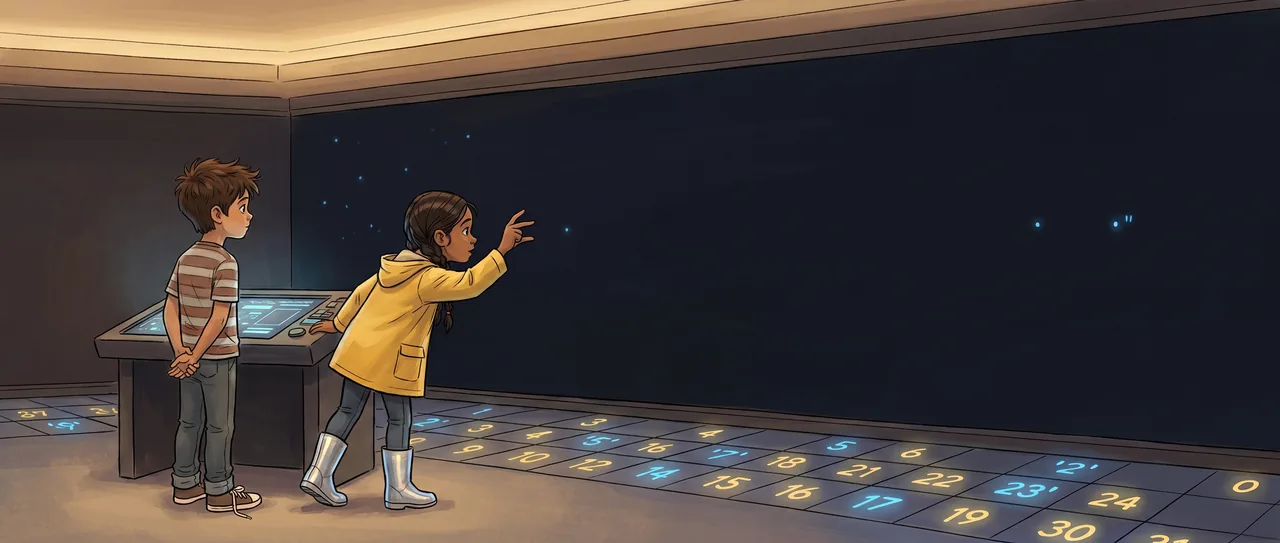
Two Spaces Apart
The last tile on the floor said THE END.
Soren hated it before he stepped on it.
The mathematics museum was still closed. The glass doors were locked. The ceiling lights were only half awake. Across the main hall, a number line ran under Soren’s shoes in square tiles, one tile for every whole number from one to ten thousand.
Most tiles were plain gray. Prime tiles lit white when you stepped on them. Twin primes, pairs of primes two apart, lit blue together and made a double chime.
Two and three made a funny sound because they were neighbors, not twins. Three and five chimed. Five and seven chimed. Eleven and thirteen. Seventeen and nineteen.
Near the beginning of the floor, the chimes came so often that Soren had to walk slowly or the sounds tangled.
By the last wall, there were long stretches of gray.
The exhibit engineer stood on a ladder, tightening a projector above the ten-thousand tile. He had a pencil behind one ear and three different screwdrivers in his vest pockets.
“Good,” he said. “It gets quiet at the end. Visitors will feel the primes thinning out.”
“They do thin out,” Soren said.
The engineer climbed down one rung. “That is what I said.”
“But not like that.”
The engineer looked at the tile that said THE END. “We open in two hours. If the complaint is philosophical, make it fast.”
Soren stepped backward off THE END. The tile did not light. It was not a number.
He had known about primes for years. A prime number could not be arranged into equal rows and columns unless one row was allowed, which was cheating in a way that mathematics permitted but did not admire. Seven stayed seven. Eleven stayed eleven. Twelve became three by four, or two by six, or one by twelve if it was desperate.
Primes became rarer as numbers grew. Not gone. Rarer.
That part fit the floor.
The ending did not.
Soren walked back to the first hundred. Chime, chime, single light, double chime, dark tile, chime. The floor felt crowded with strange numbers refusing to be built from smaller ones.
He walked forward again, faster this time. White lights blinked under him less often. Blue twins appeared, then disappeared into larger spaces.
At one thousand, the double chimes had room around them.
At five thousand, when they came, they sounded almost accidental.
At nine thousand, he waited so long between them that the museum’s air system became louder than the floor.
The engineer called from the ladder, “See? Quiet. Strong ending.”
Soren did not answer. He had stopped on a gray tile between two blue ones.
The number under his left shoe was composite. The tile two steps behind was prime. The tile two steps ahead was prime. The middle number had factors. The numbers on both sides did not.
A sandwich made of stubbornness and leftovers.
He knelt and touched the blue tiles. The glass was warm from the lights.
“How far does the floor go in the projection?” he asked.
“Past the wall,” the engineer said. “That’s the point of the projector. It shows the next million numbers as a river of sparks. But it fades. Very tasteful.”
“Can I change the test settings?”
The engineer glanced at the clock over the doors. “If you break it, we put the old poster back. The one with the cartoon calculator.”
Soren went to the control table. His paper notebook lay beside the museum tablet, looking like it had wandered in from a different century. He did not open it. The room was already full of numbers. He needed the room to do the thinking.
The tablet had a search box labeled STARTING NUMBER.
Soren typed ten thousand.
The projector threw a black river across the wall. Tiny white sparks appeared where primes lived. The sparks were farther apart than on the floor. A pair flashed blue. Then another after a long dark stretch.
The engineer said, “Pretty.”
Soren typed one million.
The river changed. The sparks thinned. The silence between them felt wider. Then, far along the wall, two blue points blinked two spaces apart.
The double chime came late, like someone answering from another room.
Soren typed one billion.
The projector hesitated. The engineer made a small unhappy sound.
The river went almost black.
Then blue.
Two sparks. Two spaces apart.
Soren did not smile. He typed a larger number, so large that the tablet had to shrink it to fit in the box. The projector worked longer this time. The wall stayed dark enough that Soren could see his own reflection in it, a narrow boy with untied shoelaces, standing where the exhibit ended.
The double chime rang.
The engineer came down the ladder.
“That does not prove anything,” he said.
“I know.”
“We have found enormous twin primes with computers. That still does not prove there are infinitely many.”
“I know.”
“The further you go, primes are less frequent. That part is proven.”
“I know.”
The engineer stared at him. “Then what exactly is wrong?”
Soren pointed at the final tile.
The engineer rubbed his forehead with the back of his wrist. There was a smear of projector dust there now. “Visitors like endings.”
Soren looked at the wall. The last pair of blue sparks had faded, but their afterimage stayed in his eyes when he blinked.
In school, when people picked partners, the room always seemed to contain finished pairs already. Soren was not lonely exactly. He had his notebook, and pencils, and the important business of being precise. But sometimes the world arranged itself into rows and columns without asking him, and he was the number left over.
On the wall, the primes did not become less prime because there were fewer of them. The blue pairs did not become ordinary because the dark stretches widened. Somewhere past where the projector had looked, maybe there was another pair. Maybe after that, another. Maybe there was a last pair so far away no machine would ever touch it. Nobody knew.
The engineer said, softer, “We cannot put ‘they go on forever.’”
“No.”
“We cannot put ‘they stop.’”
“No.”
“We cannot leave a blank wall.”
Soren turned to the floor tiles stacked under the control table. Replacement squares. Gray, white, blue, and clear glass for broken covers.
“Not blank,” he said.
The engineer checked the clock again, but this time he did not sigh. “You have forty minutes.”
Soren pulled up the last tile with the suction handle. It came free with a soft pop. Under it were wires, dust, and the metal grid that held the floor together.
He fetched a clear tile and two small blue lamp circles from the repair tray. The engineer started to reach for a screwdriver, then stopped and put both hands in his vest pockets.
Soren wired the circles himself. Not to a number. Not to the search program. To a waiting switch. When the projector searched beyond the wall, the clear tile would stay dark until the program found the next twin pair after whatever number a visitor chose. The chime might come quickly. It might take long enough for someone to shift from one foot to the other. It might not come before they walked away.
That was honest.
When the doors opened, the first visitors were smaller than Soren expected. A group of children spilled in wearing rain jackets and carrying museum maps already folded wrong. They ran the early primes into music.
Chime, chime, chime.
A girl with silver boots reached the end first. She read the new sign above the control box.
CHOOSE HOW FAR TO LOOK.
She pressed the largest button.
The wall went dark.
The younger children got restless. One hopped from foot to foot. One said, “It’s broken.”
Soren stood beside the control table and did not touch anything.
The girl in silver boots leaned closer to the dark wall.
The double chime rang.
Two blue points appeared so far to the right that everyone turned their heads at once.
The girl did not laugh. She did not say cool. She lifted one hand, held two fingers apart, and measured the darkness between where the search began and where the answer had appeared.
Then she pressed the button again.
Read the interactive version, listen to the narration, and earn a gold star →
A science-verified short story for curious kids · Curiosity Land