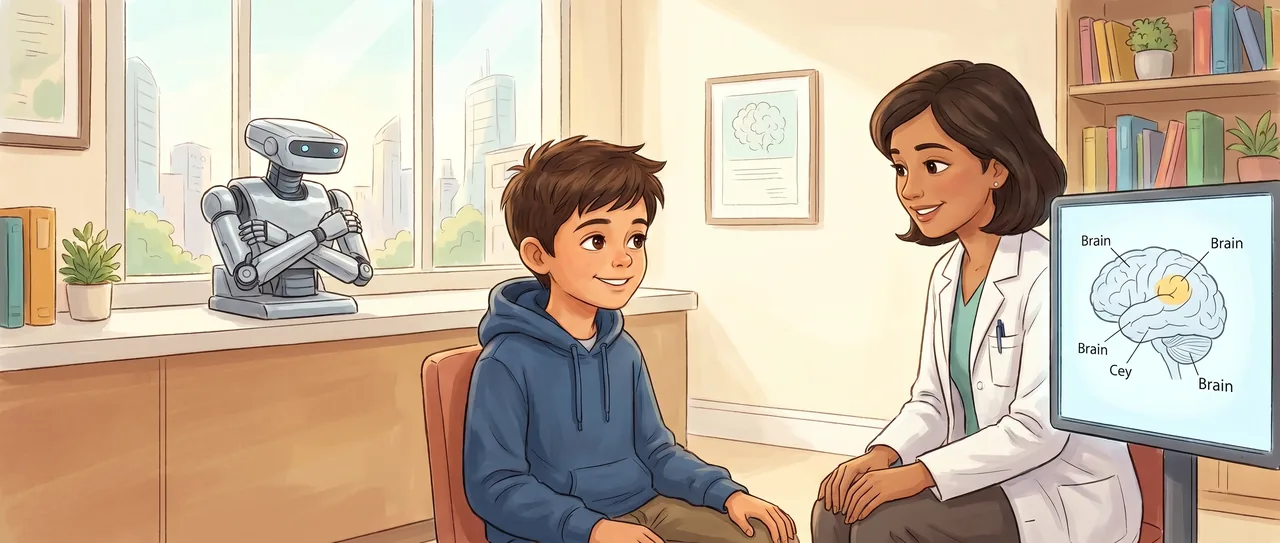
The Word That Stayed Inside
Soren was awake when the moon disappeared.
It was not the real moon. It was a white circle on a screen clipped above his knees, with three gray craters and a cartoon face that looked too pleased with itself.
“Name it,” said Dr. Rao.
“Moon,” Soren said.
A tiny blue light blinked somewhere he could not see.
“Name it again.”
Soren opened his mouth.
The word was there. It had weight. It had a roundness. It had every night he had ever looked out a car window and followed it between buildings.
His mouth made no sound.
Dr. Rao lifted one hand. The blue light stopped.
“Moon,” Soren said at once, too loudly.
“Good,” said Dr. Rao.
Soren swallowed. His throat worked. His fingers worked. His toes were cold under the warm blanket. Nothing hurt.
That was the strangest part.
Before the operation, everyone had told him this would be possible. They had said the skin and bone and tough coverings around the brain could feel pain, so those parts would be made numb and sleepy. They had said the brain itself had no pain receptors. They had said he might feel pressure, water, humming, his head held still, but not the cutting of the brain.
Soren had written it down because facts behaved better on paper.
Brain has no pain nerves.
Awake so they can ask me things.
Do not say “ow” just because it seems polite.
Now he was inside the fact, and the fact was much bigger than the sentence.
A clear drape made a little tent around his face. Beyond it, Dr. Rao and two assistants moved in blue gowns, their eyes large behind magnifying lenses. The surgical robot stood beside them with its folded silver arms tucked neatly away, waiting for commands like a very polite insect. It was not doing the thinking. It was holding still better than hands could.
On Soren’s left, Mr. Bell, the anesthetist, watched numbers glide across a glass panel. He wore orange shoes with tiny rockets on them. He had told Soren he wore them because hospitals had too many floors and not enough sky.
“Any pain?” Mr. Bell asked.
“My ear itches,” Soren said.
“That is allowed.”
“My brain does not.”
“Also allowed.”
Dr. Rao gave a small laugh without looking up. She was famous, Soren’s mother had said, for finishing operations neatly. She was also famous, Soren had noticed, for not liking delays. During practice that morning, she had shown him a stack of picture cards, a counting game, and a finger-tapping test.
“These catch the important things,” she had said.
Soren had asked, “Which important things?”
“The ones we must not disturb.”
That had not been a bad answer. It had been an unfinished answer.
The place in his brain that had been making storms was small. The doctors called it a focus. Soren called it the spark spot, but only in his head. Sometimes the spark spot made his right hand curl and twitch. Sometimes it made the left side of written words fall off the page while spoken words stayed perfectly normal. Once, during math, he had read the problem out loud correctly and written all the numbers in a descending staircase until his teacher thought he was joking.
He had not been joking.
He hated when people laughed before checking.
“Next,” said Dr. Rao.
The screen showed a spoon.
“Spoon,” Soren said.
Blue blink.
“Spoon,” he said again.
A bicycle.
“Bicycle.”
Blue blink.
“Bicycle.”
A turtle.
“Turtle.”
Blue blink.
“Turtle.”
Dr. Rao placed a tiny numbered tag somewhere on the part of him he could not see.
“Speech edge is here,” she said.
“Motor is behind it,” said an assistant.
“Good corridor,” said Dr. Rao.
Soren watched the pleased cartoon moon return to the screen. It sat there as if nothing impossible had happened.
“Can I write?” he asked.
Dr. Rao’s eyes flicked toward him over her mask.
“Not yet. We have speech and hand movement.”
“That is not the same.”
The assistant paused. Mr. Bell’s orange shoes shifted.
Dr. Rao said, “Your hand test was clear.”
“My hand is not the problem when it happens,” Soren said. “My hand moves. It writes wrong.”
“We practiced picture naming because your focus is near language.”
“I can say the word when it happens.”
Dr. Rao was quiet for one breath too long.
Soren could hear a soft suction sound and a monitor making a patient little chime. He tried not to imagine the open place under the blue drapes. He tried to imagine the notebook instead. The real one could not come in because paper shed fibers, so the nurse had scanned three pages onto the hospital slate. Lines. Margins. His careful crooked diagrams of what the seizures felt like.
Words falling left.
Hand knows motion, not map.
Speaking stays.
He said, “If you only ask me to talk, you will think that part is empty.”
Dr. Rao looked at the glass panel near his feet. The picture cards vanished. A blank page appeared, pale blue with faint lines.
“Bring up stylus mode,” she said.
The assistant said, “We have not used writing in this suite since last month’s adult case.”
“Then we remember quickly,” Dr. Rao said.
Mr. Bell placed the stylus between Soren’s fingers. His right hand was free under the drape. It looked very far away and also exactly attached to him.
“Write the word moon,” Dr. Rao said.
Soren wrote moon.
The letters were small and lopsided from the angle, but they were letters.
A blue blink.
“Again.”
Soren pressed the stylus down.
His hand moved.
It made a smooth loop, then another loop, then a tail that wandered under the line. He watched it happen. He knew the word. He could have shouted it. His fingers slid as if following a path that belonged to someone else.
“Moon,” he said.
On the slate, there was no moon. Only a string of loops.
Dr. Rao’s hand rose.
The blue blink stopped.
Soren wrote moon so hard the stylus squeaked.
Nobody laughed.
“Tag that,” Dr. Rao said.
The assistant’s voice had changed. “Writing output disruption, speech spared.”
Dr. Rao leaned closer to the place Soren could not see. “Again, half a millimeter forward.”
“Write star,” she said.
Soren wrote star.
Blue blink.
He wrote s, then a shape like a tiny ladder.
“Star,” he said.
Blue off.
He wrote star.
Another tag.
They tested counting. They tested his fingers. They tested reading a sentence. They tested copying a spiral because Soren asked for a spiral. Dr. Rao did not smile, exactly, but the line between her eyebrows stopped being a line.
The corridor changed.
Soren could tell because the room changed around it. The assistant moved a monitor. The robot unfolded one careful arm. Dr. Rao asked for a different angle. The words were ordinary surgery words, but they made a new path through the blue room.
Once, while Dr. Rao worked, she asked, “What are you writing now?”
Soren looked at the slate. He had not meant to write anything. His hand had made three small words near the bottom.
still in here
He read them out loud.
“Good,” said Dr. Rao, and this time she sounded as if the word had more than one job.
After that came quieter minutes. Soren named pictures until the pictures seemed to get bored of being named. He tapped fingers. He read. He wrote. The spark spot came out in pieces too small for him to feel. A thing that had thrown lightning through his days was lifted away while he described a turtle, a kettle, a door, a moon.
When they were done, Dr. Rao came around the drape before the sleep medicine took him under again. Her cap had slipped sideways, and a flattened curl stuck to her forehead.
“Your writing test changed the route,” she said.
Soren’s mouth was dry. “Was it supposed to be there?”
“Brains do not keep identical maps,” she said. “That is why you were here to answer.”
She tapped the slate. The screen showed a photograph from the microscope, not bloody, just pink and folded and shining under clean light. Tiny tags marked the surface. Speech. Finger. Writing. Between them were spaces with no labels at all.
Mr. Bell said, “Sleepy tide coming in.”
“Wait,” Soren said.
Dr. Rao stopped with one hand on the curtain.
On the slate, the labeled places glowed softly. The unlabeled places did not glow.
Soren raised his bandaged head one centimeter from the pillow, lifted his left hand, and touched the dark, unlabeled patch beside the word writing.
Read the interactive version, listen to the narration, and earn a gold star →
A science-verified short story for curious kids · Curiosity Land