The Skeleton That Would Not Hold Still
The clinic floor was pretending to be heavy.
Every fourth step, it tugged harder, then softer, then hard again, so the children on Luna Gate would not forget what Earth had once asked bones to do.
Soren hated the floor on scan days. It made his knees feel as if they belonged to someone taller.
Maya walked beside him, matching the changes without looking down. When the floor pulled hard, her braid bounced once. When it pulled soft, it floated near her shoulder.
“Your left foot is late,” she said.
“It is not late,” Soren said.
“It lands after the pull.”
“The pull is variable.”
“So is your foot.”
Soren was about to say that feet could not be late in any official medical sense when the clinic door opened and the scanning wall lit up with his name.
Inside, the bone specialist was eating noodles from a square cup while arguing with three screens. She had silver clips in her hair, a green stain on one sleeve, and the expression of someone who had already misplaced the next hour.
“Shoes off,” she said. “Stand on the moons.”
The moons were two pale circles in the floor. Soren stood on them. The wall washed him in blue light, then green, then a soft white that made his fingernails glow.
Maya leaned over the line she was not supposed to cross.
The specialist did not look up. “Behind the yellow stripe, please.”
Maya put one toe behind it and the rest of herself forward.
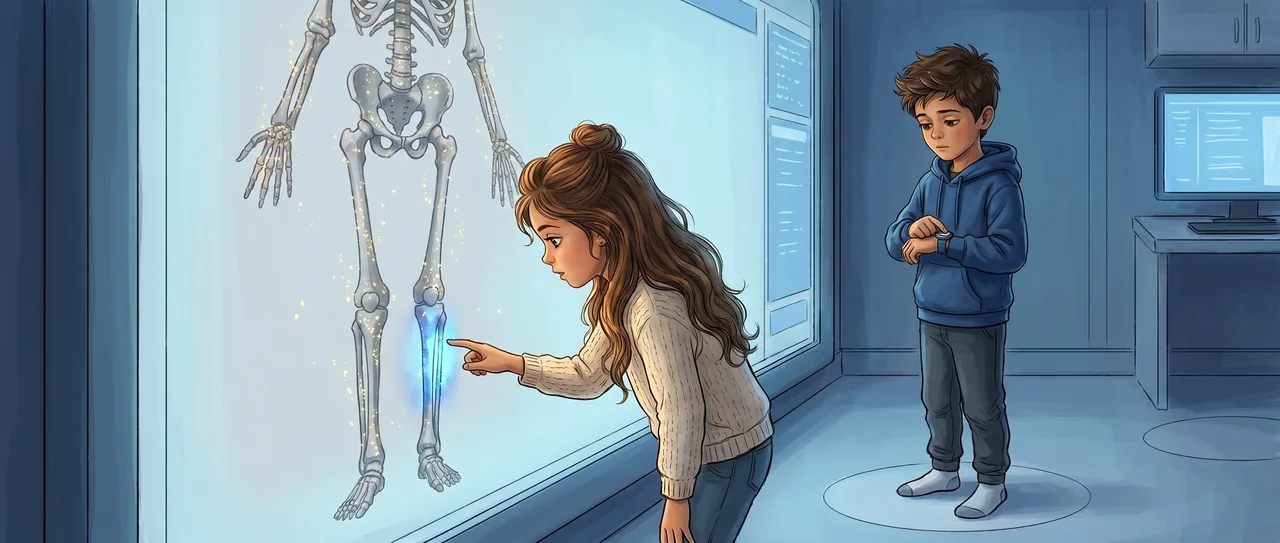
Soren’s skeleton appeared on the wall.
Not a skull-and-ribs Halloween skeleton. This one shimmered. His bones were gray-white, but inside them were little storms of color, red specks and blue shadows and gold rivers where the scanner marked density and stress.
The specialist slurped a noodle and frowned.
“Hm.”
Soren did not like adult hms. They were never empty.
“What hm?” he asked.
“Left tibia is quieter than last month. Hip too. Not dangerous, but not tournament-clear.”
The tournament was not important, except that it was the first low-gravity wall-run open to eleven-year-olds, and Soren had designed, in his paper notebook, a way to take the second turn upside down without touching the handrail.
“I did every load session,” he said.
“Your logs say you did,” the specialist said. “Your bone says you did not.”
Maya’s face changed.
Soren knew that face. Something had been added to the list in her head.
The specialist tapped the wall. The left shin glowed blue in a long, thin patch.
“Bones are structures,” she said, already glancing at another screen. “Structures need load. In low gravity, you cheat the load, the structure thins. Come back in two weeks after supervised training.”
“I did not cheat,” Soren said.
“I did not say you cheated on purpose.”
That was worse.
Maya pointed at the image. “Why is it only there?”
“Bodies are uneven,” the specialist said. “Children more so.”
“I’m here,” Soren said.
The specialist blinked. “Yes?”
“I am the child.”
“Right. Sorry.” She rubbed her forehead. “I have six growth-curve reviews, a broken elbow in hydroponics, and a baby who has decided calcium is optional. Your trainer will handle it.”
She sent the scan to Soren’s wrist tab and hurried into the next room, still carrying the noodles.
The door hissed shut.
Maya crossed the yellow stripe completely.
“She thinks your leg is lazy,” Maya said.
“My leg is not lazy.”
“Your scan is.”
Soren opened his notebook because the inside of his head had become too crowded. On Luna Gate, paper made people stare. Maya did not stare. She leaned close enough that her hair brushed the page.
He had written every load session. Date. Time. Resistance. Floor setting. Heart rate. Left boot pressure. Right boot pressure.
Maya tapped one column.
“This is ugly.”
“My handwriting is readable.”
“Not your handwriting. The numbers.”
Soren looked.
Left boot pressure. Forty-two. Forty-two. Forty-two. Forty-two. Forty-two.
Right boot pressure. Thirty-nine. Forty-four. Forty-one. Forty-six. Thirty-eight.
He had copied the numbers because the trainer displayed them. He had not questioned them. Numbers from machines felt finished.
Maya said, “Bodies are messy.”
Soren turned back through the pages. The left boot had been forty-two for twelve days.
“That is not a body,” he said.
The training room was across the hall. It smelled like rubber, warm metal, and the lemon spray adults used when they wanted places to seem less like feet.
The bone trainer waited in the center, two boots locked to a tilting plate. A screen above it smiled a cartoon femur.
KEEP BUILDING, the femur said.
Soren frowned at it. “That is a strange thing for a bone to say.”
Maya climbed onto the plate and lifted one boot. “Switch them.”
“We are not supposed to recalibrate medical equipment.”
“We are testing shoes.”
“That is almost the same thing.”
“Not if we don’t press save.”
Soren considered this. Then he unlocked the boots.
He put the left boot on his right foot and the right boot on his left. Maya set the trainer to test mode. The plate tugged downward, heavier than the corridor floor.
“Stomp,” she said.
Soren stomped with his right foot.
The screen read forty-two.
He stomped lightly.
Forty-two.
He stomped hard enough to make his teeth click.
Forty-two.
Maya’s grin was small and fierce. “It’s not you.”
Soren stomped with the other boot. The numbers jumped and wobbled like living things.
The door opened. The specialist stood there with a new noodle cup and no patience.
“Why is my trainer in test mode?”
Soren held up both hands. “We did not save.”
Maya pointed at the screen. “The left boot lies.”
“It reports a constant safe load,” Soren said. “So the trainer kept adjusting the plate wrong. My left side was getting less real load than the display said.”
The specialist stared at the numbers. Then she put the noodle cup down very slowly.
“Show me.”
They showed her.
She did not say well done. She said something under her breath about maintenance tickets. Then she looked at Soren’s scan again, and this time her face was not hurried.
“The bone was telling the truth,” she said. “The machine was being polite.”
On the wall, she opened a wider view of Soren’s skeleton. Not just the blue patch. All of it.
“See these gold flecks?” she asked.
Maya and Soren stepped closer.
“They are remodeling zones. Tiny crews. Some cells dissolve old bone. Some cells lay new bone. Your skeleton is not sitting inside you like a tower. It is being taken apart and rebuilt all the time.”
Soren looked at his ribs. Gold moved through them like city lights seen from orbit.
“How much of it?” Maya asked.
“All of it, given time,” the specialist said. “Most of the skeleton you have now will be replaced over about ten years. Some parts faster. Some slower.”
Soren touched his own wrist, where the bone was under skin, under pulse, under the place his sleeve had rubbed a red mark.
Maya said, very softly, “So the skeleton in the scan is temporary.”
The specialist did not answer. She was checking the trainer’s service record.
Soren thought of concrete. The thick gray slabs under old Earth buildings. The museum had a cube of reinforced concrete and a cube of bone under glass. The label said that, for its weight, bone was stronger. A cubic inch could bear up to nineteen thousand pounds under compression.
He had liked that fact because it made bones seem stubborn.
But stubborn things did not sparkle with repair.
Maya put her finger near the blue in his shin without touching the wall. “It got quiet because nothing asked it to speak.”
Soren looked at the gold flecks again.
His body was not ignoring him. It had been listening exactly.
The specialist dragged over a repair cart and popped open the boot sensor with a tiny hiss. “Faulty pressure membrane. I can replace it. No tournament today.”
Soren’s stomach dropped.
“But,” she said, “I can clear you for supervised loading after repair. We scan again in two weeks.”
Maya was still looking at the wall.
“What if he needs different load?” she asked.
The specialist’s hand paused inside the boot. “Different how?”
“He walks late on the left in the variable floor. The boot hid it. The trainer averaged him. But bones don’t average. They grow where the pull is.”
Soren flipped back in his notebook. The corridor floor settings. His steps. The days his ankle ached. The upside-down turn sketch.
“If I train for the turn,” he said, “the load is sideways. Not just down.”
The specialist looked from Maya to Soren, then at the cartoon femur smiling above the trainer.
“I can program lateral loading,” she said. “I usually don’t for beginners.”
“We can measure it,” Soren said.
Maya said, “We can make it messy on purpose.”
The specialist gave a short laugh. “That may be the most accurate sentence anyone has said in this room.”
Read the interactive version, listen to the narration, and earn a gold star →
A science-verified short story for curious kids · Curiosity Land