The Second Pilot
The cockpit said there were three pilots.
Maya had both hands flat on the silver pads. Soren had both hands flat on the other pair. Dr. Vale stood outside the glass with a breakfast bulb in her mouth and a repair tablet under one arm.
The practice capsule was no bigger than a closet, but it could fly a maintenance beetle around the skin of the orbital school. Not today. Today it kept blinking red.
Pilot one detected.
Pilot two detected.
Unregistered pilot detected.
“There is no third pilot,” Dr. Vale said around the bulb. “Unless one of you brought a ghost.”
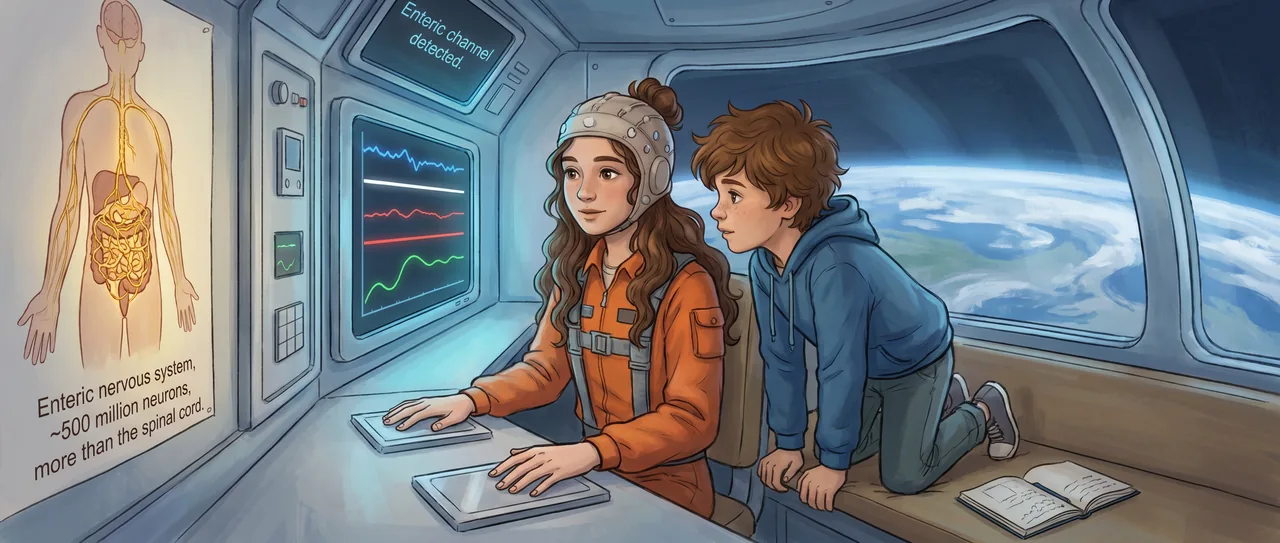
Maya looked down at the straps crossing her orange flight shirt. One belt circled her ribs. One circled her belly. A soft cap covered her hair. Little lights blinked wherever the cockpit was listening.
“It’s not a ghost,” she said.
Soren looked at the red words. “What made you think that?”
“It’s too regular.”
The capsule rolled gently in its cradle, pretending to drift. Beyond the glass, Earth slid past in a blue curve. Dr. Vale tapped her tablet too hard.
“It is a loose abdominal sensor,” she said. “The Mars crew demo is in twelve minutes. I’ll disable it.”
“No,” Maya said.
Dr. Vale lowered the bulb. “That was not one of the choices.”
Soren had already folded one knee under himself so he could reach the side screen. He did not ask permission, because the screen was in student mode and student mode had large buttons for exactly this kind of trouble.
“Show inputs,” he said.
Four lines appeared. Blue for head. White for muscle. Red for heart and breath. Green for abdomen.
The green line rose, dipped, paused, and rose again.
The red warning blinked.
Unregistered pilot detected.
Maya’s mouth tightened. “It turns there.”
“What turns?” asked Soren.
“The error. It comes after the green hill, not after my hand.”
Soren pressed replay. The lines slid backward and ran again. Blue flickered when Maya glanced at the ceiling display. White twitched when Soren shifted his thumb. Red bumped in steady beats.
Green walked by itself.
The warning appeared at the top of the green hill.
Dr. Vale frowned. “It is still a loose abdominal sensor.”
Soren tugged gently on the belly belt. The green line kept walking.
He loosened it. The green line blurred.
He tightened it. The green line sharpened again.
“Loose things don’t get cleaner when you fix them,” he said.
Dr. Vale looked at the countdown on the wall. Eleven minutes.
“Maya, hold still,” Soren said.
“I am still.”
“Be extra still.”
Maya became the kind of still that made adults ask if she was listening. Her eyes stayed open. Her fingers did not curl. Her shoulders did not lift.
The blue line flickered. The red line beat. The white line quieted.
The green line rose, dipped, paused, and rose again.
Maya stared at it.
“That’s rude,” she said.
Soren almost smiled. “It isn’t asking you.”
On the wall beside the capsule was a diagram of a human body, printed there for visiting parents who asked why a flight simulator needed biology. It showed a brain like a glowing walnut, a spinal cord like a cable, and a tangled golden net wrapped around the intestines.
Maya read the label upside down.
Enteric nervous system. About five hundred million neurons.
She leaned closer. “More than the spinal cord?”
Soren followed her eyes. “That cannot be right.”
“It says it.”
“I know. That is why I said it.”
The green line climbed again.
Outside the glass, Dr. Vale stopped tapping.
“The gut has its own nervous system,” she said. “It runs digestion. We monitor it so pilots do not get sick during long burns.”
Maya did not look away from the line. “Own means own?”
“It can do many jobs without waiting for the brain,” Dr. Vale said. “But this cockpit should not be treating it as hands on the controls.”
“Because you named every signal pilot,” Soren said.
Dr. Vale opened her mouth, then closed it.
The countdown changed to ten minutes.
Maya pulled the head cap off. Her hair sprang up in flat dark wings. The blue line dropped nearly flat.
The green line kept walking.
The capsule seemed smaller. Maya could hear the air fan above her left ear. She could hear Soren’s pencil scratch once in the notebook on his knee. She could hear her own middle make a tiny sound, like a pipe in the wall of an old house.
The screen did not blink red because of her thoughts. It blinked because there was another busy place inside the same body, doing work with no announcement.
Soren tapped the diagram. “How does it talk back?”
Dr. Vale pointed with the breakfast bulb, then remembered she was doing that and lowered it. “Vagus nerve. Brain to gut, gut to brain. Both directions.”
“Both?” Maya asked.
“Yes. Mostly information coming up from the body, but both.”
Soren looked at the screen. “Then muting the belt is wrong.”
Dr. Vale sighed
“I did not say mute forever.”
“You said disable,” Maya said.
“I said it while under pressure.”
“Different word,” Maya said.
“Different word,” Dr. Vale agreed.
Soren opened the input menu. It had choices for hand command, voice command, eye command, head command, and adaptive support. Under abdominal belt, the label read auxiliary noise.
Maya made a small sharp sound.
“That is not its name,” she said.
Soren’s pencil stopped.
The words auxiliary noise sat in a gray box. The green line moved under them, patient and unbothered.
“What should it be?” he asked.
Maya glanced at the wall diagram. “Enteric channel.”
Soren typed it. The gray box turned green.
The red warning vanished.
Pilot one detected.
Pilot two detected.
Enteric channel detected.
The capsule gave a soft chime. The maintenance beetle outside the station woke on the screen, six gold legs tucked against a panel seam.
Dr. Vale stared through the glass.
“You did not fix the signal,” she said.
“No,” said Soren.
Maya put her cap back on. The blue line returned, jagged and quick.
“We fixed what the cockpit thought a signal was,” she said.
Dr. Vale’s face changed in a way that was not quite smiling. “Can you fly?”
The countdown said seven minutes.
Maya and Soren placed their hands on the pads.
The beetle unfolded. It stepped over a rivet the size of its head. Earth rolled underneath it, too huge to fit through the window, blue and white and moving.
“Left two centimeters,” Soren said.
Maya pressed with the heel of her hand. “Left.”
The beetle moved left.
The green line rose.
No warning came.
It was stranger that way. The line had not stopped. It had not become obedient. It had simply been allowed to be what it was while the hands did hand things and the brain did brain things and the hidden net did its own quiet work.
The beetle reached the test panel. Soren matched the docking marks. Maya held pressure steady. A small clamp clicked.
Dock complete.
Dr. Vale whooped so loudly that the breakfast bulb drifted out of her hand and bounced off the glass.
“Again,” Maya said.
“The demo is in five minutes,” Dr. Vale said.
“Exactly.”
Soren was already scrolling. Below the fixed label, a new option had appeared.
Map vagus traffic, bidirectional display.
He did not press it. He looked at Maya.
Maya looked at the green line. Then she looked at the blue one.
Dr. Vale said, “That display is messy.”
“Good,” Maya said.
Soren selected the option.
A thin gold path appeared on the body diagram, running from the brainstem down through the chest and branching toward the gut. Tiny arrows lit along it, some pointing down, more pointing up.
The cockpit waited.
Maya touched the new button with one finger.
Blue light ran down the screen; green light climbed to meet it.
Read the interactive version, listen to the narration, and earn a gold star →
A science-verified short story for curious kids · Curiosity Land