The Room of Every Pair
The first thing the machine did wrong was nothing.
That was not a small nothing. It was a large, expensive nothing. The glass wall of the computation lab glowed pale blue. The cooling vents sighed. The ceiling tiles clicked as the server rack warmed itself like a metal animal.
On the wall, a sentence waited.
Where did Nia hide the copper key?
Below it, the answer box stayed empty.
Maya leaned closer to the glass. “It knows this one.”
Soren had the paper copy of the story open on the floor beside him. It was thick enough to make a soft thump when he turned a page. “It answered when we used the short version.”
“The short version was cheating.”
“It was a test.”
“It was cheating with manners.”
The lab manager hurried past carrying a tray of projector lenses. Her silver shoes squeaked on the floor. “Is the archive model charming yet?” she asked.
“It stopped,” Soren said.
“It is thinking deeply,” the lab manager said, without looking.
“It has been thinking deeply for eight minutes,” Maya said.
The lab manager glanced at the blank answer box. Her smile bent sideways. “I can rent more cloud time before the opening. Probably. Maybe. Do not press the red reset. Or the green reset. Actually, do not press anything shaped like a button.”
She vanished behind a curtain where something fell over and made a heroic crashing sound.
Soren looked at the screen beside the glass wall. “It did not run out of words. It ran out of pairs.”
Maya turned. “Say that again.”
He pointed to the display. The story had been chopped into word-pieces, not exactly words, but close enough to make rows and columns. Each piece of the story made a row. Each piece made a column. The glowing grid showed which pieces were comparing themselves with which other pieces.
In the short version, the grid had been a bright little square.
In the long version, it was a city.
Maya walked backward until her heels touched the opposite wall. The square kept going, row after row, column after column, fading where the lab wall ran out.
“Every piece looks at every other piece?” she asked.
“That is self-attention,” Soren said. “The model does not just read forward. It asks which other pieces matter.”
Maya put her finger on the first line of the paper story. “Nia put the copper key under the smallest fern before breakfast.”
Soren flipped almost to the end. “Then forty-three pages of cloud gardens, moon pigeons, the argument about soup, and the broken elevator.”
“The soup matters,” Maya said.
“The soup does not matter to the key.”
“Not yet.”
Soren accepted that with a small nod and checked the display again. “When the story gets twice as long, the square gets twice as wide and twice as tall.”
Maya stared at the grid.
She put both hands in the air, making a square with her fingers. “So twice becomes four times.”
“Four times the comparisons,” Soren said. “And then twice again becomes sixteen times from the first one. It is not climbing a ladder. It is growing a floor.”
The glass wall flickered. For a moment, the answer box showed a spinning ring. Then the ring froze.
Maya did not look annoyed anymore. That made Soren look up from his notes.
“What?” he asked.
“It is not stuck because the story is hard,” she said. “It is stuck because it is being polite to every word.”
They tried a smaller piece.
Soren fed the machine only the first page and the last page. The grid snapped into place. Thin lines leaped across it, blue and green and gold. One line ran from the word where to key. Another ran from key back to fern. Another touched smallest.
The answer appeared.
Under the smallest fern.
Maya smiled so fast it looked like a spark.
“There,” she said. “That line.”
Soren followed her finger. The bright line crossed the whole little square from the question to the first sentence of the story.
The lab seemed to get quieter.
The story was not a road. It was a room where every word could turn and point to another word, no matter how far away it stood. A tiny word at the end could reach back to a tiny word at the beginning. A pronoun could find its person. A question could find a fern hidden forty-three pages ago.
Maya whispered, “Some thoughts are far apart on purpose.”
Soren touched the glass where the line crossed the grid. “And making room for that costs something.”
Behind the curtain, the lab manager said, “If that was a discovery sound, please make it louder.”
“It was a problem sound,” Maya called.
“Those are usually the same sound in this building.”
Soren sat cross-legged on the floor. He drew a small square, then a square twice as wide. He shaded the second one in four blocks.
Maya watched the frozen long grid. “We cannot make the wall bigger by tomorrow.”
“No.”
“We cannot make every word shake hands with every word in the giant story.”
“No.”
“We need the key to shake hands with the fern.”
“Yes.”
“And maybe the soup.”
Soren looked at her.
Maya flipped to the soup argument. “Nia says she hates green bowls. Later she chooses the smallest fern because its pot is green, so nobody else will touch it. Soup matters.”
Soren read the two passages, then nodded once. “Soup matters.”
The lab manager came out with a lens tucked under one arm. “Please tell me the exhibit will not be called Soup Matters.”
“It should be called Too Many Handshakes,” Maya said.
“It should be called The Price of Every Pair,” Soren said.
The lab manager blinked. “That is annoyingly good. Continue.”
She moved toward the server rack, but Maya stepped in front of the glass wall.
“More cloud time only makes the city bigger,” Maya said. “We need a map before the city.”
The lab manager stopped. Her shoes gave one last squeak. “I am listening, but quickly.”
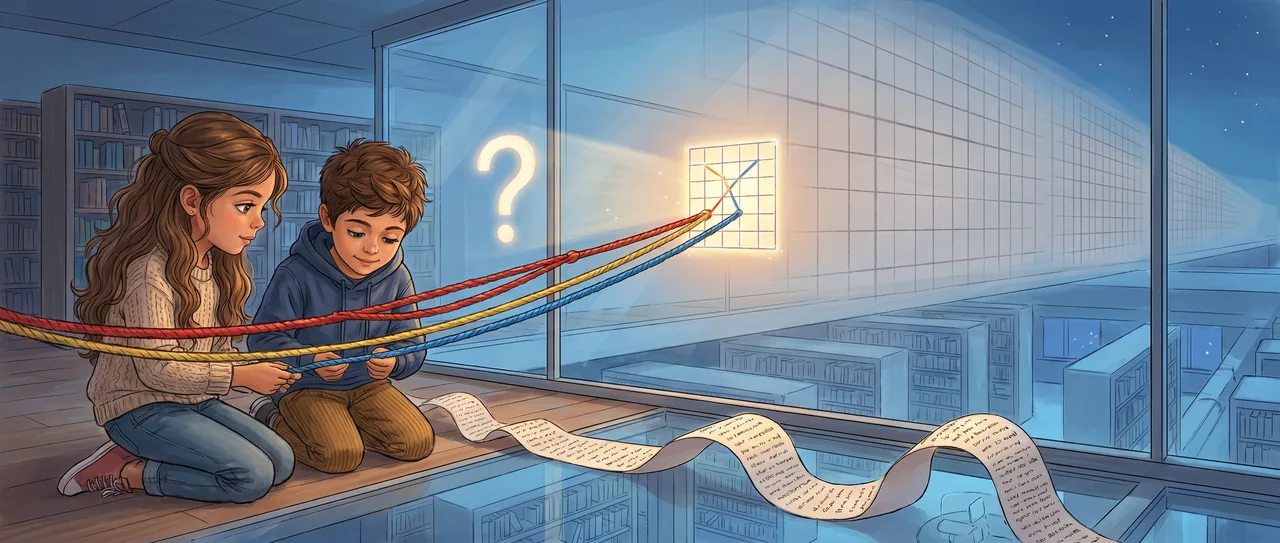
Soren picked up three colored cords from the exhibit supply bin. “First, we do not ask the model to read all forty-five pages at once.”
“That sounds like quitting,” the lab manager said.
“No,” Maya said. “It sounds like not making every pigeon shake hands with every comma.”
Soren laid the red cord from the question to the first page. “We search for possible places first. Key. Hide. Remember. Fern. Green. Bowl.”
Maya laid a yellow cord to the soup argument. “Not just exact words. Clues. Nearby meanings. Candidate pieces.”
Soren added, “Then the transformer does the expensive every-pair attention only over the question and the pieces we bring it.”
The lab manager frowned in the particular way adults frowned when they wanted something to be wrong but could not find where. “Retrieval first. Attention second.”
“For the demo,” Soren said. “It is not the same as reading everything all at once.”
Maya looked at the huge faded grid that ran off the wall. “But it gets us across this story.”
They built it on the floor because the floor was honest.
The lab manager programmed the projector to show a square of light around whatever text they selected. Soren made the first station: eight word-pieces, then sixteen, then thirty-two, with the number of little glowing comparison dots swelling from a handful to a swarm. Maya made visitors double the strip of words and watch the dots burst outward until the square looked crowded enough to buzz.
At the second station, the long story appeared as a ribbon across the wall. The question shone at one end. The answer hid far away at the other. The machine tried everything at once and froze politely.
At the third station, the search lights swept the ribbon and pulled out the first page, the soup argument, the green bowl, the smallest fern, and the last question. The grid became small enough to glow.
This time the answer box filled before the vents had time to sigh.
Under the smallest fern.
The lab manager read it twice. Then she looked at the red, yellow, and blue cords stretched across the floor. “Researchers are trying all sorts of ways to stretch this,” she said. “Sparse patterns. Windows. Retrieval. New math. Nobody gets every pair for free.”
Maya crouched at the edge of the projected grid. “What if the one thing you need is in the part you did not bring?”
The lab manager did not answer quickly.
Soren liked that.
At closing time, most of the lab went dark. The frozen giant grid still glimmered faintly on the glass, larger than the wall that held it.
The lab manager stood in the doorway with her tray of lenses. “Tomorrow, people will ask how long a story a machine can remember,” she said. “What will you tell them?”
Maya picked up the red cord.
Soren picked up the other end.
Read the interactive version, listen to the narration, and earn a gold star →
A science-verified short story for curious kids · Curiosity Land