The River Without Banks
The exhibit engineer said a river had to look like a river.
She had built the Amazon first. It ran through the center of the table in a blue glass channel as wide as Maya’s hand. Tiny boats bobbed in it. Plastic trees leaned over it. When the pump started, the whole room could hear the water moving.
Beside it, the space for the atmospheric river was empty.
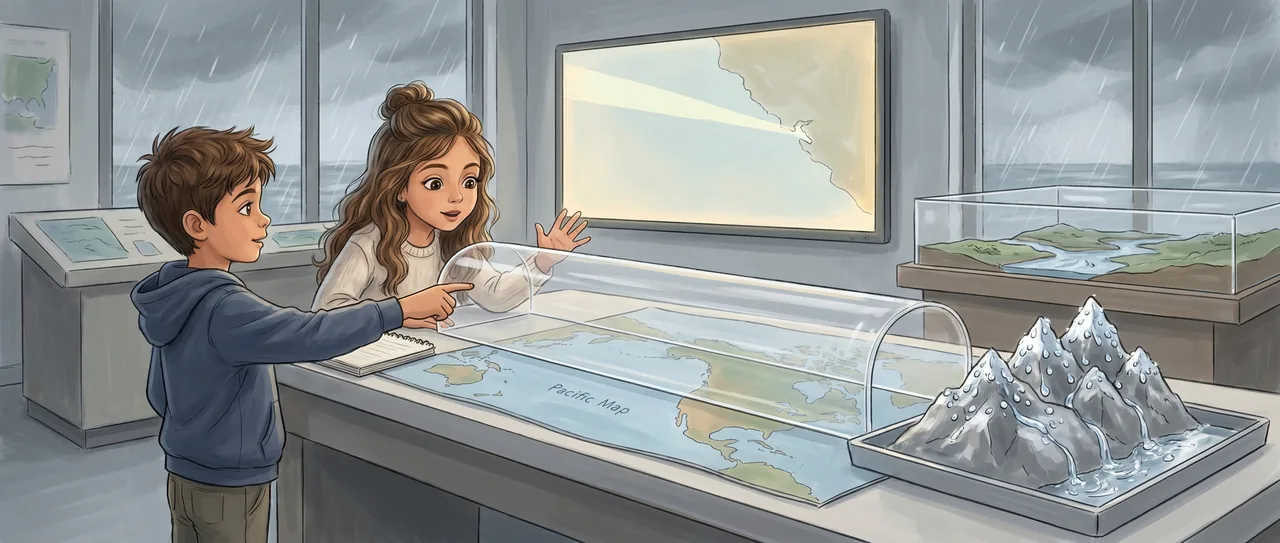
Not almost empty. Empty empty. A clear strip of plastic crossed the Pacific part of the map and ended at the little Coast Range, where the mountains were made of frosted metal.
The engineer tapped the blank strip with one fingernail. “Children are going to think we forgot this part.”
“We didn’t,” Maya said.
Soren had his notebook open against his knee. He had drawn the Amazon as a thick line, then drawn the Pacific as a rectangle full of arrows. The arrows kept getting rubbed out and drawn again.
“It carries water,” he said, “but not as liquid water.”
“That is exactly my problem,” the engineer said. She was wearing three measuring tapes, one around her neck and two clipped to her belt. All morning she had been climbing ladders, tightening bolts, and saying things like beautiful, but impossible. “Fog, maybe. Blue fog. We can light it from underneath.”
“No,” Maya said too fast.
The engineer looked at her.
Maya touched the clear strip. “Fog is droplets. People will think the river is a cloud.”
“It is a cloud, isn’t it?”
Soren shook his head. “Not exactly. Water vapor is gas. You don’t see it.”
The engineer sighed in the direction of the ceiling. “Wonderful. Our main attraction is invisible.”
Outside the exhibit hall windows, the morning sky was pale and flat. The ocean was hidden behind the dunes, but the wind had been pushing against the glass since breakfast. Not hard. Steady. Like someone leaning there and waiting.
Maya liked the blank strip. That was the problem. It looked wrong in the right way.
The engineer pointed to the supply cart. “You have forty minutes before the visiting class arrives. If it still looks like nothing, I’m using fog.”
When she walked away, her measuring tapes clicked against her legs.
Soren stared at the clear plastic corridor. “We need to make invisible water do something visible without pretending it is visible.”
“Yes,” Maya said.
“That was not a solution.”
“It was the shape of one.”
They had been given a fan, a warm-water humidifier, a sheet of clear acrylic, the frosted metal mountains, a tray to catch drips, and a tiny pump that made the Amazon look important.
The first attempt made the whole box foggy.
The engineer saw it from across the room and called, “Pretty.”
“Wrong,” Maya called back.
Soren switched off the humidifier. The fog thinned and vanished. He wrote two words, then crossed them out. “Too cold everywhere.”
Maya put her cheek near the acrylic, not touching it. “The air is spreading.”
“It needs banks,” Soren said.
“It doesn’t have banks.”
“I know. That is another problem.”
They stood on opposite sides of the table. The Amazon made cheerful river sounds between them. Maya watched the clear Pacific strip, the little mountains, the places where the plastic was dry and the places where someone’s fingerprint showed in a crescent.
Soren took two long transparent rulers from the cart and laid them upright on either side of the clear strip.
“Temporary banks,” he said. “Not saying the real thing has walls. Just keeping our model from cheating.”
Maya moved the fan lower. “The river is in the air. So the air has to move.”
Soren nodded. “Warm, wet air from the ocean. Then mountains.”
He slid the frosted metal range closer to the end of the corridor. The mountains were cold because a coil inside them carried chilled water from a small reservoir. The engineer had installed that part for a snowmelt display, then forgotten to label half the tubes.
Maya found the right switch by following the tube with her finger under the table.
The metal mountains cooled. The humidifier breathed. The fan pushed.
Nothing happened.
The Amazon gurgled loudly, as if laughing.
Soren bent until his eye was level with the clear strip. “Maybe too fast.”
“Or too warm,” Maya said.
“Or not wet enough.”
They changed one thing at a time because Soren insisted, and because Maya had learned that if she changed three things at once, Soren made a face like a door closing.
Fan slower. Nothing.
Humidifier higher. Nothing.
Mountains colder. Nothing.
Then Maya noticed the first bead.
It was smaller than a seed. It appeared on the windward side of the metal mountains, not on the ocean, not in the middle of the empty corridor, only where the moving air struck cold height and had to rise.
“There,” Maya said.
Soren did not answer. He was watching the bead grow fat. It trembled, held, then ran down the metal slope into the tray.
Another bead appeared. Then six. Then the miniature Coast Range began to rain.
The clear strip still looked empty.
The Amazon still looked like a river.
The empty strip was making weather.
Soren slowly turned the page in his notebook, but he did not write. “How much water can one of these carry?”
Maya reached for the exhibit card the engineer had printed and almost thrown away because it had too many words. She read the line with her finger under it.
“Some atmospheric rivers transport more water vapor than the Amazon River carries as liquid.”
Soren looked at the glass channel in the center of the table. The blue river shoved its tiny boats along, proud and noisy.
Then he looked at the clear strip above the Pacific, where nothing could be seen until the mountains began to shine with drops.
The room seemed to have another room folded inside it. The map seemed too small for the sky it was trying to hold.
The engineer came back with a coil of blue lights over one arm. “All right. Where do you want the fog?”
Maya pointed to the mountains.
The engineer leaned over. “Oh.”
A drop hit the tray with a small, bright tick.
Soren said, “We need the sign to say you are not supposed to see the river. You see what it does when land gets in the way.”
The engineer put down the blue lights.
“I hate that,” she said. “I also love it.”
She crouched beside the table and watched the clear corridor breathe. Her hair had escaped its clip in several directions. “But visitors will ask why it is so skinny.”
“Because they are narrow,” Soren said. “Long and narrow. Like corridors.”
“And they bring most of our big rain,” Maya said.
“Here,” Soren said. “And other temperate coasts. Not every rain. A lot of the important ones.”
The engineer grabbed a marker and wrote on a temporary card in block letters: THE RIVER IS HERE EVEN WHEN YOU CANNOT SEE IT.
Maya crossed out THE RIVER and wrote THE WATER.
Soren added, UNTIL IT BECOMES RAIN.
The visiting class arrived in a gust of wet jackets and squeaky shoes. They crowded first around the Amazon because the boats were moving. Someone said, “That one wins.”
The engineer opened her mouth.
Maya shook her head once.
Soren turned the atmospheric river fan down until the corridor was almost still. The drops on the mountains slowed. Then he turned the fan up to the mark they had made with tape. The humidifier breathed harder. The clear strip remained clear.
For three seconds, nothing happened.
The visiting class began to shift away.
Then the cold mountains silvered. Drops gathered all at once, as if a hidden hand had touched every slope. Water ran into the tray in bright threads.
“Where did that come from?” someone asked.
Maya moved aside so they could put their faces level with the empty air.
Soren pointed, not to the drops, but to the blank corridor over the ocean.
The engineer had connected the live satellite screen while they were working. It flickered on behind the table, showing the Pacific in gray and white. Across it stretched a long pale band, thin compared with the ocean, aimed at the coast like a finger.
The room got quieter.
Outside, rain struck the high windows for the first time that day.
The engineer looked from the screen to the model. “That is today?”
Soren checked the time stamp. “That is now.”
The pale band on the satellite reached across more ocean than Maya could make herself imagine. It had no banks. It had no boats. It carried a river in a form nobody could cup in their hands.
The Amazon pump hummed. The miniature mountains ticked with rain. The real windows blurred.
Maya lifted one hand above the clear strip, and cold drops tapped her wrist.
Read the interactive version, listen to the narration, and earn a gold star →
A science-verified short story for curious kids · Curiosity Land