The No-Face Branch
The museum had given the mystery human a face by accident.
It was a very serious face, with a heavy brow, a strong nose, and eyes that looked as if they had just heard bad news from a glacier.
Maya stood in front of the glowing wall and folded her arms.
“No,” she said.
Soren looked up from the testing tablet. “No because the eyebrows are too much, or no because there is no face?”
“No because there is no face.”
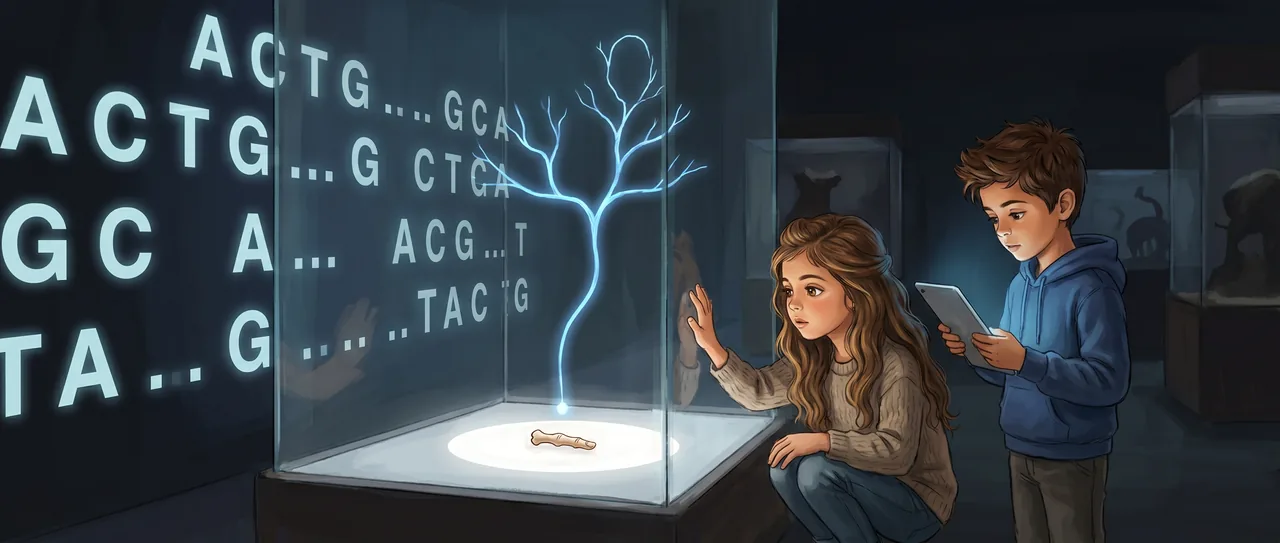
On the glass shelf below the wall sat three things. A smooth modern human skull cast. A Neanderthal skull cast with a long low head. And, in the middle of a circle of white light, a piece of bone so small it looked like a broken tooth from a doll.
The label said: Denisova Cave, finger bone fragment.
The wall above it showed the serious face again. Under the face, in neat museum letters, it said: A Lost Cousin.
Dr. Vale came hurrying past with a coil of cable over one shoulder and a half-eaten apple in her hand. She was the exhibit director. She liked big displays, loud buttons, and anything that made people stop walking.
“You two are supposed to break the exhibit,” she said. “Not glare at it.”
“It is already broken,” Maya said.
Dr. Vale looked at the face. “The portrait generator is a placeholder. We need something human there. Visitors don’t fall in love with a crumb.”
Soren looked at the bone fragment. “Maybe they should.”
Dr. Vale blinked at him, then at her apple, as if it had reminded her of another emergency. “Test the family-tree game. If the game works, I can argue about eyebrows later.”
She hurried away, dropping the cable twice before the hallway swallowed her.
The game began with a bright chime.
Build the human family tree, said the tablet.
Three skulls appeared on the screen. Modern human. Neanderthal. Unknown ancient hominin. Under them was a pile of evidence cards.
Maya dragged the finger bone card toward the unknown skull. The tablet buzzed.
Not enough skeletal evidence for skull reconstruction.
“Good,” Maya said.
Soren tapped the card again. A second view opened. Instead of bones, the screen filled with rows of letters.
A C T G. T T A C. G G A A.
The rows were chopped short, like confetti made from an alphabet.
Soren leaned closer. “Ancient DNA fragments.”
Maya pointed to the tiny bone under the glass. “That much bone had all this?”
“Not all. Pieces.” Soren scrolled. “Old DNA breaks. Also people touch things and leave their DNA everywhere, so the clean-room part matters.”
Behind the glass, there was a photograph of a scientist in a white suit, mask, hood, and gloves, holding a drill over an ancient bone.
Maya watched the rows of letters slide by. The little bone did not look little anymore. It looked locked.
The tablet chimed again.
Place unknown hominin by appearance.
“No,” Maya said.
Soren tried another button.
Place unknown hominin by sequence.
The screen changed. The skulls vanished. A branching line appeared, simple and black, with glowing points on it. Modern humans on one twig. Neanderthals on another. The finger bone fragment hovered by itself, refusing to snap into either place.
Soren grinned without looking up. “Now it is behaving wrong in a better way.”
Maya crouched until her eyes were level with the tiny bone in the case. “It was not a Neanderthal?”
“Not exactly.” Soren pulled up the comparison card. “The DNA was different enough that scientists knew it was another kind of ancient human relative. Denisovan. First from this little finger bone, then other bits. A tooth. A jaw piece later. But the DNA named the branch before there was a proper face.”
Maya put one finger on the glass, not touching the bone, only touching the place above it.
The tablet offered the serious generated face again.
Maya stabbed the back button. “It keeps trying to make the missing part into a picture.”
“That is what Dr. Vale wants.”
“Dr. Vale is wrong.”
Soren did not answer right away. He opened the next evidence card.
This one showed a dark pit full of bones. The label read: Sima de los Huesos, Spain. More than four hundred thousand years old.
The tablet displayed another scatter of DNA letters, shorter and rougher than the first.
Soren went very still.
Maya saw it happen. His shoulders lifted. His mouth opened a little. Not surprised exactly. Re-sized.
“What?” she asked.
“Four hundred thousand years,” he said. “And there are still letters.”
Maya looked back at the rows. They were not like writing in a book. They were damaged, chemical, incomplete, pulled from cold darkness by tools and patience and people who believed crumbs could answer.
The little fragment in the case sat quietly in its white circle.
Maya whispered, “The old part is not the bone.”
Soren nodded once. “The old part is the message that survived inside it.”
The tablet buzzed, impatient.
Choose a face to continue.
Maya grabbed the edge of the testing tablet and turned it sideways, as if the game might behave better if the whole world tilted.
“There has to be a way to not choose.”
Soren opened the settings menu. “There is always a way they forgot to hide.”
He found exhibit-builder mode behind a gray button labeled Staff. It asked for a password.
Maya looked down the hall. Dr. Vale was arguing with a robot vacuum that had eaten the end of her cable.
“The password is probably not password,” Soren said.
Maya read the sticky note on the underside of the tablet cover. “It is FossilsFirst.”
Soren entered it. “That is rude.”
The builder opened into blocks. Portrait. Skull model. Evidence map. Sequence alignment. Uncertainty label. Audio button. Visitor prompt.
Maya pulled Portrait into the trash.
The serious face vanished from the wall.
The space above the tiny bone went dark.
Dr. Vale’s voice rang from the hall. “Please tell me the wall did not just go black.”
“Only the wrong part,” Maya called.
Soren dragged Sequence alignment into the empty space. Rows of letters appeared huge on the wall, glowing pale blue, broken into fragments. Maya added Evidence map beneath it. Soren added Uncertainty label, then changed the text.
No skull yet. No face yet. Known by DNA.
Maya read it aloud. “Too neat.”
Soren nodded. He deleted “known.”
The label became: Met first by DNA.
Maya smiled. “Better.”
Dr. Vale arrived at a run, still holding the cable. She stopped in front of the wall.
The big empty place where the face had been was not empty now. The letters drifted there in broken rows. A line from the finger bone’s circle rose into the branching tree and made a twig with no portrait at the end.
Dr. Vale stared. “Where is the person?”
Maya pointed to the tiny fragment. Then to the letters. Then to the twig.
Soren pressed the visitor prompt.
The exhibit spoke in a clear voice, not too grand, not too soft.
“I am not drawn from a skull. I was first recognized from DNA in a small bone from Denisova Cave. Other ancient DNA, even from bones more than four hundred thousand years old, can carry pieces of lives that fossils alone may not show.”
Dr. Vale did not say anything.
From the hallway came the squeak of the robot vacuum escaping with three loops of cable dragging behind it.
Dr. Vale watched the twig with no face. “Visitors will ask what it looked like.”
“Yes,” Maya said.
“They will ask if there are more.”
“Yes,” Soren said.
“They will be annoyed that we cannot answer everything.”
Maya looked at the branch. “Good.”
Dr. Vale pressed her lips together. Her eyes moved from the broken letters to the tiny bone and back again.
Then she reached past Soren and tapped Save.
The wall chimed.
A group of preview visitors gathered at the entrance, teachers with badges and children with damp hair from the rain. Dr. Vale shoved the bitten apple into her pocket and became official all at once.
“Welcome,” she said. “You are just in time for the part we nearly got wrong.”
Maya stepped back beside Soren as the first visitors approached the case.
A small boy in a yellow coat looked at the fragment and frowned. “That is it?”
Soren handed him the visitor tablet.
The boy pressed Place by sequence.
The skulls disappeared. The blue letters rose. The faceless twig lit at the end of the branch.
The boy did not move for a long moment.
Then he said, very softly, “Oh.”
Soren tapped the corner marked Next question.
A drawer clicked inside the exhibit. Under the glass, a spoonful of gray cave dust slid into its own lit circle.
Read the interactive version, listen to the narration, and earn a gold star →
A science-verified short story for curious kids · Curiosity Land