The Empty Step
The moth would not step on the empty square.
That was the whole problem, according to Dr. Vale, who had three visitor badges on one lanyard and a coffee cup balanced on a stack of tablets. The museum doors would open in twelve minutes. The glass room was already full of folding chairs, and beyond the glass, a line of fourth graders pressed their hands and noses against the wall.
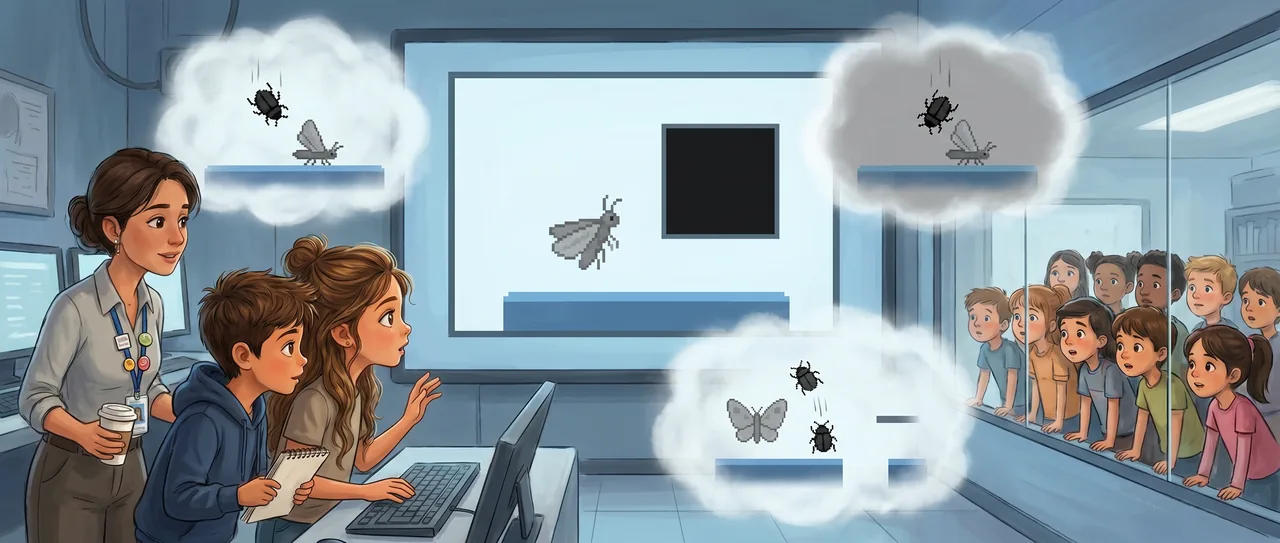
On the main screen, a pixel moth stood at the edge of a blue platform. Ahead of it was one black square, then a ladder, then the glowing fruit it was supposed to collect. The square was empty. No spikes. No enemy. No hole.
The moth waited.
"It is stuck," Dr. Vale said. "We use last month’s model. Last month’s model is boring, but it crosses the square."
Maya was already leaning over the console.
"Don’t reset it," she said.
Dr. Vale blinked at her. "Maya, the point of a demonstration is that it demonstrates."
"It is demonstrating," Maya said. "Something weird."
Soren stood beside her with his paper notebook open, though he had not written anything yet. The notebook always looked like it had wandered in from another century and refused to apologize.
"Can we replay the last six seconds?" he asked.
Dr. Vale checked the clock above the door. "You have three minutes before I become practical."
That meant yes.
Maya tapped the replay. The moth ran, ducked under a falling seed, climbed a vine, and reached the blue platform. Then it stopped before the empty square.
"Again," Soren said.
Maya played it again.
On the third replay, she put her finger against the glass just above the empty square.
"It hates that square," she said.
"It does not hate," Dr. Vale said, already turning toward a storage cabinet. "It receives pixels and outputs button presses. Left, right, jump, wait. No rules. No map. No hates."
"Wait," Soren said.
Dr. Vale paused with one hand on the cabinet handle.
"No rules?" Soren asked. "Only the screen?"
"Raw pixels," Dr. Vale said. "A great many games. A great many failures. It learned what button tends to help. Or in this case, what button tends to embarrass me."
Maya did not look away from the screen. "Show the under-screen."
"The what?"
"The colored grid thing. The one nobody looks at because it looks like soup."
Dr. Vale looked at the line of children outside the glass. Then at the clock. Then at Maya. "Two minutes."
Soren found the menu before Maya did. He had watched the lab techs last week when they thought nobody cared which tab came after Diagnostics. The side monitor filled with a square of colors, hundreds of tiny cells brightening and dimming as the moth moved.
It did look like soup.
Not tomato soup. Weather soup. Storms in a box.
Maya replayed the six seconds again. The colored grid shimmered when the seed fell. It flashed when the vine appeared. At the blue platform, before the moth stopped, a narrow stripe in the corner lit up white.
"There," Maya said.
"There what?" Dr. Vale asked.
"Again. Slower."
Soren set the replay to one frame at a time. The moth’s wings were two gray pixels, up, down, up, down. The empty square remained empty.
The white stripe brightened.
"That comes before it waits," Soren said.
"Lots of things come before lots of things," Dr. Vale said, but he had stepped closer.
Soren looked at the controls. "Can we force it to step? Just once. From this exact frame."
"That will ruin the run."
"Copy state," Maya said.
Soren nodded. "Copy state. Make a branch."
Dr. Vale opened his mouth, closed it, then reached past them and unlocked a small orange button. "Do not break my museum."
Maya copied the game at the frozen frame. Soren forced the right button.
The moth stepped onto the empty square.
For one frame, nothing happened.
For the next frame, the blue platform sank like a pressed key. A ceiling door snapped open. A black beetle dropped exactly where the moth’s head had been.
The moth disappeared in a burst of gray pixels.
Outside the glass, one of the waiting children laughed, though nobody had explained what they were seeing.
Maya’s mouth opened, but no words came out at first.
Soren flipped back to the original. "It was not afraid of the square. It was ahead of the square."
Maya pressed the replay again. Up, down, up, down. Blue platform. White stripe. Stop.
Dr. Vale set the old tablet down very carefully.
"It found the trap," he said.
"No," Maya said. "Finding is now. This is next."
Soren turned to the side monitor. "The white stripe is not the beetle. The beetle is not on the screen yet. It is something the network carries before the beetle exists in pixels."
He spoke quickly, not because he was sure, but because the steps were lining up under his feet as he said them.
Maya was already opening another panel. "There is a future viewer. The cloudy one."
"That is experimental," Dr. Vale said.
"Perfect," Maya said.
Soren found it. The panel was labeled Prediction Decoder, which sounded much grander than it looked. It showed a blurry version of the game screen, like someone had remembered the room underwater.
Maya froze the moth at the platform and selected three branches.
Wait.
Step right.
Jump.
The future viewer split into three cloudy windows.
In the first, the moth waited. The platform rose again. The beetle fell harmlessly in front of it. A moment later, the path cleared.
In the second, the moth stepped right. The beetle dropped onto its head.
In the third, the moth jumped. Its wing clipped the beetle from below, and the screen went gray.
The cloudy pictures were not sharp. They were guesses pulled from the network’s hidden storm. But they were not random. They leaned toward what the game would do next.
The empty square was full of endings.
No one spoke for several seconds. Even Dr. Vale forgot the clock.
Soren looked from the cloudy windows to the real game. A rules sheet would have said blue platform. Black beetle. Ladder. Fruit. It would have explained the pieces after they appeared. The moth had never received a sheet. It had fallen, lost, tried again, and built something inside itself that leaned forward.
Maya whispered, "It learned the room without being told what a room is."
Then the museum doors opened.
Dr. Vale made a small sound like a person stepping barefoot onto a cold floor. "We need chairs. We need the big screen. We need, oh no, we need this not to crash."
"It won’t," Soren said.
"You cannot know that."
"No," Soren said. "But we can show the branches. If it fails, we show those too."
Maya was already dragging the cloudy future windows onto the main display. She made them large enough for the children outside to see. Soren set the original game in the center and the three possible futures around it.
Dr. Vale stared at the screen. His coffee had gone untouched in his hand.
"This is not the demonstration," he said.
"It is now," Maya said.
The fourth graders came in. Their teacher tried to make them enter quietly, which worked for almost four seconds.
Dr. Vale began with his usual sentence about artificial intelligence learning from experience. Then he stopped. He looked at Maya and Soren as if they were a pair of wild birds that had flown into his lab carrying wires.
"Actually," he said, "Maya and Soren are driving."
Maya did not sit in the chair. She stood beside it, one hand on the keyboard.
Soren stood at the branch controls. "The moth only sees the pixels on the screen," he told the room. "It was not given the rules. We are going to pause it sometimes and ask what might happen next if it presses different buttons."
A boy in the front row raised his hand. "Does it know the future?"
"No," Maya said. "Watch."
She ran the game.
The moth darted through the pixel caves. The audience laughed when it ducked under the seed. They cheered when it climbed the vine. Then the blue platform appeared.
The moth stopped before the empty square.
Several children groaned.
Maya froze the frame. Soren branched the buttons.
On the big screen, three pale versions of the next moments bloomed around the moth. In one, it died. In one, it died differently. In one, it waited while the beetle fell and the path opened.
The room went quiet in a new way.
Not polite quiet. Not teacher quiet.
The kind of quiet that happens when everyone leans forward at once.
Maya pressed play.
The moth waited.
The beetle fell.
The moth crossed the square and climbed the ladder.
The children shouted so loudly that Dr. Vale spilled coffee on his own shoe and did not notice.
After the demo, when the fourth graders had gone and the chairs sat crooked in the room, Soren brought up the last frozen frame again. The fruit glowed above the ladder. The moth waited below it.
"Try a level it has not played," Maya said.
Dr. Vale looked alarmed. "That is not on the schedule."
"Good," Maya said.
Soren loaded a new cave. The walls were pale green instead of blue. The fruit hung lower. A moving shadow crossed the floor in a rhythm the moth had never practiced.
The future viewer blurred until the three windows looked like fogged glass.
Maya lifted her hand from the keyboard.
On the monitor, the moth stood still.
Around it, three pale paths flickered
Read the interactive version, listen to the narration, and earn a gold star →
A science-verified short story for curious kids · Curiosity Land