The Empty Side
Maya had been told three times not to lean over the yellow rail.
The rail was not even useful. It stopped at her waist, and all the interesting things were on the other side of it: a black block of graphite, a glittering diamond chip under a plastic dome, a square of glass in a metal frame, and a machine with a needle that kept twitching like it had a secret.
The materials engineer rubbed both hands over her face. Her badge said Dr. Rana. Her hair was pinned up with two pencils, one red and one chewed nearly to splinters.
"We may have to skip the carbon window," Dr. Rana said to the visitors. "It seems to have died five minutes before showtime, which is traditional for demonstrations. Please admire the diamond while I decide whether to forgive physics."
A few people laughed. Maya did not.
Dead was a strange word for something that looked like nothing.
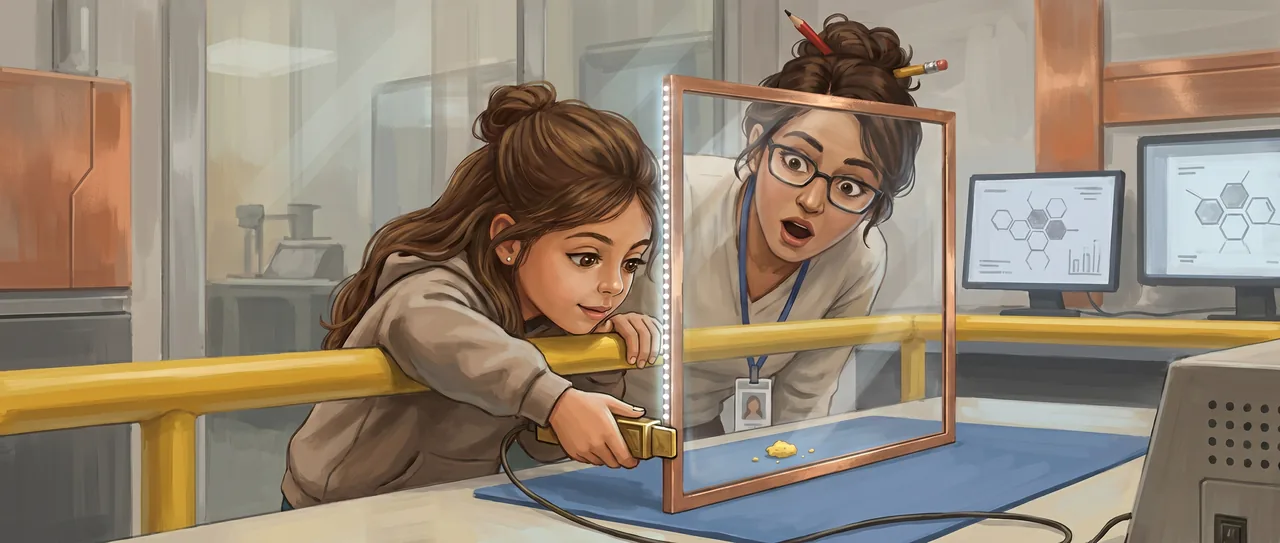
The square in the frame was almost perfectly clear. Behind it, Maya could see the blue mat on the table, the silver screws, even a yellow crumb from someone’s lunch. Two copper-colored strips touched its edges. Two spring clips pressed down from above. A row of tiny lights waited beside it, dark and neat.
Dr. Rana tapped the graphite block. "Carbon here is soft enough to write with." She tapped the dome over the diamond. "Carbon here is hard enough to scratch almost anything." She pointed at the clear square. "Carbon here is supposed to let you see through it and carry electricity better than copper, if the universe is being cooperative."
Maya’s fingers came out of her pockets.
Dr. Rana saw them immediately. "No touching the sample. It is one atom thick. That is not a figure of speech."
Maya put her hands back. "Then how can it be dead?"
"Because a sheet that thin can tear. Or fold. Or refuse to be where I need it." Dr. Rana glanced at the clock. "We grew it on copper, moved it to plastic, put it in this frame, and apparently offended it somewhere along the way."
The needle on the machine jumped once.
Maya looked at the machine. Dr. Rana did not. She was already reaching for the diamond dome.
The needle settled back to zero.
Maya added it to the list in her head.
The frame had arrows on it, but one arrow pointed toward the ceiling and one pointed sideways. The copper strips did not match. The left strip lay flat and shiny. The right strip had a tiny dull lip, like it had been folded under and then flattened badly. The spring clips touched both strips from above.
The clear square showed almost no edge at all, except when Maya tilted her head. Then a faint line appeared near the right side, not a scratch, not a crack, more like the border of a soap bubble that had forgotten its colors.
"Can I ask one thing?" Maya said.
Dr. Rana was holding the diamond dome in one hand and trying to smile at the visitors with only half her face. "One thing. Fast."
"If the carbon is one atom thick, which side is it on?"
Dr. Rana’s smile stopped. She looked at the frame. Then at Maya. Then at the frame again.
"The top," she said.
Maya waited.
Dr. Rana looked less certain. "It should be the top."
The needle twitched again when Dr. Rana’s sleeve brushed the right copper strip.
"It only jumps on that corner," Maya said.
"That corner is not enough. We need a path across the sheet."
"Maybe the path is there and the clip is not."
Dr. Rana opened her mouth, then closed it. She set the diamond dome down very carefully.
"You may point," she said. "Not touch."
Maya pointed to the left clip. "That one presses the shiny side. This one presses the folded-under part. If the graphene is on the other face there, the clip is touching plastic. Or air. Or the wrong nothing."
A small boy behind Maya whispered, "Wrong nothing."
Dr. Rana leaned close enough that her glasses nearly touched the frame. "Oh, you irritatingly possible child."
Maya liked that better than being called careful.
Dr. Rana brought over a tester with two blunt gold pads instead of sharp points. "Only the copper contacts," she said. "If you scratch the middle, I will make a noise only bats can hear."
Maya took the tester. It was heavier than it looked. She touched one pad to the left copper strip and one to the right. Nothing happened.
She moved the right pad to the dull lip underneath, where the copper folded around the edge.
The machine sang a thin, bright note.
Everyone leaned forward at once.
Dr. Rana did make a noise, but it was not for bats.
"The film is not dead," Maya said.
Dr. Rana unscrewed the frame with quick, annoyed fingers. She did not remove the clear square. She only loosened the clips, lifted the copper fold with tweezers, and slid both spring contacts so they pressed the same face.
"The sample was upside down on one edge," she said. "No, worse. It was half upside down. I have invented a very expensive way to connect a circuit to emptiness."
She switched on the power.
The row of tiny lights sprang awake.
They did not blaze. They made a clean white line, steady and almost delicate. Through the clear square behind them, Maya could still see the yellow crumb on the blue mat.
Dr. Rana placed a thin plastic hoop under the middle of the square. Then she lowered a rounded metal pin until it pressed down on the suspended film. The machine drew a curve on its screen.
"
"
The pin rose. The clear square stayed clear.
Maya had seen carbon before. It was pencil dust on her fingers. It was black smears on homework. It was the word adults used when they talked about smoke and old air and things needing to be reduced.
Dr. Rana touched a key, and the wall screen changed.
At first Maya thought it was a honeycomb. Then the honeycomb became too regular, too endless, six-sided ring joining six-sided ring, black dots at the corners, nothing extra, nothing thick enough to cast a proper shadow.
"That is an image of the lattice," Dr. Rana said. Her voice had gone quieter. "Carbon atoms. One layer. Hexagons all the way across."
Maya stepped closer to the rail until it pressed into her hoodie.
The graphite block, the diamond chip, and the empty-looking window sat in a row on the table. Same carbon. Different arrangements. One wrote dark lines. One caught every light in the room. One was so thin people kept trying to look through it, and it had carried the current anyway, once somebody touched the side where it actually was.
Dr. Rana glanced at Maya. "We have a public station for graphite tape flakes. Not graphene most of the time. Usually many layers. But sometimes the layers get surprisingly thin."
She held out a roll of clear tape.
Maya pressed a strip of clear tape to the black graphite block, lifted it, and held the gray ghosts up to the lamp.
Read the interactive version, listen to the narration, and earn a gold star →
A science-verified short story for curious kids · Curiosity Land