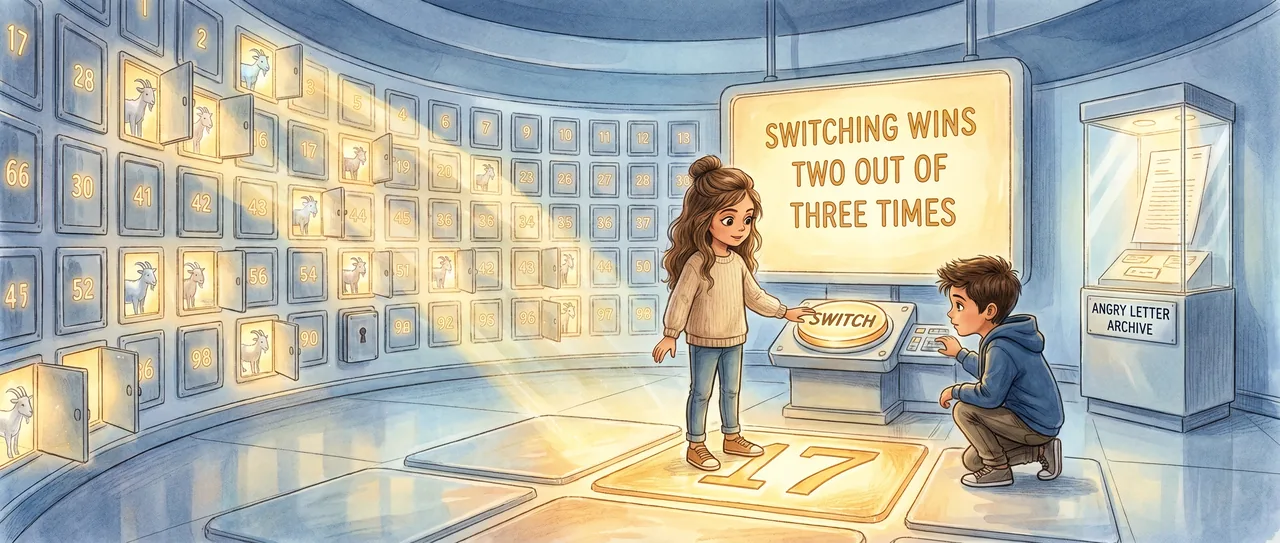
The Door That Would Not Be Half
The first thing the exhibit manager said was, "Please do not make anyone angrier about goats."
Maya stopped with one foot inside the Probability Pavilion. "That is a sentence."
Soren looked past her.
Three doors stood at the center of the room, tall and shiny, with handles shaped like question marks. Above them floated the words Pick a door. Behind one is a Mars rover. Behind two are goats.
The goats were not real goats. They were light-goats, museum goats, made of projection and old video from some farm archive. One of them was chewing the corner of a holographic hat.
The Mars rover was not a real rover either, but it looked real enough to drive over your shoe.
A paper sign had been taped over the exhibit screen. It said, Switching after a goat appears wins two out of three times.
Someone had written under it, in red marker, NO IT DOESN'T.
Someone else had written, OBVIOUSLY HALF.
The exhibit manager carried a roll of fresh tape in her fist. Her hair had escaped its clip on one side. She looked like a person whose morning had contained too many parents.
"The old television puzzle," she said. "Visitors pick a door. The host opens a different door with a goat behind it. Then visitors can stay or switch. The exhibit says switching is better. Visitors say the exhibit is broken. One retired engineer lay down on the floor to demonstrate fairness."
"Was he fair?" Soren asked.
"He was flat," said the manager.
Maya had already walked to the doors. "Where is the rover now?"
"The system randomizes it," said the manager. "But I am changing the sign to say either remaining door is equally likely. It will be wrong, apparently, or maybe right, apparently, but it will be quieter. I need quiet math today."
Soren stared at the taped sign.
Half felt right. One goat gone. Two doors left. One rover. One goat. Half.
He did not like how clean it felt. Clean answers sometimes hid crumbs in the corners.
On the wall beside the exhibit hung a glass case titled The Angry Letter Archive. Inside were copies of old letters, carefully preserved. Dear Madam, one began, you are utterly incorrect. Another said, No professional mathematician would make such a mistake. A small plaque explained that when this puzzle had been printed long ago, thousands of readers, including many mathematicians, wrote to insist that switching could not help.
Soren put both hands in his pockets.
Maya read three letters and smiled with only one side of her mouth. "This is better than goats."
"It still feels like half," Soren said.
"Yes," Maya said. "That is the trap."
"You don't know that yet."
"I know where it snags. The goat isn't just gone. Somebody chose which goat."
The exhibit manager rubbed her forehead with the tape roll. "You have fifteen minutes before the school group arrives. If you can make it make sense without anyone shouting, I will not put up my coward sign."
She walked away to stop a small child from feeding a snack wrapper to a projection goat.
Maya pointed at door one. "We always pick that one."
"That changes the game," Soren said.
"No. It pins it down."
He liked that.
The first run, the rover was behind door one. Maya picked door one. The host screen opened door three. A goat appeared and sneezed sparks of light.
"Stay wins," Soren said.
Maya nodded. "Write it."
He did, because his notebook was already open. Door one chosen. Rover door one. Switch loses.
The second run, Soren set the rover behind door two using the staff controls the manager had left unlocked for volunteers. Maya picked door one again.
The host screen opened door three.
"It had to," Maya said.
Soren looked at door two, still closed.
Maya switched. The rover rolled out, its little camera mast turning toward them like it had been waiting.
Soren wrote. Door one chosen. Rover door two. Switch wins.
The third run, the rover was behind door three. Maya picked door one.
The host opened door two.
"It had to," Soren said.
Maya switched. The rover came out from door three.
Soren wrote the last line slowly. Door one chosen. Rover door three. Switch wins.
There were only three places the rover could have been at the start. In one, switching lost. In two, switching won.
He shut the notebook before the answer could turn into homework.
"Again," he said.
Maya looked pleased. "Good."
This time Soren was the host.
Maya turned her back while he hid the rover behind one door. She picked. If she had picked the rover, he could choose either goat door to open. If she had picked a goat, his hand had nowhere free to go except the other goat.
That was when the room changed size.
The doors did not look like three doors anymore. They looked like the first second of the game, still standing inside the last second. Maya's first choice carried one chance. The two doors she had not picked carried two chances together. When Soren opened a goat, he did not spread those two chances evenly like butter. He shoved the whole heavy thing onto the only unopened door left.
Maya was watching his hand hover over the controls.
"You feel it now," she said.
"The host is part of the machine," Soren said.
"Yes."
The school group arrived in a wave of shoes and voices. The exhibit manager hurried behind them, still holding the wrong sign.
"No shouting," she warned.
"We need them to be hosts first," Maya said.
"Contestants like being contestants," the manager said.
"That is the problem," said Maya.
Soren dragged three glowing floor tiles into a row. The museum tiles were made for rearranging exhibits, and they clicked together with satisfying little thunks. Maya set a tiny projected rover behind one tile and goats behind the others.
"Everyone pick tile one," Soren said.
The group groaned.
"Terrible strategy," someone said.
"Perfect strategy," Maya said. "For seeing."
They ran the three worlds side by side.
In the first world, the rover began under tile one. The host opened a goat. Staying won.
In the second world, the rover began under tile two. The host had to open tile three. Switching won.
In the third world, the rover began under tile three. The host had to open tile two. Switching won.
The children did not shout. That was stranger than shouting. They leaned forward.
One child said, "But after the goat, there are two left."
"Yes," Soren said.
Maya tapped the second and third worlds with her shoe. "But before the goat, there were these. The host knows where the rover is. The goat he shows you is not random from the whole room. It is chosen from what he is allowed to show."
The child looked at the doors. Then at the floor worlds. Then at the doors again.
"That's rude," the child said.
"Very," said Maya.
The exhibit manager lowered the wrong sign.
Visitors began lining up. Some stayed and won. Some switched and lost. That made people suspicious again until Soren started sorting the results into two glass tubes labeled stay and switch. Not one game. Many games. Not a feeling. A pile.
The switch tube filled faster.
Not every time. That mattered. A person could switch and still get a goat. A person could stay and still get the rover. The truth did not arrive like a king. It arrived like rain in a measuring cup.
An older boy with a silver jacket crossed his arms. "I still don't like it."
Maya shrugged. "You don't have to like it."
Soren handed him the host controls. "You have to open a goat. Every time."
The boy hid the rover. A smaller girl picked a door. The boy reached for a handle, stopped, moved to the only goat he was allowed to show, and opened it.
His mouth made no sound.
Maya bounced once on her toes.
The silver-jacket boy looked at the unopened door he had not let himself touch. "Oh."
No one laughed. Not even Maya.
The glass case of angry letters shone beside them. Soren glanced at the sharp old handwriting, at all those certain grown-up sentences folded behind glass. The puzzle had not needed people to be foolish. It had needed them to start in the wrong place.
The manager peeled the red-marked sign off the exhibit screen. Under it, the original words glowed bright and calm.
Switching wins two out of three times.
"We should add the floor worlds," Soren said.
"And host controls," Maya said.
"And the angry letters stay," said Soren.
"Especially those," said Maya.
A very small child, the same one who had tried to feed the projection goat, pointed at the three big doors.
"What if there were more?" she asked.
Maya and Soren looked at each other.
The exhibit manager said, "How many more?"
"A hundred," said the child.
The pavilion heard that number. The ceiling projectors woke. Door after door after door appeared around the room in a bright curve, each one small enough for a goat and large enough for a question.
Soren set the prize behind one door. Maya planted both feet on the glowing number seventeen and held her hand above the switch button.
Across the floor, ninety-eight small goat doors clicked open, one after another.
Read the interactive version, listen to the narration, and earn a gold star →
A science-verified short story for curious kids · Curiosity Land