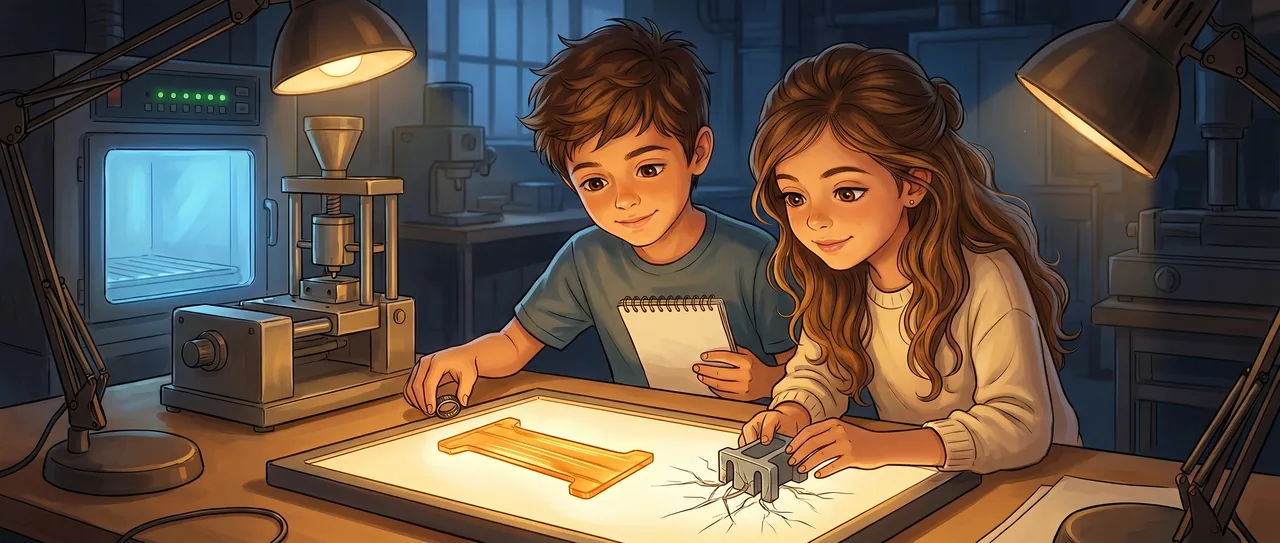
The Direction the Plastic Remembered
The connector failed at three hundred degrees Celsius, but not by melting.
That was the insulting part.
Maya watched through the oven window as their little amber plug sat between two ceramic boards, neat as a piece of candy. The quartz window stayed clear. No smoke. No fog. No sagging. The display beside the oven still read three hundred degrees Celsius in calm blue numbers.
Then the signal line blinked red.
Soren leaned closer to the screen, not the oven. He had already written the temperature, the time, and the exact second the first green dot vanished. His paper notebook looked ridiculous beside the foundry’s floating displays, which was one reason he kept using it.
“It did not soften,” he said.
“The pins moved anyway,” Maya said.
Inside the hot chamber, one row of metal contacts had lifted just enough to stop touching. The connector had kept its shape everywhere except the only place it mattered.
Dr. Avila came over with one glove half on and a mouth full of sesame cracker. She was the kind of engineer who walked fast even when standing still.
“Ceramic backup,” she said. “I knew the student mold was ambitious.”
“It’s liquid crystal polymer,” Maya said. “It’s supposed to do this.”
“It is supposed to survive this,” Dr. Avila said. “Surviving is not the same as behaving. I have a live feed with the orbital materials class in eighteen minutes.”
She tapped the red light on the display and looked at the clock, not at them.
Soren said, “Can we have the failed part when it cools?”
“You can have anything that is not currently three hundred degrees,” Dr. Avila said. “Do not touch the hot stage. Do not change the oven program. Do not make me explain to your parents why you smell like burnt gloves.”
“We won’t,” Maya said.
Dr. Avila was already gone, calling, “And if you find a miracle, label it clearly.”
The foundry hummed around them. On one bench, a printer laid down silver traces thinner than eyelashes. On another, a robot arm dipped ceramic wafers into a bath the color of tea. Their own corner held the small injection molder, a metal mold no bigger than a lunchbox, a jar of amber pellets, and the failed promise of heatproof plastic.
Soren waited until the chamber dropped below safe temperature. Waiting made Maya feel fizzy under her skin, so she looked at the spare parts instead.
There were three practice connectors on the tray. Same polymer. Same mold. Same neat comb of tiny slots for pins.
Not the same shine.
Maya picked up one cooled practice piece and turned it under the bench light. The amber surface flashed in long lines down the body, like hair brushed flat. On the failed one, once Soren lifted it out with tongs, the lines split around the pin holes and met again in a faint seam.
“There,” Maya said.
Soren looked where she pointed. “A weld line?”
“A river line.”
“That is not a term.”
“It went around the holes and bumped into itself.”
Soren held the part beside the paper diagram of their mold. The melted polymer had entered from a little round gate in the middle, then spread outward into the comb teeth, splitting around every pin slot.
He drew arrows from the gate. Then more arrows. Then he frowned.
“The contacts lifted where the arrows turn sideways,” he said.
Maya took the cooled runner, the leftover stem of plastic from the mold. It was thin and ugly, the part everyone snapped off and threw away. She bent it along its length. It flexed and sprang back. She turned it sideways and pressed. It cracked with a small dry tick.
Soren’s head came up.
“Again,” he said.
“There’s only one runner.”
He took the two halves and tried each direction, carefully, not forcing. Along the length, the pieces resisted. Across the length, pale lines opened.
“It is stronger one way,” he said.
Maya smiled, quick and sharp. “It has a grain.”
“Plastic does not have grain.”
“This one does.”
Soren did not correct her. He went to the shelf and pulled down the little polarized viewer used for checking stress in clear parts. He laid a runner piece on the glass and rotated the top filter.
The scrap did not just shine. It changed.
Gold became brown. Brown became black. A bright streak ran straight from the gate like a road seen from above. The failed connector showed crowded colors around the pin slots, bending and twisting where the melt had split.
Maya stopped bouncing.
The piece on the glass looked solid. It clicked when Soren tapped it. It could sit in an oven hot enough to bake a cake to charcoal and not sag. But inside it, something had kept the shape of motion. The part was not only what it was made of. It was how it had arrived.
“Liquid crystal,” Soren said softly.
Maya looked at the amber scrap. “Crystals that flowed.”
“Long molecules,” Soren said. “Like rods. The flow lines them up.”
“And then it freezes them that way.”
“Solidifies,” Soren said.
“Freezes,” Maya said, because she liked the word better.
On the next bench, a display showed options for the mold: center gate, end gate, dual gate, field assist. Maya had ignored it earlier because she had been thinking about temperature. Three hundred degrees had sounded like the whole monster.
Now the monster had arrows.
Soren tapped the diagram with his pencil. “If it enters from the end, the flow goes down the length of the connector. Along the row of pins.”
Maya said, “Not around them.”
“Mostly not.”
“And field assist?”
Soren read the label. “Electric field between the side plates. Aligns the liquid crystal domains during fill. Interlock required.”
“It combs while the river runs.”
“That one may actually be a term someday,” Soren said.
They did not ask Dr. Avila. She was on the far side of the room, arguing cheerfully with a camera drone that refused to frame her furnace.
Soren checked the mold insert number against the diagram. Maya fetched the end-gate insert from the labeled drawer. They worked with the safety prompts, not around them. The machine would not heat until the guard clicked shut. It would not energize the field plates until both hands were off the mold. The foundry had been built for people who wanted to try dangerous things without being foolish about it.
Maya poured in the last amber pellets.
The molder warmed them until the pellets became a thick, shining melt. On the tiny screen, pressure rose. The plunger pushed.
Soren watched the fill animation. “Front is straight.”
Maya watched the actual mold as if she could see through steel.
The machine gave one soft chime.
Cooling took ninety seconds. Maya counted only to seventeen and then had to start walking in a square.
When the mold opened, the new connector looked boring.
That was good.
No split shine around the pin slots. No little river crash in the middle. The amber lines ran from one end to the other, thin and straight, as if someone had brushed the whole part with an invisible comb.
Soren trimmed the runner. Maya placed the connector between the ceramic boards and latched the metal contacts. Her fingers wanted to hurry. She made them not.
Dr. Avila appeared beside them exactly when the oven door sealed.
“What did you change?” she asked.
“Direction,” Maya said.
“And field assist,” Soren said. “Same polymer. Different memory.”
Dr. Avila looked at the mold diagram, then at the old connector, then at the new one behind the quartz window. For once, she finished chewing before speaking.
“All right,” she said. “Let us see if your plastic remembers under pressure.”
The oven climbed.
One hundred degrees. One hundred eighty. Two hundred forty.
The connector did not slump.
At three hundred degrees Celsius, the quartz window stayed clear. The contacts stayed seated. One green dot lit on the display, then the next, then the next, until the whole row shone like a tiny runway.
Dr. Avila made a sound that was not quite a laugh and not quite a cough.
“The orbital class is going to love this,” she said. “Do not go anywhere.”
But Maya had already gone as far as the cutoff bin.
She picked up the ugly runner from the new part. Soren picked up the old one. They did not put them in the trash.
Dr. Avila hurried toward the camera drone, holding the successful connector in insulated tweezers and talking too fast.
Maya set the cutoff runner on the viewer. Soren turned the polarizer ring one careful notch.
Across the glass, the scrap curved like a frozen stream, bright at the banks, black at the bend.
Read the interactive version, listen to the narration, and earn a gold star →
A science-verified short story for curious kids · Curiosity Land