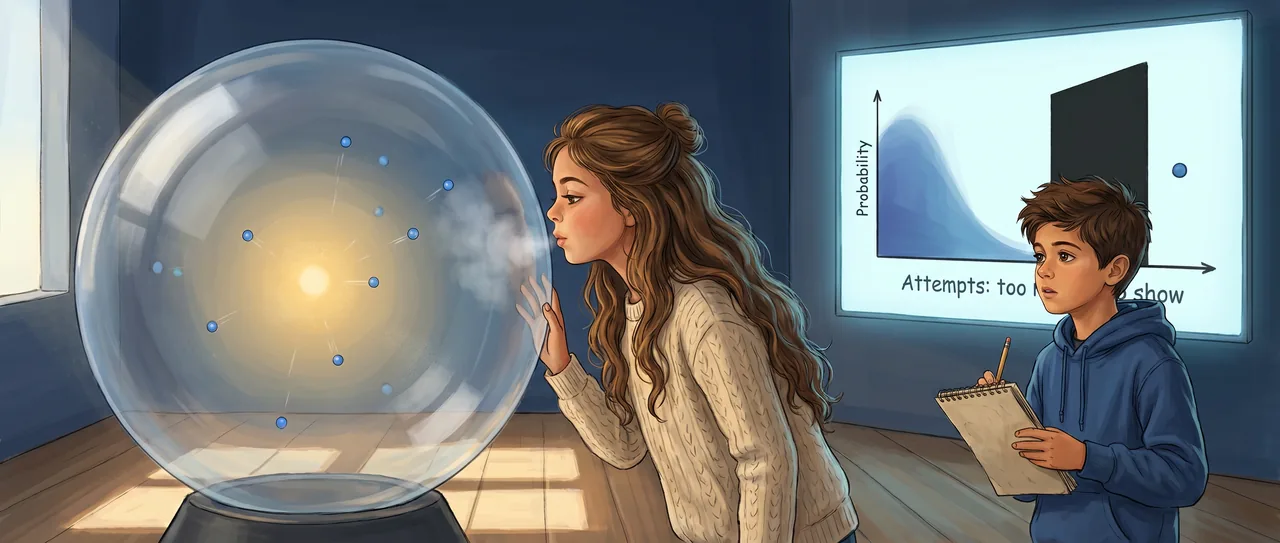
The Almost Impossible Sun
On the morning the museum's sun refused to shine, Dr. Ito had a cable in her teeth and three alarms speaking into her left ear.
The sun was not the real Sun. The real one hung above the glass roof, white and steady and too bright to look at. This sun was a clear sphere as wide as Maya's arms, full of tiny blue points that were supposed to rush and collide and make a soft gold glow for the first school tour of the day.
Instead, the sphere looked like a jar of angry fireflies that had forgotten fire.
Soren stood beside the control rail with his paper notebook open. The museum scanners kept trying to read it as an ancient artifact.
Dr. Ito pulled the cable from her mouth. “Core temperature,” she said. “It is always core temperature. Children set stars like soup.”
Maya pointed at the display. “It says fifteen million degrees.”
“Then children set displays like soup,” said Dr. Ito. She reached over and slid the temperature higher.
The blue points went wild. The sphere flashed red, and a warning bloomed across the glass.
Not a solar solution.
Maya folded her arms. “The Sun is not having a tantrum.”
Soren wrote: hotter makes wrong star.
Dr. Ito looked toward the entrance hall, where a line of students had begun to gather under the hanging planets. “I have four minutes before I either fix a star or pretend comets are more exciting than they are.”
“Comets are exciting,” Soren said.
“Not today,” said Dr. Ito. She shoved a toolkit toward them with her foot. “Do not break the Sun more.” Then she crawled under the simulator table, where the alarms were louder.
Maya reset the temperature to solar. The sphere calmed. Blue points rushed together, slowed, curved away, rushed together again. Zero fusion events, said the display.
“That number is too clean,” Maya said.
Soren leaned closer. “Too clean?”
“Not small. Zero. Stars don't do zero.”
He switched the motion to step mode. The blue points became pairs. Two rushed toward each other, close enough that their fuzzy edges almost touched. Then both sprang backward as if a tiny invisible hand had slapped them apart.
“Protons,” Soren said. “Same charge. They repel.”
“I know that part.” Maya tapped the glass when the next pair bounced. “But outside, the Sun is doing this anyway.”
The real sunlight lay across the floor in pale rectangles. Dust moved through it like slow weather.
Soren opened the diagnostics menu. It had tidy museum words, not engineer words. Hydrogen abundance. Core pressure. Collision rate. Electric barrier.
Under electric barrier, a little diagram showed two hills facing each other. The proton dot rolled partway up, ran out of energy, and rolled back down.
Maya watched it three times. “It's treating them like beads.”
“They are particles,” Soren said. Then he stopped with one finger still above the glass. “Mostly.”
Maya turned to him.
“Particles are waves too,” Soren said. “Not ocean waves. Probability waves. We did it with electrons in the diffraction tray.”
“So why are these beads?”
Soren searched the menu again. The alarms under the table made a hiccuping sound. At the entrance, the first students pressed close to the rope. One of them said, “Is it supposed to be dark?”
Maya ignored them. She was already on the next wrong thing.
“Wave display,” she said.
“I don't see it.”
“Because it's not where it belongs.”
Soren did not ask how she knew where something invisible belonged. He had known Maya long enough. He opened Advanced View, then Comparison Mode.
Two boxes appeared.
Classical particles only.
Quantum behavior included.
The first box glowed green.
Maya made a short sound, not a laugh exactly. “The Sun is in marble mode.”
Soren touched the second box.
Nothing happened.
A small message appeared.
Barrier transmission probability set to zero.
“There,” Maya said.
Soren did not touch it yet. “Wait.”
“We have less than four minutes.”
“Three,” said Dr. Ito from under the table.
Soren switched on the probability graph. A black wall rose between two blue smears. On one side, the smear was thick. Inside the wall, it faded almost to nothing. On the far side, a thread of blue remained.
Maya leaned so close her breath fogged the glass.
The next proton came at the barrier. It did not have enough energy. The hill was too high. The rules on the left side of the screen said no.
For a breath, the blue smear lay on both sides of the wall.
Then a dot appeared beyond it.
Not over. Not through like a drilled hole. There, where it should not have been if it were only a bead.
The sphere gave one quiet click.
Fusion events: one.
Soren's pencil stopped moving.
Maya whispered, “Again.”
Most pairs bounced. Almost all of them. The counter raced through thousands of collisions with nothing gold at all. Then another pair crossed the not-crossable place. Then another. A faint warmth of color gathered at the center of the sphere.
Soren tapped the line that said Unsuccessful encounters.
“Can we rename that?” he asked.
Maya glanced at him. “To what?”
“Attempts.”
Maya's face changed the way it did when a pattern snapped into place. Not finished. Bigger.
She renamed it.
The display now read Attempts: too many to show.
Gold light threaded the blue.
Dr. Ito rolled out from under the table with a smudge on her cheek. “Why is it working?”
“It was pretending protons were only little balls,” Soren said.
“And the probability was zero,” Maya said. “Stars don't do zero.”
Dr. Ito stared at the control rail. Then at the glowing sphere. Then at the waiting students.
“Bless every stubborn proton,” she said. She stood and smoothed her jacket with both hands. “Can you run the opening?”
Maya looked at Soren. Soren looked at the sphere.
“Yes,” they said together.
Dr. Ito hurried to the doors and lifted the rope.
The students poured in. Some were taller than Maya. Some wore jackets that adjusted their temperature by themselves. One boy looked at Soren's notebook and whispered, “Paper?”
Soren heard him. He did not close it.
Maya set the simulator back to the beginning, solar temperature, solar pressure, hydrogen waiting in blue. The sphere dimmed until it looked empty except for motion.
“This is a star that should not work if you treat everything like tiny hard balls,” she said.
Soren brought up the electric barrier. The proton rolled up the hill and fell back. Laughter moved through the group.
“So you make it hotter,” said the boy with the temperature jacket.
Maya slid the temperature up. The warning flashed red again.
Not a solar solution.
The laughter stopped.
Soren switched on the wave view. The protons became blue smears, thin at the edges, strange and alive on the screen.
“At the Sun's center,” he said, “most hydrogen nuclei do not get through the electric push. Almost none do.”
He set the barrier transmission to its first thin mark.
The class waited. Nothing happened fast enough to impress anyone.
Maya did not speed it up.
The counters climbed. Attempts. Attempts. Attempts.
Then the center of the sphere clicked gold.
A second click came. Then another. The light did not explode. It gathered, patient and bright, as if the glass had been remembering daylight and had finally started saying it back.
On the display, one line appeared in small letters.
Without tunneling, a star like the Sun would not shine.
No one whispered about paper.
Dr. Ito stood by the door with her hand over her mouth, leaving the smudge on her cheek untouched.
Maya slid the quantum setting to zero, and the pocket star went black. She slid it back to the first thin mark. In the square of real sunlight on the floor, the glass sphere lit again.
Read the interactive version, listen to the narration, and earn a gold star →
A science-verified short story for curious kids · Curiosity Land