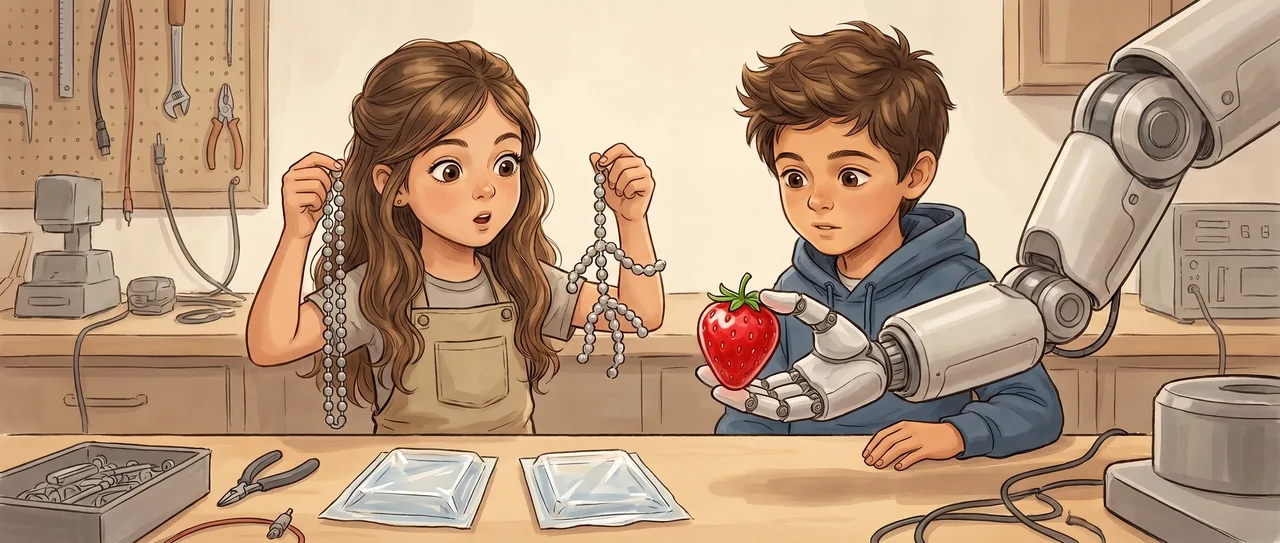
Same Beads
The robot hand dropped the strawberry on its first try.
It was not a real strawberry. It was blown glass, hollow, red as candy, and much too expensive for dropping. It hit the padded table with a sound like a tiny bell being insulted.
Mr. Vale shut his eyes.
Maya leaned closer to the robot fingers. The left fingertip had gone cloudy white where it bent. The right fingertip had a neat little crack across it.
Soren picked up the glass berry and turned it over in both hands. No chip. He set it back in the nest of blue foam.
“Again?” Maya asked.
“No,” said Mr. Vale. “Not again. The greenhouse people arrive in twenty minutes, and I told them this hand could pick soft fruit without bruising it.”
“It almost did,” Soren said.
“That is not a category engineers use,” said Mr. Vale. He rubbed his forehead with the heel of his hand. There was a streak of silver dust on his cheek. “The material is wrong. Which is impossible, because I ordered the same polymer for all the pads.”
He held up two packaging sleeves. Both labels said polyethylene. Both labels showed the same repeating chain, carbon, carbon, carbon, carbon, with little hydrogens attached like handles.
“Same stuff,” Mr. Vale said. “Same recipe. Same failure.”
Maya looked at the cloudy bend again.
“Not the same failure,” she said.
Mr. Vale was already at the counter, opening drawers too fast. “We can thicken the pads. Maybe double layers. No, triple. Where did I put the cutter?”
Soren touched the cracked pad with one fingernail. “This one snapped. That one whitened and stretched.”
“Same label,” Mr. Vale called.
Maya pulled the two packaging sleeves from under his elbow before he could stack tools on them. The labels were nearly identical, except for a small line of letters in the corner. One said LDPE. One said HDPE.
She held them up to the light.
“Different tiny letters,” she said.
“That is supplier nonsense,” said Mr. Vale. “Low density, high density. It is still polyethylene.”
Soren looked at the robot hand. “Low density and high density are not nonsense if one cracks and one doesn’t.”
Mr. Vale opened his mouth, then the front door chimed. He looked toward the hallway where voices were arriving, cheerful and early.
“I need to delay them,” he said. “Do not run the hand. Do not glue anything to anything. Do not invent a new chemistry while I am gone.”
He hurried out, still holding the cutter.
Maya and Soren stood in the sudden quiet of the lab.
The robot hand waited with its fingers spread, as if it had been caught asking a question.
Soren went to the scrap bin and pulled out strips from both sheets. He did not write anything down. He only lined them up on the table, two clear pieces, two milky pieces, two thin curls.
Maya bent one strip around her finger. It folded softly and stayed alive in her hand. She bent the other strip the same way. It resisted, then made a white crease like a scar.
“Same beads,” she said. “Different necklace.”
Soren reached into the parts tray and took a handful of identical white snap beads left from a school demonstration. He clicked them into a straight chain. Maya made another chain with the same number of beads, but every few beads she added a short side branch.
Soren laid his straight chain beside hers.
Maya pushed both chains toward each other.
His straight chain slid close to another straight chain and nested against it. Hers snagged on itself, lumpy and loose.
“Oh,” Soren said.
He took three more straight chains and pressed them together. They made a stiff little raft. Maya’s branched chains made a springy pile that would not stack.
“High density packs tight,” Soren said. “Low density has branches. It can’t pack tight.”
Maya picked up the soft strip. “So this one should touch the fruit.”
“And the stiff one should hold the shape,” Soren said.
They both looked at the robot fingers.
Then Maya ran to the waste strip drawer.
Mr. Vale had said not to glue anything. He had not said not to lace.
The fingertip pads were mounted with tiny screws, which meant someone had expected them to be changed. Soren found the right driver by testing three wrong ones first. Maya cut the soft sheet into small ovals with the lab scissors. They were not perfect. One looked like a potato. Another looked like a cloud.
Soren cut thin ribs from the stiff sheet and laid them behind the soft ovals. “Bones and skin,” he said.
“Fruit hand,” Maya said.
They used the old screw holes and a strip of woven fiber from the scrap box to hold the layers together. No glue. No new chemistry. The pads looked strange, clear ribs under cloudy skin.
From the hallway came Mr. Vale’s voice, loud and bright. “Of course we test everything before presentation. Constantly. Repeatedly.”
Maya made a face.
Soren tightened the last screw. “We are testing.”
They set the glass strawberry back in the foam nest.
Maya did not press the big green run button. She pressed the small gray calibration button first. The robot hand opened and closed slowly, once, twice. The soft pads wrinkled. The stiff ribs held.
Soren moved the berry half a finger-width to the left.
“What are you doing?” Maya asked.
“It missed low last time,” Soren said.
“It missed because the pad cracked.”
“And because it was low.”
Maya smiled quickly and pressed run.
The robot hand lowered.
One finger touched the glass berry. The soft pad flattened. Another finger curved around the other side. For a moment nothing moved except the tiny wrinkles in the cloudy plastic.
Then the hand lifted.
The glass strawberry rose into the air.
Maya did not breathe until the robot set it in the second foam nest without a sound.
The hallway voices stopped.
Mr. Vale stood in the doorway with three greenhouse engineers behind him. His mouth was a little open.
Soren pointed to the two packages on the table. “Both polyethylene. Not both the same shape inside.”
Maya held up the bead chains. Straight in one hand, branched in the other.
Mr. Vale came forward slowly. He took the straight chain and pressed it beside another straight chain. Then he took Maya’s branched chain and tried to stack it. It buckled away.
He laughed once, not because anything was funny, but because the laugh had nowhere else to go.
“I ordered the formula,” he said. “You used the structure.”
One of the greenhouse engineers, a woman with copper rings on every finger, crouched beside the robot hand. “Can it do it again?” she asked.
Maya and Soren looked at each other.
Soren moved the berry a little farther away this time. Maya ran calibration again.
The hand found the berry, held it, lifted it, and placed it down. No bell sound. No crack.
The engineer with the rings whispered, “That might work on the tomato seedlings too.”
Mr. Vale was staring at the labels now as if the tiny letters had become trapdoors. “Same repeating unit,” he said. “Different branching. Different packing. Different material.”
Soren had gone still in the way he did when a question got too large for his face.
Maya saw it too. The lab changed without moving.
Soren picked up the two bead chains again. Same number of beads. Same color. Same snaps. One became a raft. One became a thicket.
Maya touched the soft pad on the robot hand. “How many kinds of same are there?”
No one answered quickly.
That was the best part.
Mr. Vale walked to the tall storage cabinet at the back of the lab. “If you two have five minutes before the presentation,” he said, “there is something worse in here.”
“Worse?” Soren asked.
“Better,” Mr. Vale said. “Worse for labels.”
Maya was already beside him.
Mr. Vale unlocked the cabinet and stepped back.
Maya slid the cabinet door open. Inside, white pellets filled twenty clear jars, each jar stamped with the same two letters and the same four numbers.
Read the interactive version, listen to the narration, and earn a gold star →
A science-verified short story for curious kids · Curiosity Land