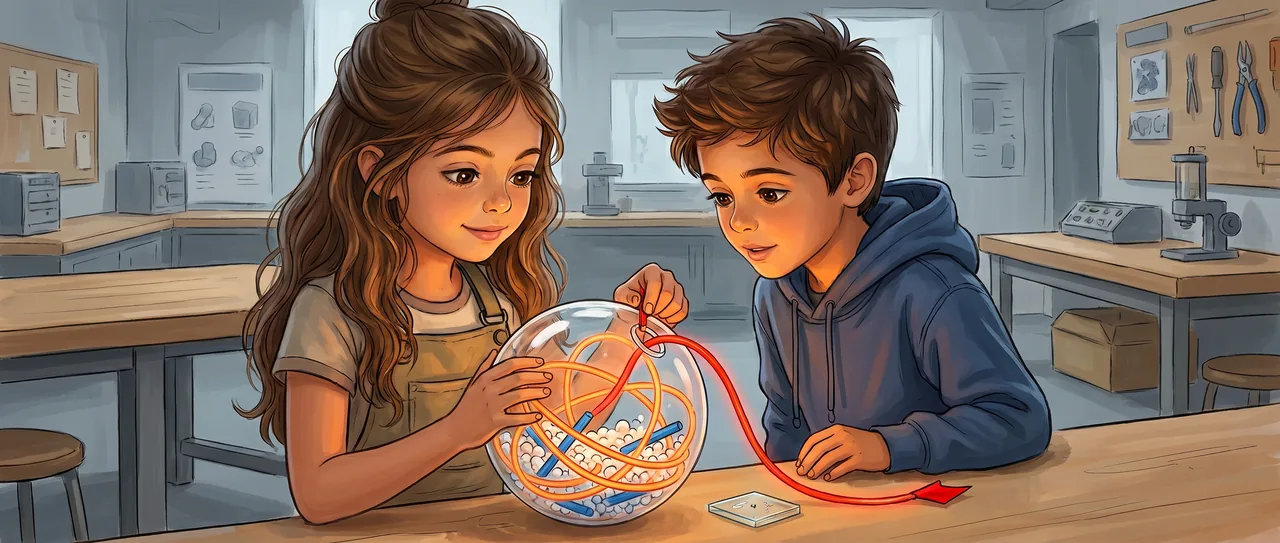
More Than It Looks Like
By nine forty-two, the nucleus had eaten the rope three times.
Not the real nucleus. The real nucleus was a circle etched on a glass chip, so small that the arrow beside it seemed to point at empty glass. The museum kept it under a magnifier with a label that said: ABOUT SIX MICROMETERS WIDE.
The rope was real enough. Two meters of orange glow-cord lay across the makerspace floor, longer than Maya, longer than Soren, longer than the table where the opening-day cookies waited under a silver lid.
Dr. Voss stood with a roll of tape between her teeth and a visitor badge stuck to her sleeve. She was the kind of adult who walked quickly even when standing still.
“Simple,” she said around the tape. “Children take the two-meter DNA cord. Children fit it in the nucleus box. Children gasp. Cameras happen.”
Soren looked into the clear plastic sphere on the table. It was already full of orange knots from their last try. The red flag tied near the middle of the cord had vanished somewhere inside.
“What is the red flag supposed to be?” he asked.
“A gene,” said Dr. Voss. “Any gene. A friendly gene. Please do not make me name it before coffee.”
Maya pressed her nose close to the plastic. “It’s gone.”
“That is the point,” said Dr. Voss. “Packed.”
“No,” Maya said. “Lost.”
Dr. Voss pulled the tape from her mouth. “The donors arrive in eighteen minutes. I need this exhibit to say one amazing thing. Two meters. Six micrometers. Fits.”
Soren tugged the end of the cord. The knot inside tightened. The red flag did not appear.
“If the cell did it this way,” he said, “it could never use the gene.”
Dr. Voss opened her mouth, then a speaker in the ceiling squealed. Somewhere in the hall, a recorded voice began saying, “Welcome to the future of hehhhhhhhhh.”
Dr. Voss closed her mouth.
“Do not set anything on fire,” she said, and ran out.
Maya emptied the sphere. The cord spilled onto the table in a soft, glowing heap.
Soren smoothed one length with his palm. “A human cell has about two meters of DNA if you stretched it out.”
“I know.”
“And the nucleus is about six micrometers.”
“I know that too.”
“The problem is not the numbers.”
Maya picked up the red flag and let it dangle. “The problem is the stuffing.”
On a tray beside the sphere were pieces left over from other exhibits: white foam beads, tiny clips, clear rings, magnetic dots, and bendy blue rods. Museum pieces always looked like they were waiting to become something else.
Maya took a foam bead and wound the cord around it.
Soren leaned closer. “Not too many turns.”
“How many?”
“In cells, DNA wraps around histone proteins. Less than two turns around each group.” He caught the cord before it crossed itself. “Not knots. Spools.”
Maya wound it less than twice and passed the bead to him.
Soren clipped it gently so it would hold but still slip if pulled. Then he tried another bead. The cord shortened. Not by being cut. By curling around something.
Maya’s fingers moved faster. Bead, wrap, pass. Bead, wrap, pass. The long orange line became a chain of small bright bundles.
Soren laid the chain in loose loops across the table. “It still needs folding.”
Maya grabbed the bendy blue rods and bent them into a frame inside the clear sphere. “Loops attach here.”
“Not all in one place,” Soren said.
“I know.” Maya clipped a loop to one side, then another to the opposite side. “Neighborhoods.”
Soren looked at her.
“What?” she said.
“That might actually be a word scientists use. Chromosomes have territories.”
“Good. The rope likes it.”
They worked without talking for a while. Outside the room, adults tested microphones and footsteps clicked past the door. Inside, the orange cord became smaller and stranger. It no longer looked like something defeated. It looked like something arranged.
Maya left the red flag near a clear window in the sphere.
Soren pulled the flagged section. It slid forward, a small bright tongue of cord. The rest stayed folded.
He pushed it back. Pulled again. It came forward again.
Maya grinned. “Not lost.”
“Available,” Soren said.
Dr. Voss burst back in carrying a screwdriver and half a cookie.
“The future is speaking normally again,” she said. “Please tell me the nucleus is friendly.”
Maya held up the sphere.
Inside it, the orange cord wound around white beads, looped through blue supports, and curved back on itself in layers. The red flag rested at the window like it was waiting for a hand.
Dr. Voss squinted. “It is beautiful. Is it too complicated?”
“Yes,” Maya said.
“No,” Soren said at the same time.
Dr. Voss looked from one to the other.
Maya said, “Cells are complicated.”
Soren said, “But the visitor only has to do this.”
He tugged the red flag. The marked section slipped outward. Nothing tangled. Nothing tore. The cord was packed, but not gone.
Dr. Voss slowly put down the cookie.
“Oh,” she said.
That was when the museum lights dimmed for the first show.
The wall screen woke up behind them. It showed the glass chip under the magnifier. At first there was only gray, then the etched circle swelled into view, pale and round on the screen.
Dr. Voss tapped the label beneath the chip. “Actual size is still the speck on the glass. The screen is just making it visible.”
Maya looked at the speck. Then at the two-meter cord inside the sphere. Then at her own hand resting on the table.
The skin across her knuckles was not smooth anymore. It was crowded with rooms too small to see, and in almost every room, a line longer than she was tall had been folded without being lost.
Soren had gone very still.
Maya knew that stillness. It was how Soren looked when the inside of his head had run out of shelves.
He reached for his paper notebook, then stopped with his fingers on the cover. Instead he picked up the old exhibit sign. It said: CRAM THE DNA IN!
“No,” he said.
He turned the sign over. Maya found a marker in the cup by the printer.
Soren wrote slowly, because he always wrote like the words deserved time.
MORE THAN IT LOOKS LIKE.
The first visitors gathered outside the glass door. Dr. Voss glanced at the clock, then at the sign, then at the sphere.
“Fine,” she said. “But if anyone asks about histones, you two are standing here.”
Maya slid the old sign into its holder. Soren set the glass chip beside the sphere, with its almost invisible etched circle facing up.
The doors opened.
Maya touched the red flag, and a short red-marked section of the two-meter cord slid loose from the packed clear sphere.
Read the interactive version, listen to the narration, and earn a gold star →
A science-verified short story for curious kids · Curiosity Land