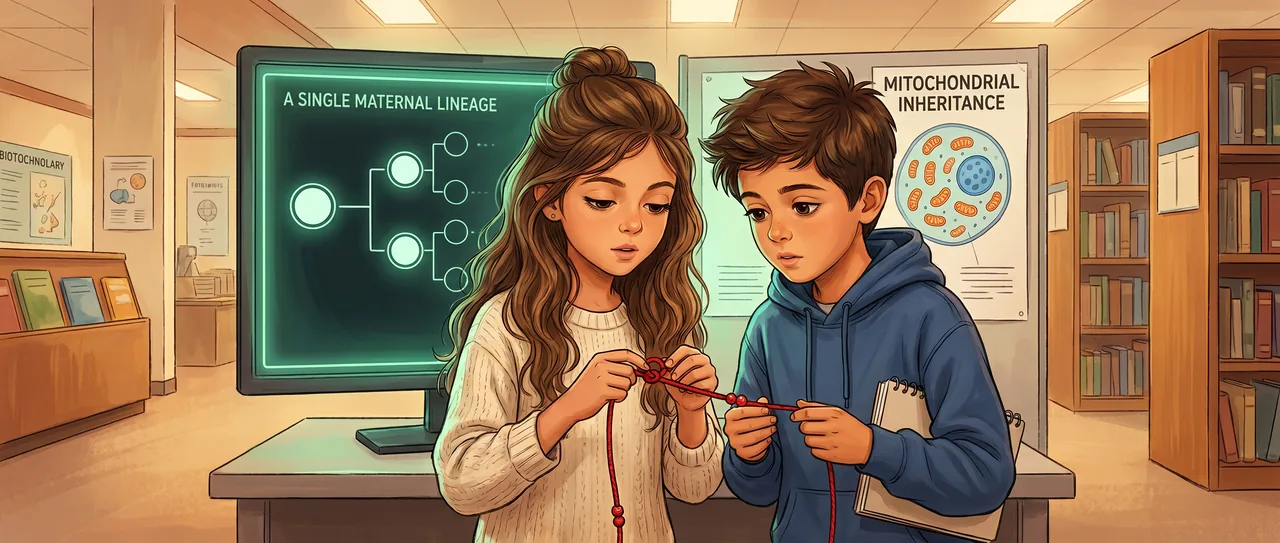
The Thirty-Seven Small Doors
The machine refused to draw Soren’s family.
It made a soft, polite sound, the kind a door might make if it were embarrassed. On the screen, Soren’s name sat in a green circle. His mother’s sample glowed green too. The line between them brightened. Then the line to his father blinked gray and vanished.
Maya leaned over the folding table. "Do it again."
"I did it three times," Soren said.
"That isn't a reason."
"It is exactly a reason." But he pressed run.
Around them, the public library had become a tiny biotechnology fair. There were pipettes where the chess tables usually went. A poster showed a cheek cell so large it looked like a moon. The outreach engineer had named the exhibit Your Family Tree Inside One Cell, and she had said it would show how DNA connected everybody to everybody.
Now the exhibit was not connecting fathers to anybody.
The engineer hurried over with two cables in one hand and a paper cup of tea in the other. She had pink safety glasses pushed into her hair.
"That screen is being dramatic," she said. "The main stage demo starts in ten minutes. Please do not make it more dramatic."
"It's dropping all the father lines," Soren said.
"Bad import file," the engineer said. "Or bad children. Very common in libraries."
Maya did not smile. She tapped the gray place where the line had been. "What kind of DNA is it using?"
"The friendly kind," the engineer said. "Small, quick to read, lots of copies in a cheek swab. Mitochondrial. We use a little piece as a teaching sample, not the whole private genome."
She reached for the keyboard.
Soren moved his notebook over the keys. He did not slam it. He placed it exactly where her hand wanted to go.
The engineer stared at it. "That is paper."
"Yes," Soren said.
"On my keyboard."
"Also yes."
Maya pointed at the poster of the cheek cell. The nucleus was a big blue planet in the middle. Around it floated hundreds of orange beans.
"Those are mitochondria," Maya said. "The orange things."
"Powerhouses," the engineer said quickly.
"Not just powerhouses," Soren said. He flipped through his notebook to the page he had filled during the introduction, because the inside of his head had already been too small by then. "You said they have their own DNA."
"Thirty-seven genes," the engineer said. "Very small compared with the chromosomes in the nucleus."
The gray father line blinked again, waiting to be blamed.
Maya bent close to the poster. "Own DNA. Separate."
"Anciently separate," the engineer said, already looking toward the stage, where a microphone squealed. "Very wonderful. Very not useful while my exhibit is broken."
Soren wrote the word separate and underlined it once. "If the mitochondria have their own genome, and the exhibit is using mitochondrial DNA, why would it draw the same tree as nuclear DNA?"
The engineer opened her mouth.
Maya got there first. "It shouldn't."
The room noise kept going. Children pumped pipettes. Someone laughed near the robot arm. A printer clicked out labels. But in front of the screen, the family tree had gone very still.
Maya touched her own cheek with the tip of her tongue, as if she could feel the cells there. A whole crowd of tiny orange parts lived in each one, each carrying a little set of instructions that was not the blue planet in the middle. Not a side note. Not a mistake. A second thread, folded inside the first.
"What if the gray lines are not missing?" she said.
Soren looked at the sample table. There were six practice records, each with a child, a mother, and a father. He pulled the laminated consent cards closer. "The mitochondrial sequence matched the child to the mother."
"Only the mother?"
"Let's test instead of admiring ourselves."
Maya grinned. "Good."
The engineer made a helpless sound. "Eight minutes."
"Then stop deleting the evidence," Maya said.
Soren opened the comparison panel. The software showed letters in rows, A, C, G, and T, marching across the screen. Most positions were the same. A few had colored boxes. Child and mother matched in every colored place. Child and father did not.
"Maybe these are all just cases where the fathers don't match," the engineer said.
"Six times?" Soren asked.
"Library families are complicated."
Maya was already sorting the records. She did not sort them by last name. She sorted them by the mitochondrial letters, sliding cards into little stacks.
"Here," she said. "These two children have the same mitochondrial pattern. Different fathers. Same mother?"
Soren checked. "No. Their mothers are sisters."
Maya set those cards together.
Soren's pencil moved down the page. Child to mother. Mother to her mother. Sisters share. Father not in this line.
The engineer stopped holding the cables in a useful way. Tea tilted dangerously in the cup.
Soren said, "It is not a family tree. It is one branch."
"Not branch," Maya said. "Branches split both ways. This is a river."
The engineer whispered something that sounded like a word she should not say in a library. Then she looked at the big banner that said Your Family Tree Inside One Cell.
"It was such a good banner," she said.
"It was the wrong banner," Maya said.
"That is not comforting."
Soren took the dry erase marker and drew on the blank back of a poster. He made a circle for a child, then a line to a mother, then to a grandmother, then to a great-grandmother, the line narrowing as it went back because the poster was too small for the past.
Maya added tiny orange dots beside each circle.
"Where does the father go?" the engineer asked.
"For this DNA?" Soren said. "He doesn't."
Maya put the cap on the marker with a click. "He goes in the other exhibit."
The engineer looked at the clock.
"Can you fix it?" she asked.
It was not a question for herself. That made it better.
Soren turned the laptop so the settings panel faced them both. He liked settings panels. They were places where machines admitted what they had been told to believe.
The program had boxes labeled Parent One and Parent Two. Under DNA type, it said mitochondrial. Under Display, it said standard family tree. Under Missing Parent Alert, it said on.
"There," Maya said. "It thinks the father line is missing."
"Because someone told it two parents had to be present for every DNA path," Soren said.
The engineer shut her eyes. "Someone did."
Maya changed Display to single-line inheritance. Soren hesitated over Missing Parent Alert.
"Off?" Maya asked.
"No." He clicked the label and typed a new name: Outside this path.
The screen redrew.
The gray vanished. Not like a failure. Like fog lifting. Soren's green circle connected to his mother, then to her mother, and then to an empty place labeled earlier mother-line sample unavailable. The practice records curled into six glowing paths. Some joined at sisters. Some ran alone to the edge of the screen.
The engineer set down her tea without drinking it. "Oh."
The main stage microphone squealed again.
The engineer grabbed the old banner, flipped it, and handed Maya the thick marker. "New title. Huge letters. No poetry. Children can smell poetry when adults panic."
Maya wrote, The DNA That Comes Through Mothers.
Soren added, Thirty-seven genes. Many copies. One line.
Maya looked at the second sentence. "Too many words."
"It is already few."
"Children can smell few words when Soren panics."
He crossed out Many copies, then put it back smaller underneath.
The engineer laughed once, sharp and relieved, and carried the poster to the stage. She did not explain it for them. She only said into the microphone, "Our exhibit has changed shape because two people found out it was asking the wrong question."
Maya and Soren stood beside the screen while visitors gathered.
A small child swabbed her cheek and dropped the tip into a tube. The portable reader hummed. A line appeared from her circle to her mother's circle. The child's father stood right there with a backpack full of snacks, and when his line did not appear, he frowned for half a second.
Then the child pointed at the screen and said, "So this one is not about you."
"Apparently not," he said.
"It is about Grandma's grandma's grandma?"
"And farther," Soren said.
"How far?"
Maya looked at the edge of the display, where the line ran out of room.
The engineer, who had heard the question, started to answer. Then she pressed her lips together and went to untangle a cable.
Soren said, "As far as there have been mothers."
The little child stared at the glowing line.
Maya stared too.
The library ceiling was still the library ceiling, with square lights and a water stain shaped like a rabbit. The carpet still had flattened gum under one table. But the screen had made a narrow path through all of it, through cheeks and cells and orange folded things, through people whose names were gone, through bodies that had carried bodies that had carried bodies.
Soren touched the paper in his pocket, then left it there.
The little child asked, "Is it the same in boys?"
"Yes," Maya said. "They get it from their mothers too. They just do not pass it on."
The child's father bent toward the screen. "So my cells are full of my mother's mitochondria?"
"Your cheek cells are," Soren said. "Almost all your cells have them."
The father stood very still. Then he took out his phone, not to answer it, but to take a picture of the line.
More visitors came. The exhibit did not draw the whole of anyone. It drew one small, stubborn part. The part that did not mix half and half. The part that kept its own tiny genome while the huge library of chromosomes shuffled and paired and reshuffled.
Maya watched people change their stance in front of it. They came expecting a tree with everyone arranged neatly. They left carrying a line that did not care about last names.
At the bottom of the screen, a new button pulsed. Print wall path.
Soren clicked it.
The printer began coughing out strips of red paper, one after another, each printed with circles and names and then, where records ended, blank circles. Maya taped the strips along the exhibit wall. Soren matched the ends. The paths did not stop where the data stopped. They simply ran out of paper.
"Blank circles are honest," Soren said.
"They look hungry," Maya said.
"They are not a mouth."
"They are kind of a mouth."
"Fine. A scientifically cautious mouth."
The engineer brought over a roll of red cord from the craft table. "The printer is out of paper," she said. "The craft table is not."
Maya tied cord to the last printed circle. Soren held the knot flat with his thumb while she pulled it tight. The cord led from the printed mother-line into nothing labeled at all.
The engineer looked down the hallway toward the children's room. "We are not taping things to the emergency exit."
"We won't," Maya said.
She walked to the edge of the exhibit wall. There was a narrow gap between the display case and the corner, just wide enough for cord.
Soren fed her the roll.
Maya lifted the loose red cord, slipped it through the gap beside the display case, and let it run into the dark hallway.
Read the interactive version, listen to the narration, and earn a gold star →
A science-verified short story for curious kids · Curiosity Land