The Square That Would Not Shrink
The dragon fit in twelve words.
That was what made Maya angry.
It was not even a small dragon. It uncurled across the whole coding dome, green scales flashing, wings beating in neat triangles of light. Its tail wrapped around the moon painted on the ceiling. Everybody clapped because everybody had to lean back to see all of it.
On the screen below the dragon, the dome printed the program that made it.
Repeat scale pattern. Bend spine. Mirror wing. Change green by row. Loop.
Twelve words, if you counted kindly.
Maya crossed her arms. "That is cheating."
Soren looked up from the little paper notebook balanced on his knee. Nobody else had paper. The dome had wrist screens, wall screens, table screens, and one hovering screen that kept drifting into people’s hair. Soren had paper.
"It follows the rules," he said.
"It is too big for twelve words."
"That is the point."
Their own entry sat on the launch pad, refusing to become anything.
It was a square of black and white pixels, no bigger than a lunch tray, blinking in the middle of the ceiling like a piece of broken television. Maya had made it by tapping black, white, black, black, white, white, and whatever came next before she could guess it. Soren had checked that she was not making stripes by accident. Then he had run the dome’s compressor.
The compressor had coughed.
Not really. Computers did not cough. This one made a sound like a polite throat clearing and printed: compressed size larger than original.
Ms. Vale hurried past with a coil of glowing cable over one shoulder. Her silver boots clicked fast, as if the floor were late for something.
"Your square is still too heavy," she said. "Make it smaller before final launch. Big show in seven minutes."
"It is already small," Maya said.
"Small on the ceiling," Ms. Vale said. "Heavy in the message. Different problem. Try finding the pattern. Everything has a trick if you look hard enough."
She vanished behind the projector stack, where something was beeping in a way that made adults speak in short sentences.
Maya stared at their square. "Everything does not have a trick."
Soren wrote down the compressor’s complaint. Then he drew three boxes.
In the first box he wrote: white forever.
He sent it to the test strip. A white ribbon raced around the dome, bright as noon.
"Tiny program," he said.
In the second box he wrote: black white black white, keep going.
The test strip became a perfect checkerboard road.
"Also tiny," Maya said. "Annoyingly tiny."
In the third box Soren copied the first row of their square. Black, white, black, black, white, white, black, white, white, white, black. He stopped when his pencil reached the edge of the page.
"Keep going," Maya said.
"That is the problem. I have to."
On the other side of the dome, a boy named Theo launched a galaxy. It spun open, arms glittering with stars. The whole room went blue and silver. The program below it said: draw spiral, sprinkle stars, fade outward.
Maya made a sound like a zipper getting stuck.
"That galaxy is basically a bracelet," she said. "Ours is the monster."
Soren tapped the pencil against his teeth. "The dome is not measuring how hard it looks. It is measuring how short the recipe can be."
"Then the dragon is simple."
"For the dome, yes."
"And our square is complicated."
Soren looked at the lunch-tray patch of static above them. "Unless there is a recipe we missed."
Maya leaned over his notebook. "There is not."
"We do not know that."
"I know the shape of it. No repeats. No mirror. No rows doing secret row things."
"That is not proof."
"I did not say proof. I said shape."
Soren accepted this. Maya’s shapes were often early versions of proofs that had not grown bones yet.
He opened the dome’s helper and typed: shortest program for an object.
A neat paragraph appeared, which was the kind of paragraph that wanted to be helpful and instead became furniture.
Soren read silently. His eyebrows moved once.
"What?" Maya asked.
"There is a name. Kolmogorov complexity. The complexity of a thing is the length of the shortest computer program that makes it."
Maya pointed at the dragon with her chin. "Short."
"Yes."
"Our square."
"Long. Maybe as long as itself."
The dome lights shifted. For a moment the dragon, the galaxy, the checkerboard road, and their stubborn little square all shone together.
The square looked smaller than everything.
It also looked like the only thing the dome had to carry in its hands, piece by piece, with no basket and no shortcut.
Maya uncrossed her arms.
"People are going to laugh," Soren said.
"They already did."
"They thought it was broken."
"It is not broken. It is expensive."
Soren smiled at that, quick and sideways.
Ms. Vale reappeared, now with a screwdriver clipped behind one ear and a smudge of blue dust across her cheek. "Four minutes. Did you find your trick?"
"No," Maya said.
Ms. Vale winced. "That is not usually the proud answer."
"We found the not-trick," Soren said.
He turned the screen so she could see. On it were three entries: the white ribbon, the checkerboard, and their square. Beside each one the dome had printed message size. The ribbon was almost nothing. The checkerboard was almost nothing. The square filled the limit nearly to the top.
Ms. Vale bent closer. "Random static is not a very dramatic ceiling."
"It is not trying to be dramatic," Maya said.
"The festival is called Impossible Big."
"Then everyone else made big," Maya said. "We made impossible small."
Ms. Vale opened her mouth. The beeping projector beeped again, but she did not turn around this time.
Soren said, "If a pattern can be described by a little program, it is not complex this way. It can look huge and still have a short description. But if the bits have no shorter program, the only way to send them is to send them."
"We cannot prove no shorter program exists," Maya said, before Ms. Vale could say it. "But your compressor could not find one. Neither could we. And if somebody does, they should get our spot."
Ms. Vale looked from Maya to Soren, then up at the square.
"The judges expect spectacle," she said.
"Good," Maya said. "They will be looking in the wrong direction."
That made Ms. Vale laugh once, not like a teacher laugh, but like a person who had dropped a cup and decided the crash was music.
"One minute," she said. "You choose your own launch."
The dome darkened.
Children pressed close to the rail. Parents lifted phones. The ceiling became black glass.
Theo’s galaxy went first, and the room filled with gasps. A forest grew from six instructions. A whale made of blue dots swam through a hoop of stars. Someone launched a city that built itself street by street, window by window, from a program shorter than a grocery list.
Each time, the dome announced the compressed message size in a cheerful voice.
Tiny.
Tiny.
Tiny.
Maya stood with one finger above the launch key.
Soren did not tell her when to press it. He had the notebook closed in both hands.
The whale faded. The ceiling waited.
Maya pressed the key.
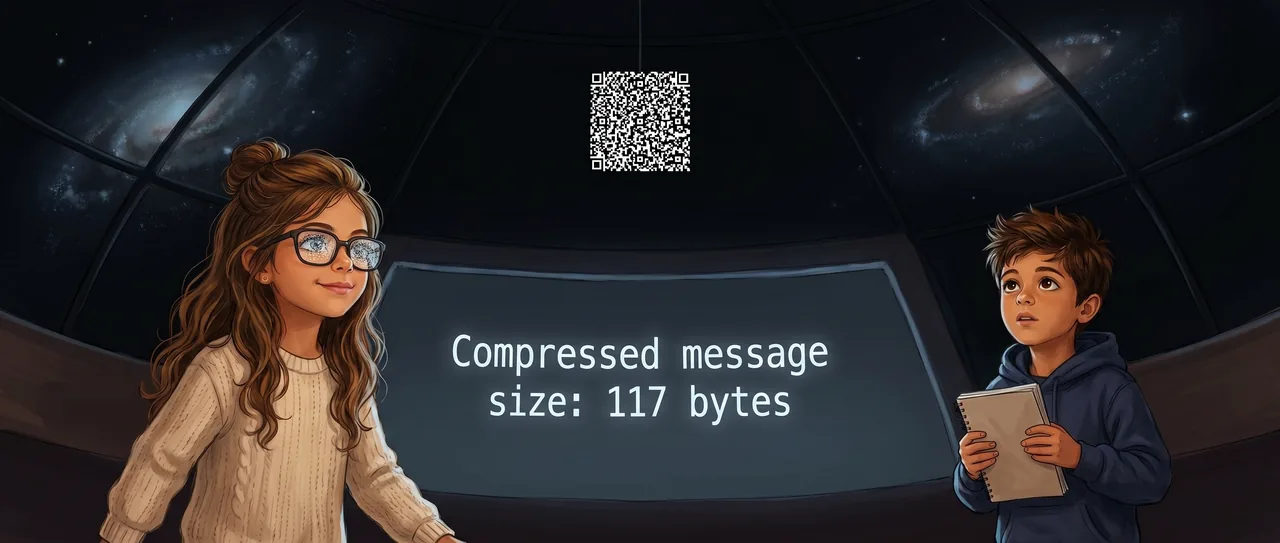
Their square appeared alone.
No wings. No spiral arms. No glittering forest. Just black and white pieces, packed tight, each one refusing to stand in for another.
A few people laughed, then stopped when the dome voice spoke.
Compressed message size: one hundred seventeen bytes.
The largest number of the night hung under the smallest thing in the sky.
The square did not spread. It did not become a dragon. It did not apologize.
Maya stepped closer until the tiny black-and-white squares filled both lenses of her glasses.
Read the interactive version, listen to the narration, and earn a gold star →
A science-verified short story for curious kids · Curiosity Land