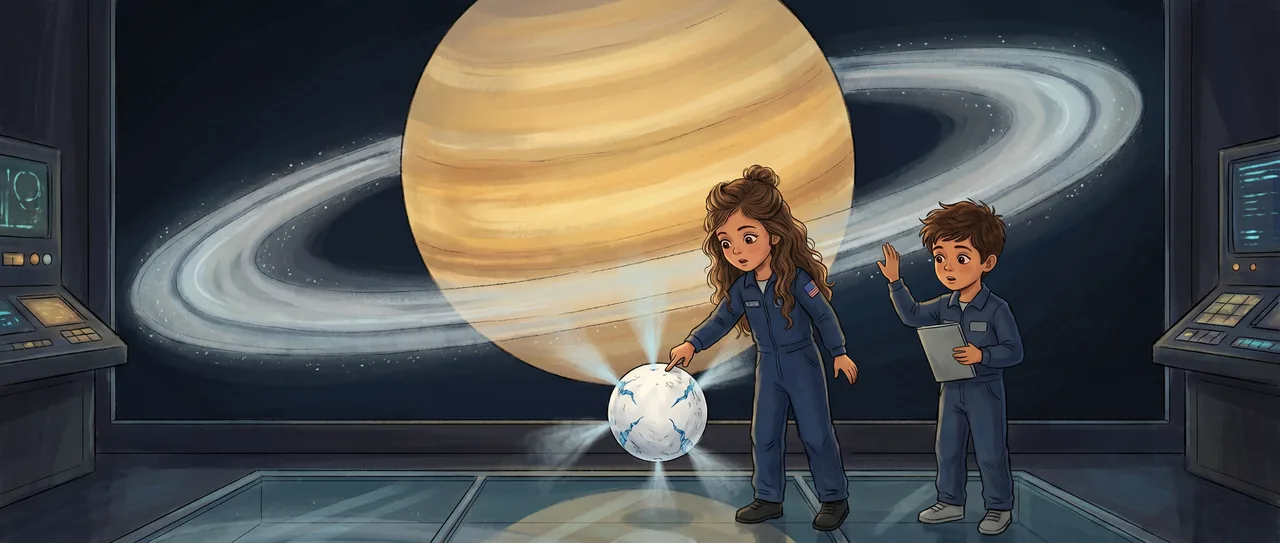
The Ring That Would Not Stay
Maya stood inside Saturn's E ring before breakfast.
It was supposed to be a rehearsal. The visitors from the Mars schools would arrive after lunch, and the projection room had to make Saturn's rings behave. But the outer ring kept fading away.
Not dramatically. Not with sparks or alarms. It simply thinned until Saturn floated in the middle of the room wearing its bright flat rings and one missing ghost.
Soren sat cross-legged on the glass floor with his paper notebook open on his knee. Nobody used paper on Kronos Station except Soren. The station printers made it from algae pulp in thin gray sheets, and Soren treated every page like it had crossed space by itself.
'Run it again,' he said.
Maya flicked two fingers through the air. Saturn rebuilt itself around them. Gold ball. Black shadow. Rings like cut glass. Far out from the bright rings, the E ring appeared as a pale fog so wide it almost touched the walls.
Then it began to vanish.
Maya walked through the fading light. The ring particles slid over her arms and knees like cold dust, though there was nothing to feel. Projection only. Still, she held her breath when the last glimmer passed through her chest.
'It's not a brightness problem,' she said.
From the doorway, Dr. Kade said, 'It is almost always a brightness problem.'
He had a tool strap over one shoulder and a cup of coffee sealed to his wrist with a magnet. His hair stuck up on one side. He was responsible for docking clamps, visitor oxygen allotments, and the ring show, in that order. The ring show was losing.
'Increase opacity by twelve percent,' he said. 'Children like visible things.'
'If we make it brighter, it still disappears,' Soren said.
Dr. Kade squinted at the empty place where the E ring had been. 'Then increase particle count.'
'That makes more disappearing,' Maya said.
Dr. Kade looked at her, then at his coffee, as if hoping one of them would become easier. A chime sounded from his tool strap.
'Docking clamp six is sulking,' he said. 'Do not break Saturn.'
He left at a jog.
Soren wrote three words, more disappearing particles.
Maya crouched beside him. 'What if the ring is hungry?'
Soren did not look up. 'Rings do not eat.'
'This one does something like eating. It needs more. From somewhere.'
Soren tapped the simulation controls. The room showed labels for Saturn's moons. Titan was huge and orange. Rhea, Dione, Tethys, Iapetus, all tidy dots. Enceladus was so small the label looked embarrassed.
The station guide notes sorted the moons by visitor interest. Titan had six pages. Enceladus had two lines and a pronunciation button.
Maya pointed. 'There.'
Soren zoomed. Enceladus swelled from a dot to a white ball with cracks near the bottom. Its south pole had four long blue scratches.
'Tiger stripes,' Soren said. 'Not actual tigers.'
'I know.'
'Water vapor and ice come out there.'
'I know that too.' Maya leaned closer until Enceladus filled the room and Saturn vanished. 'But I knew it like a fact on a wall. I did not know it like this.'
She pinched the air and turned the moon. The south pole faced up. From the cracks, the archived plume data rose in thin white fans.
Soren's pencil stopped moving.
The fans did not look like much. A few pale sprays from a moon about five hundred kilometers wide. Smaller than many countries. Small enough that the visitor script called it minor.
Maya backed the simulation away from the moon.
The sprays stretched.
Farther.
Farther.
The white grains spread along Enceladus's path, looped around Saturn, and became a ghost ring so wide the walls could not hold it. The room dimmed to make space for it. Saturn hung in the center, enormous and banded, and the little moon kept throwing brightness into the dark.
Soren said, very quietly, 'Oh.'
Maya did not answer. The running list in her head went still, as if every strange thing had turned to look at the same tiny place.
Soren flipped to a clean page. Then he stopped and shut the notebook.
'No,' he said. 'Not yet.'
He stood and opened the simulator's source map. The map showed where particles entered the model. There were entries for ancient ring debris, micrometeoroid dust, background ice.
No Enceladus.
Maya made a sharp sound. 'They left out the moon.'
'They left out the part that keeps happening,' Soren said.
He dragged a new source marker onto Enceladus's south pole.
The simulator flashed red. Source incomplete.
Maya read the fields aloud. 'Direction. Speed. Grain size. Composition.'
'We have the archive,' Soren said.
The archive opened like a drawer in the air. Cassini. Old mission. Old enough that the spacecraft had ended before Maya and Soren were born, but its measurements still sat in the station memory, patient as seeds.
Maya pulled plume images into the model. Soren matched the spray direction to the tiger stripes. Maya added water vapor. Soren added ice grains. Maya found salty particles in the archive and slid them in with two fingers.
A second warning appeared. Organic molecules detected in plume archive. Display category?
Soren looked at Maya.
'Not aliens,' she said.
'Not proof of life,' he said.
They both waited, because the words on the screen felt too small for the thing under them.
Beneath Enceladus's ice was an ocean. Not a pretend ocean. Not blue on a poster. Liquid water hidden under a frozen shell, pressed around a rocky heart, sending pieces of itself into space through cracks at the south pole. The plume was not just spray. It was a message thrown upward by a dark sea.
Maya touched the display category and chose Ocean Material.
The warning vanished.
The ring began again.
This time the E ring did not fade. It breathed outward from Enceladus grain by grain, a pale path made by a small moon that would not stay sealed.
At the far end of the room, the doors opened. Dr. Kade came in with a new tool mark on his sleeve and half his coffee missing.
'I have saved clamp six,' he said. 'Have you saved Saturn?'
Soren ran the old version. The E ring appeared and vanished.
Maya ran their version.
Enceladus crossed the room like a bead of ice. The plumes rose. The ring filled around Saturn and stayed.
Dr. Kade took one step into the projection and stopped with his boot inside the ghostly ring.
'I thought that source was already in the model,' he said.
'It was in the notes,' Soren said.
'Not in the universe,' Maya said.
Dr. Kade opened his mouth. Closed it. Then he laughed once, not because something was funny, but because something had become too large for the first sound he chose.
'I have been telling visitors Saturn has rings for twenty years,' he said. 'I forgot one of them is being made right now.'
A station chime sounded overhead.
Visitor group approaching. Ring room ready status required.
Dr. Kade looked at the door, then at the children, then at the moon pouring itself into space.
'Ready?' he asked.
Soren glanced at Maya. 'Almost.'
He opened one more panel. It was not part of the visitor show. It was a live feed from the plume watch telescope on the station's outer spine. The telescope could not see through Enceladus's ice. Nothing on Kronos Station could. It could only watch the south pole when sunlight caught the spray.
The feed showed Enceladus as a bright crescent, small against black. At the bottom edge, faint jets rose like white threads.
Beside the image, a schedule blinked.
Plume watch window opens in nine minutes.
Dr. Kade said, 'That feed is usually too quiet for visitors.'
Maya said, 'Good.'
The first visiting students pressed their faces to the glass doors. Some were taller than Maya. Some wore Mars-red school bands.
Dr. Kade lifted his hand to begin the usual welcome about the famous rings of Saturn.
Maya was already at the controls.
Soren set the simulation clock to now.
The doors slid open. The visitors stepped into Saturn's shadow, whispering.
Titan glowed orange in the distance. The bright rings shone like blades. But the room's light gathered around a little white moon near the floor.
The hooded boy looked up.
Maya set two fingers on Enceladus's south pole. Soren slid the plume layer higher. On the screen, the first white grains struck the detector map and blinked one by one.
Read the interactive version, listen to the narration, and earn a gold star →
A science-verified short story for curious kids · Curiosity Land