The Quiet Between Questions
The possible alien signal arrived during the microphone check.
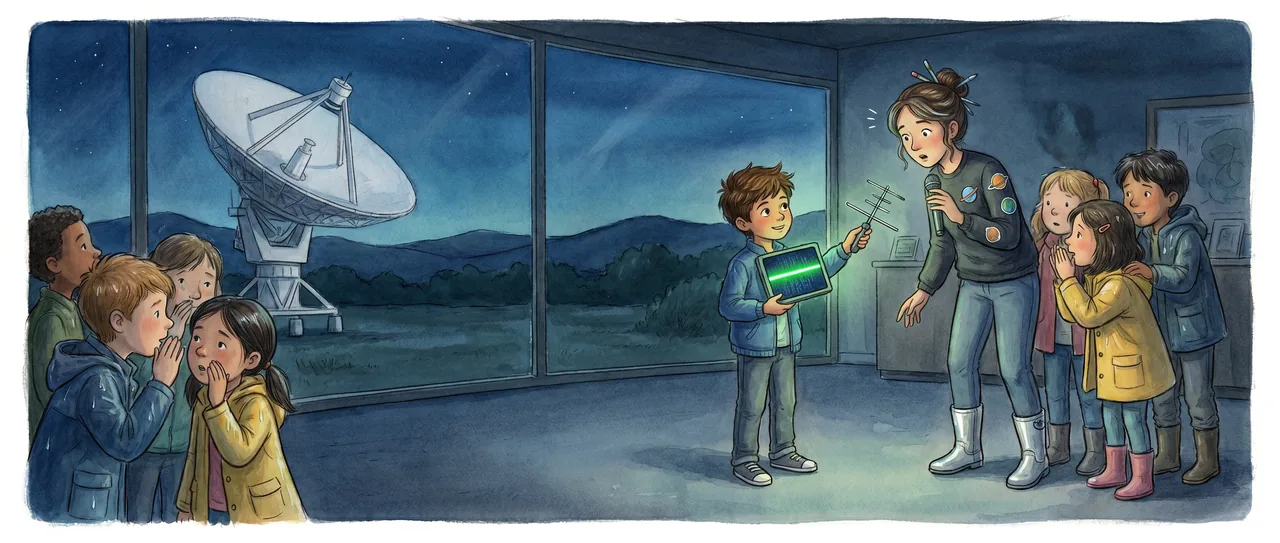
It was a bright green knife on the waterfall screen, straight as a ruler, dropping through the black-and-blue fuzz that came from the training receiver. The receiver sat on a rolling cart in the visitor center, pointed through the glass wall toward the dark hills and the enormous white radio dish beyond them.
The outreach director was on the stage with a wireless microphone in one hand and a stack of planet stickers in the other. She had silver boots, three pens in her hair, and the brisk expression of a person who had misplaced both a laser pointer and her patience.
"Testing," she said. "Testing, one, two. Soren, does the space noise look spacey enough?"
The green line flashed brighter.
Soren leaned closer to the screen.
"It looks too straight," he said.
"Straight is good," the outreach director said. "Straight looks scientific. We open doors in seven minutes."
Soren did not answer. The line had edges. Natural things on the screen smeared and wandered. The bright band near the bottom was the observatory's own calibration signal. The fuzzy arch at the top was from a satellite passing somewhere it was allowed to pass. But this line held still, thin and sharp, the way a person holds a pencil against paper.
He wrote three words in his notebook, not because anyone had asked, but because the inside of his head had become crowded.
Green line. Still.
The youth night was called Where Is Everybody? The title hung in blue paper letters over the stage. Under it were photographs of galaxies, exoplanet shadows crossing their stars, and an old black-and-white picture of Enrico Fermi, who had once asked why, if the galaxy was so big and so old, no one had shown up.
Soren had known the question before he came. The Milky Way had hundreds of billions of stars. Many stars had planets. The universe was much older than people. Radio waves crossed space at light speed. Telescopes had listened. No confirmed alien message had ever been found.
He had known all of that in the flat way a person knows the names of oceans on a map.
The director tapped the microphone with one finger.
On the screen, the green line stabbed brighter three times.
Soren looked at the microphone. He looked at the waterfall. He looked at the clock above the exit.
Six minutes.
"Please don't tap that," he said.
"Why?"
"It answers."
The director froze with the microphone near her mouth.
"The aliens?"
"The cart."
She stared at the screen. The green line glowed beautifully. Too beautifully.
"Oh," she said. "That is a shame. It would have been a very convenient alien."
Then the front doors opened and thirty children poured in with damp jackets, loud shoes, and the kind of questions that arrived before the rest of them.
The director's face changed into her public face.
"Welcome, sky listeners," she said into the microphone.
The green line brightened.
Soren's fingers curled around the edge of the cart.
The first part went exactly wrong.
The director told everyone that radio telescopes did not take pictures like ordinary cameras. They caught waves too long for eyes. She pointed through the window to the giant dish, pale in the last blue of evening, and said it could hear whispers from clouds of hydrogen between the stars.
Then she waved at Soren.
"Our assistant tonight will show you what the sky sounds like."
Soren was not an assistant. He was eleven, which in some rooms meant smaller than the equipment and in other rooms meant available for carrying cables. He pushed the cart forward anyway.
The screen faced the audience. The receiver hissed through the speakers.
A child in the front row raised a hand.
"Is that aliens?"
"No," Soren said.
The director laughed. "Probably not."
"No," Soren said again.
The room went a little quiet, which was different from silent. Jackets rustled. Sneakers squeaked. Air moved in the vents. The receiver hissed. The green line held its place.
Soren lifted the small antenna from its stand and turned it toward the stage.
The line brightened.
He turned it toward the glass wall and the big dish outside.
The line faded but did not vanish.
He turned it toward the director's hand.
The line burned green.
A murmur moved through the children.
The director lowered the microphone. "My microphone is pretending to be a civilization."
"It is very committed," Soren said.
This time the children laughed in the way people laugh when something has become stranger, not smaller.
Soren took the microphone gently from the director and carried it to the metal cabinet where spare cables were kept. He opened the door, placed the microphone inside, and closed it.
The green line vanished.
The screen was not empty. It crawled with speckles and slopes and dim patches. The speakers hissed softly, like rain on leaves far away.
Soren stood beside the cart with his hand still on the cabinet handle.
The director looked from the screen to the audience.
"That," she said, "is why the observatory asks people not to bring phones near the telescopes. We are extremely good at hearing ourselves."
Soren rolled the cart to the center of the stage. On the table were cards printed with possible answers to the Fermi question. The director had meant to let everyone vote for their favorite.
Life is rare.
Intelligence is rare.
Civilizations do not last long.
They are too far away.
They do not use radio.
We are listening at the wrong time.
We are listening in the wrong way.
They choose not to be heard.
There were more cards than Soren expected. They covered the table like fallen windows.
A boy near the aisle said, "Which one is right?"
The director opened her mouth.
Soren moved one card that had slipped under another. It said, We have barely begun to look.
He placed it at the front edge of the table.
"We don't know," he said.
No one laughed.
The director did not correct him. She had a pen behind one ear now and planet stickers stuck to her sleeve.
Soren picked up a roll of blue painter's tape and made a tiny square on the floor. Smaller than a dinner plate.
"Pretend the floor is the whole galaxy," he said.
The children looked at the carpet spreading under every chair, under the table, under the stage, under their shoes.
Soren pointed at the little taped square.
"This is not the real amount we have searched. It is just to make the problem fit in the room. The real comparison is worse."
A girl in a yellow coat crouched to see the square better.
"Worse how?" she asked.
Soren looked at the galaxy photographs on the walls. One showed the Milky Way as a river of stars too crowded to count. Another showed a field of galaxies, each one full of stars, the black spaces between them not empty at all.
The visitor center lights hummed. Outside, the dish moved so slowly that the motion was almost invisible.
"Worse like scooping one cup from the ocean," Soren said, "and not finding a fish, and having to decide what that means."
The girl stayed crouched.
"It means you need a bigger cup."
"Maybe," Soren said.
A smaller child behind her said, "Or maybe fish don't like cups."
"Maybe."
"Or that ocean."
"Maybe."
The room changed then. It did not get louder. It got wider. The taped square looked suddenly ridiculous and important at the same time.
The director sat down on the edge of the stage, as if her silver boots had run out of instructions.
Soren turned the receiver volume lower. The hiss became a thin breath.
"The paradox is not just that space is quiet," he said. "It is that there are too many possible reasons for quiet."
He stopped there. The cards did the rest.
The children came forward in a slow crowd. Nobody grabbed the stickers. Nobody voted. They bent over the answer cards and began placing them in new patterns.
The yellow-coated girl put We are listening at the wrong time beside Civilizations do not last long.
The boy from the aisle put They do not use radio beside We are listening in the wrong way.
A child with rain still shining on their hair picked up They choose not to be heard and held it without putting it down.
"If someone was quiet," the child said, "you couldn't tell from far away if they were gone or hiding or just talking different."
Soren nodded once.
The child placed the card by itself, a little apart from the others.
The director whispered, "We were supposed to end with everyone choosing an answer."
Soren looked at the table covered in unchosen answers.
"This is better," he said.
The director's smile was tired and crooked. "Yes. Annoyingly."
At the end, she gave out planet stickers anyway. Some children put them on their sleeves. Some stuck them to the answer cards. One sticker, a small blue planet with a silver ring, ended up on the card that said We have barely begun to look.
The receiver kept hissing.
Soren stepped onto the ramp. Across the dark service road, the great white dish tilted one careful degree, and the red listening light blinked against the railing.
Read the interactive version, listen to the narration, and earn a gold star →
A science-verified short story for curious kids · Curiosity Land