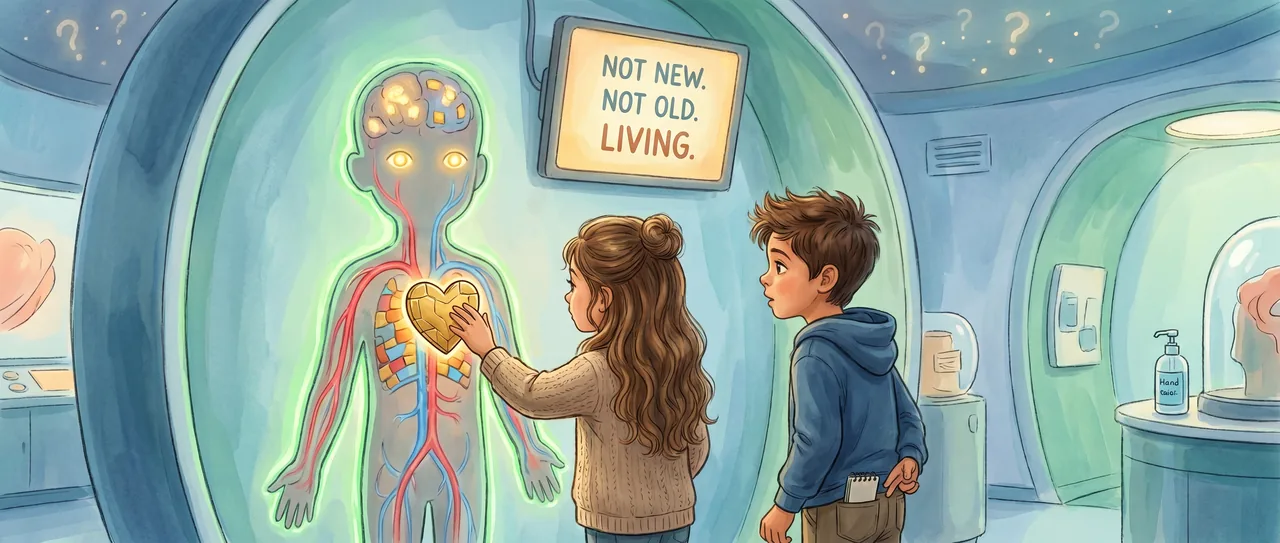
The Parts That Stayed
The sign over the exhibit said, EVERY SEVEN YEARS, YOU ARE NEW.
Maya stopped so suddenly that Soren bumped her shoulder.
“No,” she said.
The guide, who had been walking backward while talking into a tiny microphone, did not stop. “Mostly new,” she said. “That is what the next room is for. Please keep moving. The skin station only has room for one group at a time.”
Soren looked at the sign, then at Maya. “What made you say no?”
Maya pointed, not at the words, but at the glowing outline of a child on the wall. Different parts of the body blinked in different colors. Skin flashed green. Blood pulsed red. The liver gave a slow blue shimmer.
“The eyes aren’t blinking,” Maya said.
The guide smiled the smile of someone who had answered this before and was already late for lunch. “The exhibit simplifies. Bodies replace cells at different speeds. Skin is weeks. Red blood cells are about four months. Some gut lining cells are only days. The idea is, you are always being rebuilt.”
“That part is blinking,” Soren said, pointing to the stomach.
“Yes,” Maya said. “Not the eyes.”
The room was shaped like the inside of a giant body, if a giant body had polished floors and hand sanitizer at every door. Along one wall stood clear bins of colored tiles. Each tile had a cell name and an age printed on it.
BUILD AN ELEVEN-YEAR-OLD, said the screen.
Soren picked up a green tile. “Skin cell. Twenty-eight days.”
Maya picked up a red one. “Red blood cell. One hundred twenty days.”
“Hair cell, dead,” Soren read.
“Rude,” Maya said.
The guide clapped twice. “Fast challenge. Fill the outline with the ages of your cells. If the body agrees, it lights up.”
A group of younger kids rushed for the bins. They slapped green and red tiles everywhere. Their outline buzzed and flashed TRY AGAIN.
“Average it,” the guide called. “Do not get stuck on one stubborn toe.”
Soren frowned. “Averages hide things.”
Maya was already moving.
She took a gold tile from the bottom bin. It was heavier than the others. In small black letters it said, CEREBRAL CORTEX NEURON. YOUR AGE.
Soren reached for another gold tile. CENTER OF EYE LENS. OLDER THAN YOUR FIRST MEMORY.
Maya’s mouth opened, then closed.
The guide saw the tiles and sighed. Not angrily. More like the world had handed her one more complicated thing. “Those are advanced tiles. You can use them if you want, but they slow the game down.”
“That is the game,” Maya said.
Soren held the lens tile up to his own eye. The gold square blurred into a warm square of light. “How can a cell in my eye be older than my first memory?”
“Because the center of the lens is made very early,” the guide said. “Those fiber cells lose almost everything inside them so light can pass through without scattering. They are packed like clear glass. The body does not swap them out the way it swaps out skin.”
Soren lowered the tile.
Every color he had ever named had come through a part of him that had been waiting before he knew colors had names.
Maya had gone very still. She was like that sometimes, not quiet exactly, but aimed.
“Put it in the eye,” she said.
Soren placed the gold lens tile over the left eye of the outline. It clicked. A ring of gold light appeared.
The younger kids groaned.
“No fair,” one said. “They found a secret piece.”
“It was in the bin,” Maya said.
Soren searched the bottom bin again. “Cortex neuron,” he said. “The thinking wrinkly outside part.”
“Not all thinking,” the guide said automatically. “But many of the neurons in the cerebral cortex are as old as you are. They are not replaced like blood or skin.”
Soren looked at the tile. “But I did not know multiplication when I was two.”
The guide opened her mouth.
Maya answered first. “Maybe the cells stay, but their connections don’t.”
The guide closed her mouth. Then she said, “That is a good maybe.”
Soren put the cortex tile into the head. It clicked harder than the eye tile, like a lock accepting a key. Gold lines ran across the outline’s brain, branching and branching until the whole skull looked full of lightning that had decided to hold still.
Soren’s notebook stuck out of his back pocket. A boy from the other group had noticed it earlier and said, “My grandpa uses paper.” Soren had pretended not to hear, which was not the same as not hearing.
Now he touched the edge of the notebook without pulling it out.
Some things did not keep old parts because they were broken. Some things kept old parts because the keeping was part of the work.
Maya dug both hands into the gold bin. “There’s a heart one.”
Soren read over her wrist. “Cardiomyocyte. Heart muscle cell. Many last your whole life.”
“Many?” Maya asked.
The guide leaned closer despite herself. “Heart muscle can renew a little, very slowly. Not like skin. A lot of those cells stay with you for decades. Some started beating before you were born.”
Maya pressed the tile between her fingers. “Before lungs.”
“Yes,” the guide said. “Before air.”
The room seemed to shrink to the size of Maya’s fist around the tile. Then it did the opposite. Soren heard the air vents, the beeping from another exhibit, the soft thump of someone jumping at the bone-density platform. Under all of it was his own heart, which he usually ignored because it had the manners to keep going.
Maya put the heart tile into the chest.
It did not click.
The screen flashed TRY AGAIN.
The guide straightened. “That happens. The exhibit can be picky.”
“No,” Soren said. “We put it like skin. One tile for the whole part.”
Maya stared at the chest outline. “But the tile says many. Not all.”
Soren took the heart tile out. The gold light vanished.
There were red tiles marked BLOOD CELL. There were pink tiles marked BLOOD VESSEL LINING. There were pale tiles marked CONNECTIVE TISSUE. There were more heart muscle tiles, some gold, some amber, some with different ages.
“They mixed it,” Soren said.
“Like a crowd,” Maya said.
They worked without talking for a while.
Skin went on the outside. Blood moved through the channels. Gut lining blinked fast. Liver took blue. The center of each eye got one old gold piece. The cortex got gold, not everywhere, but enough that the outline’s head glimmered. The heart took several colors, but deep in the thick muscle wall they placed gold tiles, one by one.
The guide stopped calling to the next group.
When Maya set the last tile in the heart, the outline did not buzz.
It breathed light.
Green flickered at the edges. Red rushed and vanished and rushed again. Blue rose slowly. Amber held. Gold stayed steady in the eyes, the head, and the heart.
The screen changed.
NOT NEW. NOT OLD. LIVING.
Then another line appeared beneath it.
ASK A BETTER QUESTION.
The guide laughed once, surprised. “I forgot it did that.”
There was a keyboard below the screen. Most of the letters had been rubbed shiny by other hands.
Maya looked at Soren.
Soren looked at the gold places.
He did not take out his notebook.
Maya typed with two fingers, fast and uneven.
IF THE CELLS STAY, HOW DO THEY LEARN TO BE DIFFERENT?
The screen held the question for a moment. Then it sent the words upward, where they joined hundreds of other questions drifting across the ceiling like slow sparks.
The guide called the next group. Maya did not move. Soren set two fingers against his wrist, and on the screen the three gold places kept blinking.
Read the interactive version, listen to the narration, and earn a gold star →
A science-verified short story for curious kids · Curiosity Land