The Parts That Change
The human was failing before Maya even got her boots zipped.
It stood in the middle of the climate lock, silver and smooth, with a face like a spoon. Wires ran from its fingers, ribs, neck, and knees to the big wall screen. Every part of it glowed the same polite yellow on the thermal camera.
Thirty-seven degrees Celsius everywhere.
“That is not a human,” Maya said.
Aunt Lio did not look up from the tablet clamped to her wrist. She had three pencils in her hair and a strip of sensor tape stuck to her sleeve. “It cost more than my apartment, so please call it the thermal response mannequin.”
“It has no cold fingers.”
“It has finger heaters.”
“It has no sweat.”
“It has moisture ports.”
“It has no opinion about socks.”
At that, Aunt Lio did look up. “Maya, I have twelve minutes before the review board arrives to decide whether our field cloak gets tested by actual rescue teams. The mannequin is supposed to show that the cloak keeps a human stable from polar wind to desert heat.”
The climate lock rumbled. On one side, a thick round window looked into the cold room, where fans drove snow crystals through blue light. Above the door, a sign read minus fifty degrees Celsius, full protection required. On the other side, heat shimmered behind orange glass. That sign read plus fifty degrees Celsius, water and time limits required.
The silver mannequin stood between both doors, perfectly yellow, perfectly wrong.
Maya kept a list in her head of things that did not make sense yet. This one shoved everything else down the list.
Aunt Lio tapped the screen. “Run polar sequence.”
The left door opened. Cold air rolled over the floor like something alive. The cloak around the mannequin tightened, puffed, and sealed. On the screen, the mannequin’s hands dipped blue. Its neck sensor climbed orange. A red message flashed.
Surface instability. Human model unsafe.
Aunt Lio made a sound like she had bitten a wire.
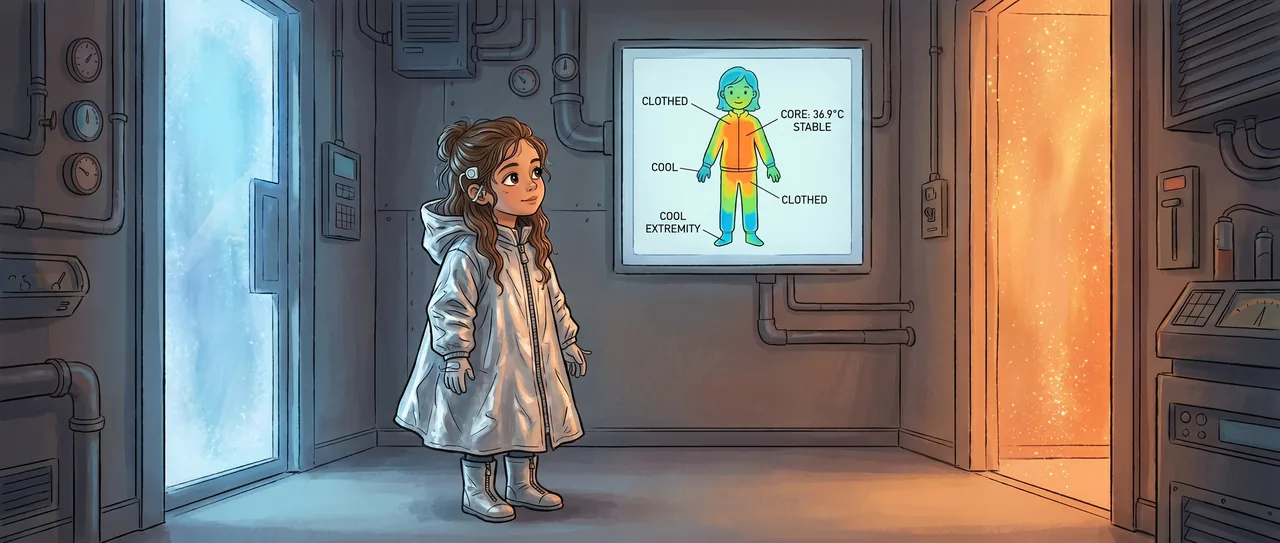
Maya stepped closer to the screen. The mannequin’s chest had stayed yellow. Its head had stayed yellow. Only the edges had changed.
“Why is that unsafe?” Maya asked.
“Because the board wants stability.”
“Inside stability or outside stability?”
Aunt Lio opened her mouth. She closed it again. Then she pointed at Maya’s half-zipped boots. “Absolutely not.”
“I did not say anything.”
“You were about to say live calibration.”
Maya zipped the second boot. “The visitor loop is approved for students. The cold ramp is five degrees, the polar exposure is twenty seconds in full gear, the heat ramp has water, and the ear patch stops the test if core temperature moves too far.”
Aunt Lio stared at her.
Maya stared back.
“I read the wall,” Maya said.
Aunt Lio muttered something about children with eyes, then slapped a small sensor patch behind Maya’s ear. “If the patch chirps, you stop. If I say stop, you stop. If your toes feel strange, you stop. If you enjoy being correct, you do it quietly.”
“No promises on the last one.”
The cloak was too big for her, but the inner straps tightened softly around her shoulders and waist. It did not feel like armor. It felt like a sleeping bag had learned manners.
Aunt Lio handed her thin sensor gloves. “Hands inside. No bare skin in polar air.”
Maya wiggled her fingers. On the wall, her thermal shape appeared.
She was not yellow.
Her nose was green. Her ears were orange. Her right hand was warmer than her left. Her knees looked patchy, and one elbow flashed brighter where she had leaned on the equipment case.
The computer put a square around her left hand.
Asymmetric extremity cooling.
Aunt Lio reached toward the delete control.
“Don’t,” Maya said.
The cold ramp opened first.
Five degrees Celsius did not sound like a monster number. It was just a refrigerator with a floor. But the air found every loose place. Maya’s cheeks tightened. The tiny hairs on her arms lifted under the sleeve. Her fingers, even inside the sensor gloves, began to fade on the thermal image.
The line marked core stayed almost flat.
Thirty-six point eight.
Her shoulders started to twitch. Not a big shiver. A small one, like her muscles were whispering to one another without asking her.
On the wall, her skin changed faster. Blue crept into the fingertips. Green slid up the wrists. The cloak sealed at the cuffs, not squeezing hard, just closing leaks.
“Polar window,” Aunt Lio said. “Twenty seconds.”
The inner door opened.
Maya’s breath snapped white inside the face shield. The fans flung ice dust against the glass. Her fingers vanished into dark blue on the screen, but the ear patch did not chirp. The core line trembled by one tiny mark and held.
Ten seconds.
Her jaw wanted to chatter. Her legs wanted to bounce. She let them. The shiver spread, quick and busy, as if her muscles had found work to do.
Twenty seconds.
The door shut.
Aunt Lio pulled her back into the middle lock with both hands hovering nearby but not touching. “Heat ramp,” she said. “You can quit now.”
Maya shook her head. The inside of the helmet smelled like plastic, cold breath, and her own skin waking up.
The hot door opened.
Warmth came gently at first. Then all at once. Forty degrees. Forty-five. The cloak loosened at the wrists and neck. Tiny vents opened with soft clicks.
Maya’s face bloomed orange on the wall. Her fingers came back from blue to green, then yellow, then bright gold at the tips. Sweat gathered behind her knees and under the edge of the sensor patch. A fan breathed across the fabric, and the wet places cooled.
The core line rose one little step.
Thirty-six point nine.
Plus fifty degrees waited beyond the orange glass. Aunt Lio looked at the timer. “Ten seconds only.”
Maya nodded.
The heat room smelled like sun-baked stone. The air pressed on her face shield. Sweat ran down her spine, startlingly cold when the cloak moved air over it. Her hands glowed bright now, full of heat being carried outward.
The ear patch did not chirp.
Back in the middle lock, Aunt Lio stared at the wall.
Maya’s thermal body looked wrecked. Blue fingers from cold. Red cheeks from heat. Wet dark patches where sweat had cooled the fabric. A dozen colors, none of them tidy.
Across the bottom of the screen, the core line ran almost straight.
Aunt Lio whispered, “Oh.”
The review board arrived exactly then, three adults with badges, coffee cups, and faces prepared to be disappointed.
The tallest one pointed at the red message still flashing from the mannequin run. “Surface instability. That is the failure?”
“No,” Maya said.
All three adults looked down.
Aunt Lio pressed her lips together, then stepped aside from the control panel.
Maya’s gloves were still cold at the fingertips. Her shirt was damp under the cloak. She tapped the screen twice, bringing her run beside the mannequin’s run.
“The mannequin tried to be thirty-seven everywhere,” Maya said. “People do not do that.”
The adults looked at the colors. They did not interrupt.
“In cold, the edges changed.” Maya touched the blue fingers on the screen. “In heat, other parts changed.” She touched the orange cheeks, the bright hands, the dark wet patches. “The line that mattered stayed here.”
She pointed to the narrow core trace.
The shortest board member leaned closer. “The cloak is not failing to keep the surface constant.”
“It should not keep the surface constant,” Maya said. “It should help the parts that change.”
Aunt Lio moved fast then. Not in front of Maya. Beside her. She changed the review setting from uniform skin target to core protection target. The red message vanished. The mannequin’s messy finger data stopped being a failure and became a moving graph.
The board asked for more runs.
Aunt Lio called in volunteers from the hallway, two rescue trainees, a pilot, a cook from the cafeteria who came because someone said there would be free electrolyte ice. Each person stepped through the safe loop. Each one made a different weather map.
One trainee’s ears went cold first. The pilot sweated across her upper lip before the heat ramp even opened. The cook’s hands stayed warm longer than anyone’s, then flushed scarlet in the heat room. Their skin colors scattered all over the wall.
Their core lines stayed inside the same thin band.
The computer stopped drawing red boxes around the differences. It began to gather them.
Maya stood in the middle of the lab with cold fingertips, damp hair, and one sensor patch pulling at the skin behind her ear. On the wall, all the human maps layered together, storms of color around small steady lines.
Beyond the glass, the blue room roared. The orange room shimmered. Between them, the tray of unused sensors waited under the light.
Maya peeled a fresh sensor from its paper and pressed it below her other ear.
Read the interactive version, listen to the narration, and earn a gold star →
A science-verified short story for curious kids · Curiosity Land