The Ninety Percent Room
The brain was wearing a crown.
It sat on a pedestal in the middle of the museum lab, pink and rubbery and too large, with a gold plastic crown tilted over one wrinkle. Above it, a sign flashed, Your Brain’s Happy Chemical.
Maya stood in front of it with a roll of tape hanging from one finger.
“No,” she said.
The brain kept flashing.
Across the room, the gut exhibit sat dark.
It was much smaller. A clear box, a pump no bigger than a lunchbox, a microscope screen, and a sealed cartridge labeled Mini-Intestine, Human Cells, Do Not Open. Inside the cartridge was a channel thinner than a shoelace, lined with living gut cells grown in the museum’s partner lab. If the right filtered microbe broth flowed past them, the screen was supposed to show golden sparks where serotonin appeared.
That was the part Maya had read twice on the exhibit card.
About ninety percent of the body’s serotonin is made in the gut.
Not the brain.
The card did not say the brain was unimportant. It said the brain made its own serotonin, safely behind its barrier, and the gut made most of the body’s supply for the gut’s own busy work. Moving food. Sending signals. Being more than a tube.
Maya liked cards that made adults’ posters look suspicious.
Dr. Lio hurried past with a toolbox and a paper cup of coffee balanced in the same hand. He was the exhibit designer. His hair always looked as if he had taken off a hat that was never there.
“Maya, can you tape the serotonin arrows onto the brain wall?” he asked.
“No,” Maya said again.
Dr. Lio stopped. “That was not one of the options.”
“The gut demo is dark.”
He glanced over. “The preview group arrives in twelve minutes. If the gut cartridge is being dramatic, we’ll run the brain game first.”
“It says most serotonin is made in the gut.”
“Yes, yes, but people know brains. We lead with what people know.”
“That is backwards.”
Dr. Lio took a careful sip of coffee and winced because it was still too hot. “Everything is backwards until after opening day. Please do not open anything sealed, do not touch the pump needles, and do not let the crown fall off the brain. The director likes the crown.”
He vanished behind the wall where the sound system was repeating, Welcome to the pancreas, welcome to the pancreas, welcome to the pancreas.
Maya looked at the crown.
Then she looked at the dark gut screen.
The exhibit table had three cartridges clipped into a foam tray. One had a blue sticker. One had a green sticker. One had no sticker at all. The printed instructions said, Load green cartridge for community filtrate. Load blue cartridge for blank control.
The green cartridge was already loaded.
The pump hummed. Fluid moved. The microscope screen showed a gray tunnel of cells and no gold.
Maya did not touch the seal. She crouched until her eyes were level with the cartridge labels.
The green sticker covered part of the tiny etched code.
Maya peeled up one corner with her fingernail.
A seventeen.
She checked the run sheet taped under the table. A seventeen, blank control. A seventy-one, community filtrate.
She looked at the blue cartridge.
A glittery blue sticker covered its code almost completely. Dr. Lio loved color systems. Dr. Lio also put glitter stickers on things that should have been left alone.
Maya peeled the blue sticker back.
A seventy-one.
“That is not decorative,” she said.
The pump made a tiny clicking sound. On the screen, the gray gut cells waited under the microscope light.
Maya read the next line of the instructions out loud, because out loud made adults’ rules behave better.
“Cartridges are sealed. Students may switch cartridges by pressing orange release. Do not remove caps.”
Good.
She pressed the orange release. The green cartridge popped up. She set it in the tray and clipped the blue one into the pump.
For three seconds, nothing happened.
Then the gray tunnel on the screen filled with moving clear liquid. A dot appeared near the left edge. Then another. Then a scatter of gold, small as dust in a sunbeam.
Maya leaned closer.
The gold did not spread like food coloring. It appeared in little places along the gut lining, here, then there, then in a cluster that blinked and faded. The cells were not smiling. They were not thinking thoughts. They were answering chemicals with chemicals.
The sign over the brain kept flashing, Your Brain’s Happy Chemical.
The gut screen glittered without asking permission.
The first preview visitors came in as a clump of jackets, backpacks, and voices. A museum guide tried to steer them toward the crowned brain.
“Welcome to the brain station,” the guide said.
Maya stepped between the group and the pedestal.
“Wait,” she said. “You have to vote first.”
The guide blinked. Dr. Lio was still behind the wall, arguing with the pancreas speaker.
Maya held up two foam buttons from the exhibit bin. One had a brain on it. One had a twisty gut on it.
“Where does your body make most of its serotonin?” Maya asked.
A boy with a red backpack hit the brain button before she finished.
“Brain,” he said.
“Brain,” said two others.
A small girl in striped socks looked at the gut button and made a face. “That one looks like noodles.”
“Press one,” Maya said.
The girl pressed the gut button with one finger, as if it might be sticky.
The tall screen above them lit up. Brain votes, eight. Gut votes, one.
“Now watch,” Maya said.
She tapped the microscope display. The golden flecks flickered along the tiny gut channel.
“This is a sealed model of gut lining cells,” she said. “The liquid flowing past them was filtered from gut bacteria grown safely in a lab. No live bacteria in this cartridge. Some bacteria can make neurotransmitters themselves. Some make other molecules that nudge gut cells. The gut cells are making serotonin where the gold appears.”
The red-backpack boy frowned. “But serotonin is for being happy.”
“That is the poster version,” Maya said.
The museum guide made a quiet cough.
Maya pointed to the screen. “Your brain uses serotonin. Your gut uses serotonin. Most of the serotonin in your body is made down here, in the gut lining. About ninety percent.”
The striped-socks girl looked at the golden dots. “So my stomach has messages?”
“Your gut does.”
“My stomach says horrible things before math quizzes,” the girl said.
Two kids laughed.
Maya did not. On the screen, the gold lights came and went in uneven patches, like windows in a city where nobody had agreed what time to wake up.
The red-backpack boy leaned over the display. “Are the bacteria controlling it?”
“No,” Maya said.
“Are the gut cells controlling it?”
“No.”
The girl in striped socks looked up. “Then who is?”
The pump clicked softly. The answer was too crowded for one button.
Dr. Lio came out from behind the wall. The sound system finally said, Welcome to the genome lab. He saw the group around the gut screen and the dark, ignored crown on the brain.
“Oh,” he said. “You fixed the cartridge.”
“The stickers were wrong.”
Dr. Lio stared at the screen. “That is much prettier than when I tested it.”
“You tested the blank.”
“Ah.” He looked at his glittery blue sticker stuck to Maya’s fingertip. “That may have been me.”
The striped-socks girl was still staring at the gold. “If bacteria send messages, and gut cells send messages, and brain cells send messages, am I one thing or a bunch of things?”
Dr. Lio opened his mouth.
Maya shook her head once.
He closed it.
The crowned brain blinked cheerfully behind them.
Maya picked up the sign that said Your Brain’s Happy Chemical and turned it over. The back was blank. She took a thick marker from the table and wrote new words across the white plastic.
Messages From the Crowd.
Dr. Lio read it. “The director likes simple.”
Maya slid the sign into the holder above the gut screen. “This is simple.”
The preview group pressed closer. The guide handed out magnifying viewers. Someone whispered, “That’s inside us?” Someone else whispered, “Not exactly, but kind of.”
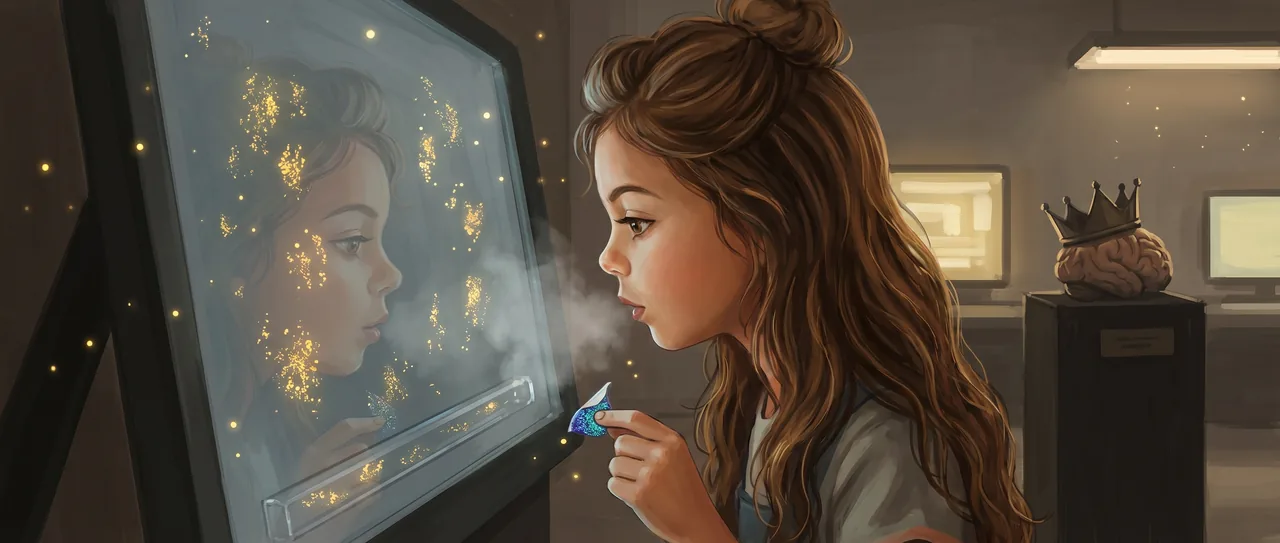
Maya stood on tiptoe to adjust the screen angle. Her reflection appeared faintly in the glass, forehead, nose, chin, and below it the golden lights blinking in the tiny channel.
Maya bent closer until her breath fogged the display glass, and the gold lights kept blinking under her ribs’ reflection.
Read the interactive version, listen to the narration, and earn a gold star →
A science-verified short story for curious kids · Curiosity Land