The Mountain Under Water
Maya’s mountain looked excellent until Soren measured it.
It had snow made of torn white paper. It had a blue plastic ocean around it. It had a tiny flag on top that said EVEREST in Maya’s square letters.
Soren crouched beside the table in the ocean science center lobby, his notebook balanced on one knee. He checked the numbers on the cardboard trench, then the height of the mountain, then the blue plastic waves.
“Your mountain is sticking out,” he said.
“It’s Everest,” Maya said. “It does that.”
“Not there.”
Maya leaned over the table. The Mariana Trench was painted as a dark blue crack. At the deepest place, Challenger Deep, she had put Everest inside it like a tooth in a gum. The peak rose proudly above the water.
Soren tapped the flag with his pencil. “If the trench is about eleven kilometers deep, and Everest is not quite nine kilometers tall, the top should still be underwater.”
Maya stared at the flag.
“How far underwater?” she asked.
Soren wrote without looking up. “A little more than two kilometers. Over a mile.”
The flag suddenly looked silly. Very silly. Offensively silly.
Maya pulled it out.
Across the lobby, Maya’s aunt was trying to hang a banner while carrying a stack of name tags in her teeth. She ran the center’s open-house nights with the fierce calm of a person who believed every table should have exactly three brochures.
“Twenty minutes,” she called. “Keep your display on the table. People like eye level.”
Maya looked at the table. It was two meters long. The deepest known place in the ocean was not going to fit politely between the touch tank and the free stickers.
“We need a different scale,” Soren said.
They tried one centimeter for one kilometer.
At that scale, Challenger Deep was eleven centimeters down. Everest was almost nine centimeters tall. The missing water above the peak was only about two centimeters, the width of Maya’s thumb.
Maya held her thumb over the drawing. “That does not feel like a mile.”
“It is a mile,” Soren said.
“It is a thumb.”
They tried making the trench longer across the table, but then down became sideways, and sideways did not make Maya’s stomach drop.
They tried folding paper into a deep blue slot, but the cardboard buckled and made the ocean look like a taco.
Soren crossed out three scales in his notebook.
Maya walked away while he was still calculating. She did not mean to be rude. Her feet had already chosen the lobby stairs.
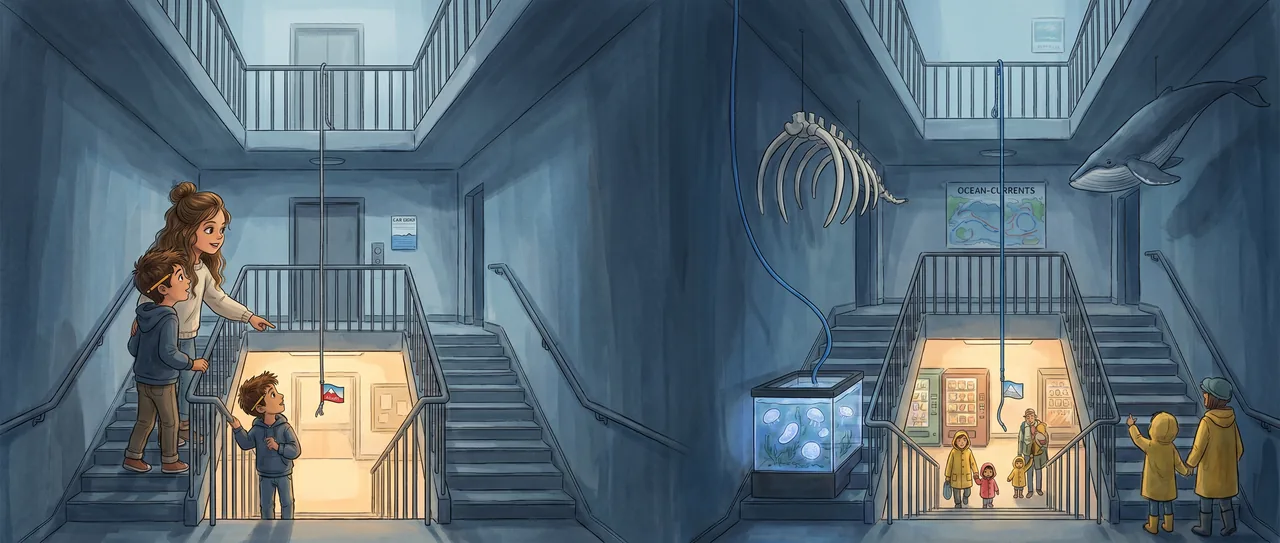
The ocean center had four floors wrapped around an open stairwell. A whale skeleton hung from the ceiling, white ribs floating above the railings. Down below, the basement door stood beside vending machines that hummed softly to themselves.
Maya looked from the top railing to the basement floor.
“Come here,” she said.
Soren came, pencil behind his ear.
Maya pointed down the stairwell. “One millimeter for one meter.”
Soren’s eyes moved. Top railing. Second floor. First floor. Basement.
“That makes eleven kilometers into eleven meters,” he said.
“Is the building eleven meters?”
Soren did not answer right away. He went down one flight, counting steps under his breath. Maya heard him at the landing. Then the next landing. Then his voice came up from below.
“Close enough if sea level starts at the fourth-floor rail.”
Maya grinned.
Her aunt appeared at the top of the stairs with a roll of tape around her wrist. “No,” she said at once.
“We did not say anything,” Maya said.
“You were about to say something with string.”
“Cord,” Soren said.
“No cord across stairs. No tape on painted walls. No blocking exits. No making visitors trip into the jellyfish exhibit.”
“We can use the railing,” Maya said.
“And binder clips,” Soren said.
“And the cord stays inside the open middle,” Maya said. “Nobody walks there unless they are a whale skeleton.”
Her aunt looked up at the whale. One of the name tags slid off her stack and fluttered to the floor.
“You have fifteen minutes,” she said. “If anyone falls, I am becoming a botanist.”
Maya and Soren ran.
They found blue cord in the education closet and gray cord in the craft bin. Soren measured with a tape measure that snapped at his fingers if he pulled too fast. Maya clipped the blue cord to the fourth-floor railing and let it fall through the open center of the stairwell.
It dropped past the whale ribs.
Past the third floor, where a poster showed ocean currents curling around the globe.
Past the second floor, where a tank of moon jellies pulsed like slow glass hearts.
Past the first floor, where families were starting to come in from the evening rain.
The cord nearly touched the basement landing.
“Sea level,” Soren said, clipping a card at the top.
“Challenger Deep,” Maya said, clipping a card at the bottom.
Soren measured upward from the bottom along the gray cord. Eight meters. Eight and a half. Eight point eight.
“Here,” he said.
Maya clipped the gray cord beside the blue, rising from the basement. It stopped on the stairwell wall between the first and second floors, not near the top at all. She tied the tiny Everest flag there.
The flag hung below sea level by more than the height of the tallest grown-up in the lobby.
Maya stood beside it on the stairs. She looked up.
The sea-level card was far above her, at the fourth-floor rail. Between the little flag and the air was blue cord, stairwell, whale shadow, and empty height.
Soren came to stand one step below her. For once, he did not write anything down.
“That is the top,” Maya said.
“Yes,” Soren said.
“The top of the tallest mountain.”
“Yes.”
A family stopped on the stairs. Then another. Someone on the first floor asked where the mountain was.
Maya pointed down instead of up.
People leaned over the railing. Heads appeared on every floor, looking not at a screen, not at a poster, but into the drop inside the building.
Soren spoke when they asked. He did not make his voice large. He did not need to. “The blue cord is the ocean depth at this scale. The gray cord is Everest, placed on the bottom. The peak is the flag. The sea is still above it.”
A small child reached toward the flag and stopped, fingers open.
Maya’s aunt came halfway down the stairs with a crooked banner still over one shoulder. She looked at the table in the lobby, where the old cardboard ocean sat flat and useless.
“People like eye level,” she said softly.
Maya looked over the railing. Visitors were walking up and down, using their own legs to measure the invisible water.
“This one has different eyes,” Maya said.
Soren went to the basement landing and added one more card. He had written the words carefully, dark enough to read from above.
DEEPEST KNOWN PLACE IN THE OCEAN.
Under that, smaller, he had written:
ABOUT ONE THOUSAND TIMES THE AIR PRESSURE AT SEA LEVEL.
Maya came down to read it. The basement felt cooler. The vending machines hummed. Above them, the blue cord climbed and climbed, past the Everest flag, past the jellyfish, past the whale bones, to the bright card at the top.
Her aunt called from above, “We have a line for the stairs.”
Soren opened his hand. In his palm was a tiny silver submersible from the model shelf, no bigger than a bean.
Maya nodded.
At the very bottom of the blue cord, Soren clipped on the tiny silver submersible, and Maya crouched beside it and pressed her ear to the cool wall.
Read the interactive version, listen to the narration, and earn a gold star →
A science-verified short story for curious kids · Curiosity Land