The Cloud That Held Steel
The thing called sky-glass broke before anyone touched the blowtorch.
It sat in the middle of the museum worktable, pale blue and cloudy at the edges, inside a plastic box with a label that said: SILICA AEROGEL, NINETY-NINE POINT EIGHT PERCENT AIR.
Maya had been staring at the label since they arrived. Not because of the number. Because of the box.
The aerogel was not sitting on the black foam pad like the other samples. It was caught by two clear clips at its corners, as if someone had tried to make fog behave.
Soren leaned close, his notebook already open in one hand. He did not write yet. He looked first.
A sound came from the box.
Not a snap. Smaller.
Tick.
A white crack ran from one clip toward the center of the square.
The exhibit manager spun around from the safety hood. He wore orange goggles on top of his head and had three markers clipped to his shirt pocket. All three were uncapped.
“No,” he said. “No, no, no. That is the good tile.”
Maya pointed. “It was already angry there.”
“Materials are not angry,” the manager said. He lifted the lid, then stopped himself and put both hands in the air. “Nobody breathe on it.”
Soren wrote one word: clipped.
The manager checked the clock. “The public demonstration starts in twenty minutes. We can skip the weight part. We still have the torch part if the crack holds.”
He looked at Maya and Soren. “Actually, no. We skip everything dramatic. We put it under glass. People can read the sign.”
Maya made the face she made when adults turned a living thing into homework.
Soren said, “The sign says it can hold thousands of times its own weight.”
“Yes,” the manager said. “Under the right conditions.”
“What conditions?” Soren asked.
The manager had already turned to rummage through a drawer. “The kind we do not have time to rebuild.”
Maya bent until her chin was almost level with the table. The crack did not wander randomly. It began exactly where the clip pressed the corner. Another tiny cloudy mark sat under the second clip, waiting.
“Not there,” she said.
The manager held up a roll of clear tape. “If I stabilize the edges…”
“No,” Maya said.
The manager blinked.
Maya pointed at the clips, then the tape. “Same mistake, flatter.”
Soren tapped his pencil against the notebook once. “It can hold weight if the weight is spread out. The clip puts force in one small place.”
“It is a solid,” the manager said, but his voice had less certainty in it now.
“It is almost not,” Maya said.
That made the manager pause.
On another table were the things for the show: a daisy in a water tube, a small butane torch, a stack of steel washers, a square of acrylic, a ring stand, and a model of a Mars rover with dusty wheels.
The manager followed Maya’s eyes. “Do not improvise with fire.”
“We are improvising with not breaking it,” Soren said.
The broken tile came out first, not by fingers, but on the foam pad. The manager held his breath so hard his cheeks puffed. Maya slid the pad sideways while Soren lifted the clips away one at a time with tweezers.
The aerogel did not crumble.
It sat there, lighter than it looked, stranger than smoke, casting a shadow that seemed too strong for it.
Soren put the cracked tile on the scale. The numbers trembled below a gram.
“That cannot be right,” the manager said.
“It is right,” Soren said. He touched the table beside the scale. “The table is shaking.”
The museum was waking up beyond the prep room. Somewhere, a floor polisher hummed. Doors thumped. A group of children laughed in the lobby.
Maya had already taken the acrylic square and set it on four bottle caps.
“No,” Soren said.
Maya looked up.
“Bottle caps have rims. They will press lines.”
Maya moved them away. “Good.”
They tried a folded microfiber cloth. Too soft. The acrylic sagged at the center. They tried foam. It grabbed. They tried the shallow lid from a specimen tray, turned upside down, with a rim that supported the whole edge evenly.
Maya ran one finger just above the rim without touching it. “Like holding a soap bubble by the whole room.”
Soren nodded. “The tile rests. The weight rests on the tile. No pinching.”
The manager was watching them now, one marker drying out in his hand.
“There is another tile,” he said. “Uncracked. In the shipping box. I was saving it.”
“For what?” Maya asked.
The manager opened his mouth. Closed it. Then he brought the box.
The new aerogel square looked less like an object than a place where the air had become shy. When the lid came off, Maya felt herself stop moving too fast. Even her hands slowed.
Soren did not write. He placed his notebook on the far end of the table, where no one would bump it.
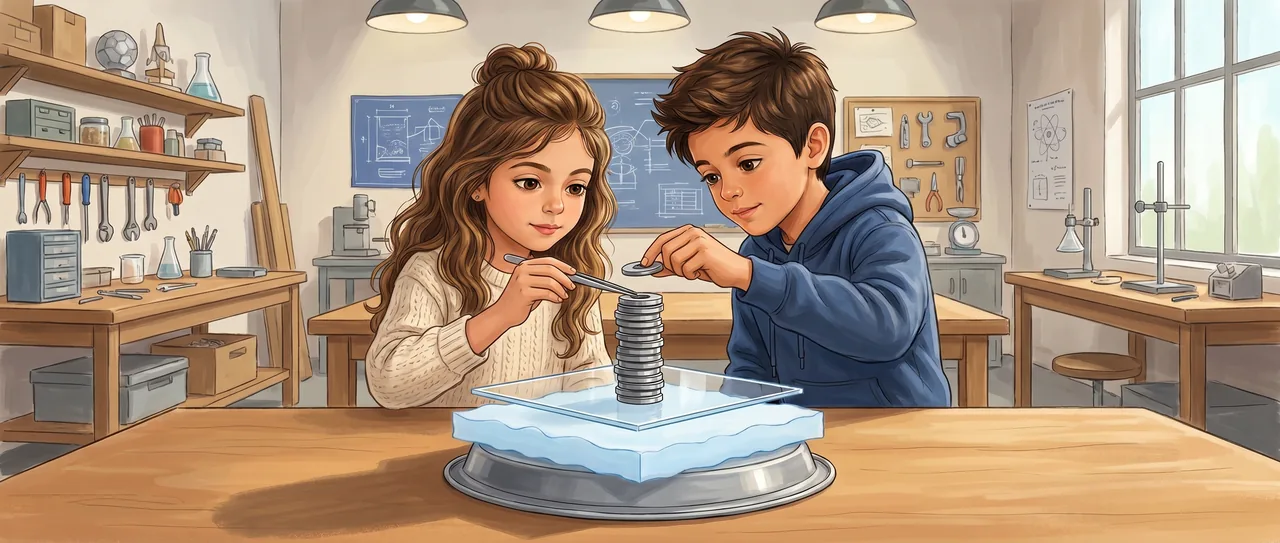
Together they lowered the aerogel onto the tray lid. Maya held one corner with tweezers. Soren held the opposite corner. The square settled without a sound.
The manager whispered, “All right.”
Maya set the acrylic sheet on top.
Soren added one steel washer.
Nothing happened.
He added another. Then another. The washers rang softly against each other, bright little circles of weight.
The aerogel did not sink.
The manager leaned closer. “That is already hundreds of times its own weight.”
Maya held out her hand without looking away. Soren placed another washer in her palm.
She set it down.
The pale square stayed still beneath the clear sheet, almost invisible except for its blue edges. Steel gathered above it in a neat, heavy tower.
The room seemed to tilt around that little stack. Solid no longer looked like one thing. Heavy no longer looked like power. Empty no longer looked empty.
From the lobby, a voice called, “Are we ready?”
The manager straightened so fast his goggles fell over his eyes. “We are ready,” he said, sounding surprised to hear himself.
The demonstration room filled with children and parents. The manager talked too quickly at first. He loved a crowd but feared a schedule. He pointed to the label. He said aerogel began as a gel, then the liquid inside was replaced with gas so the tiny structure remained.
Maya stood beside the table with the tweezers in her hand.
Soren stood on the other side, watching the corners.
When the manager reached for the steel washers, Maya slid the acrylic sheet into place before he could set them down.
He smiled at the audience. “My assistants are stricter than gravity.”
Soren put on the first washer. Maya put on the next. Soon the tower of steel stood on the cloud-colored square.
A small child in the front row said, “That is fake.”
Soren picked up the empty shipping box and turned it upside down. Nothing fell out.
Maya lifted one loose crumb of broken aerogel with tweezers. The crumb was so light it trembled when someone in the front row whispered.
The child stopped leaning on the barrier.
For the fire part, the manager moved behind the safety shield. He placed the unweighted aerogel tile on a metal ring, with only its edges supported. Maya laid the daisy on top. Its white petals spread across the pale blue square.
The manager clicked the torch once. Twice. On the third click, a blue flame appeared.
He lowered it under the aerogel.
The children went quiet in a way that was better than applause.
The flame roared against the underside. The daisy did not blacken. Its stem did not curl. One white petal shifted from the warm air rising around the shield, but the flower stayed whole.
Soren watched the space between fire and flower. It was not much space. It was hardly any space at all. But inside the aerogel were tiny pockets and winding paths too small to see, and heat could not hurry through them.
The manager kept the flame there for another breath, then another.
Maya did not look at the crowd. She looked at the flower.
Read the interactive version, listen to the narration, and earn a gold star →
A science-verified short story for curious kids · Curiosity Land