The Blank Strip
Soren had been wrong for four days before anyone else noticed.
He had planted the seeds carefully, twelve in each clear tray. Same seeds. Same water. Same shelf under the station lamp. Same little labels written in pencil because the air in the rainforest made ink feather and blur.
Tray one held compost from the kitchen barrels. Tray two held sand from the river path. Tray three held soil from under the tallest trees Soren had ever stood beneath.
By the fourth morning, the compost tray was a crowd of green loops. The sand tray had two skinny sprouts, both leaning like they wanted to leave. The forest tray had five sprouts, pale and small, with yellow at the edges.
That was the wrong part.
Mr. Pell swept into the lab carrying a coil of glowing cable around his neck. He made every room feel like it had become a stage by accident.
“Beautiful,” he said, without looking closely. “Our lunar classroom logs in at ten. We show them the richest forest on Earth. We show them the richest soil. Perfect.”
Soren looked at the yellow sprouts.
“It is not perfect,” he said.
Mr. Pell blinked at the trays. “They are plants. Plants are always a little dramatic.”
“These are the same seeds.”
“Then use the green ones.” Mr. Pell pointed at the compost tray. “Children on the Moon do not need to see disappointing lettuce.”
“They are radishes,” Soren said.
Mr. Pell had already turned to untangle the cable from a microscope arm.
Soren wrote down the heights of the sprouts. He did not write because a teacher had asked. He wrote because the forest tray was behaving wrong, and wrong things could slip away if you did not pin them to paper.
Outside, rain ticked on the metal roof. It had rained every afternoon since Soren arrived with his aunt, Dr. Lio, who measured how much carbon the forest held in trunks and branches and leaves. She was somewhere up the hill, arguing with a drone that kept mistaking hanging vines for tree crowns.
Soren tested the trays again.
The compost strip changed color fast, blooming purple and blue in the little squares for nutrients. The river sand strip stayed nearly blank, which was rude but expected. The forest soil strip stayed nearly blank too.
Soren stared at it.
He tested a second pinch from the forest tray. Blank.
He rinsed the spoon, dried it on his sleeve, and tested a third pinch from the bottom. Blank.
At school, blank meant unfinished. Blank meant you had not brought enough answer.
Here, blank sat under a forest so loud with life that the windows trembled with insects.
Soren took the three strips to the porch. The station stood on stilts above red-brown mud, with the forest pressed around it like a crowd trying to hear a secret. Leaves bigger than dinner plates slapped rain off their tips. A blue morpho butterfly opened and shut like a piece of sky changing its mind.
Dr. Lio came down the trail with mud up to her knees and a tablet tucked inside her shirt.
“Aunt Lio,” Soren said, “the forest soil is poor.”
“Yes,” she said. She kissed the top of his head without stopping. “Old, wet, leached, complicated. Where is the battery case?”
“In the dry box.”
“You are a glorious creature.” She took two steps, then looked back. “Do not let Mr. Pell call it dirt.”
Then she was inside, already saying into her headset, “No, the drone is counting vines as crowns again.”
Soren stood with three strips in his hand.
Yes was not enough.
He went to the demonstration plot behind the station, where square mesh bags lay pinned to the forest floor with little metal hooks. Visiting classes used them to see what happened to fallen leaves over time. Soren had helped place them on his first day, when the bags were flat and full and smelled like crushed green tea.
The first tag said two weeks. Inside, the leaves were spotted and soft.
The second tag said six weeks. The leaves had holes and dark edges. Threads of pale fungus crossed them like tiny roads.
The third tag said three months. Soren lifted the bag and felt almost nothing. Inside were crumbs, veins, and pieces too small to name.
He did not open the bags. He pressed his fingers against the mesh and watched two termites move through the dark bits underneath, each carrying a piece of leaf smaller than a freckle.
The forest floor was not like the forests near home, where autumn leaves piled thick and dry and stayed there for months. Here, the litter layer was thin. A few fresh leaves. A few sticks. Then roots, fine and pale, woven through the top of the soil like the forest had stitched itself to the ground.
Soren scraped gently with a fallen twig. Roots appeared at once.
He tried a place beside the path. More roots.
He tried beneath a buttress root taller than his shoulder. Roots again, hair-thin, crowded into the skin of the earth.
Rain fell harder. Water ran down trunks, over bark, through leaves, into the soil. Soren held a nutrient strip under the drip from a broad leaf. It came away almost blank.
The forest was not leaving much for the rain to carry off.
A fruit dropped somewhere in the trees with a heavy plunk. Something rustled above him, then stopped. The green went upward and upward, trunks lifting leaves into the wet light, vines crossing the gaps, moss shining on bark, insects cutting and chewing and carrying. The soil strip in Soren’s hand looked empty. The forest around it did not.
He ran back to the station with mud on both legs.
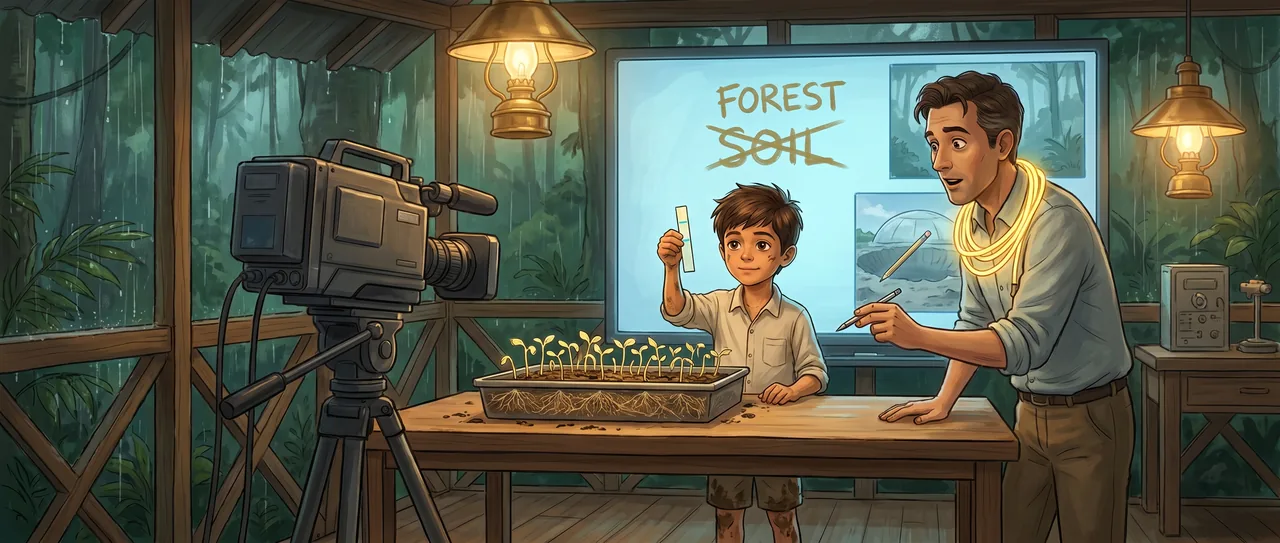
Mr. Pell had arranged the compost tray under the main camera. On the screen behind him floated the title in enormous gold letters: THE RICHEST SOIL ON EARTH.
“That is not forest soil,” Soren said.
“It is brown,” Mr. Pell said. “It is lively. It will read well on camera.”
“It will lie well on camera.”
Mr. Pell slowly lowered the light wand he was adjusting.
Soren put the three test strips on the table. Compost bright. Sand blank. Forest blank. Then he put the mesh bag from the three-month marker beside them, still closed, still tagged. He added a clear sleeve from the nursery shelf, where a young tree seedling grew with white roots pressed against the plastic.
Mr. Pell looked annoyed, then interested, which on his face were almost the same expression.
“The broadcast starts in three minutes,” he said.
“I need one minute,” Soren said.
“You have forty seconds.”
The screen chimed. A row of small windows opened, classrooms waking one by one, some on Earth, one labeled Shackleton Crater Learning Dome. In that window, children floated their pencils and caught them again.
Mr. Pell smiled his stage smile. “Welcome, explorers. Today we are visiting one of the richest forests on Earth.”
He reached for the compost tray.
Soren put his hand on the lid.
Mr. Pell’s smile froze.
Soren slid the forest tray into view instead. The radish sprouts looked small and yellow under the big light.
“This is soil from under giant trees,” Soren said. His voice came out thinner than he wanted, but it came out. “It did not grow the best radishes.”
In the lunar window, a pencil drifted past a child’s ear.
Soren held up the pale test strip. “This says there is not much loose plant food here.”
Mr. Pell whispered, “Soren.”
Soren picked up the compost strip, bright with color, and laid it beside the pale one. “This has more loose nutrients. But it is not the rainforest.”
A voice from one of the windows asked, “Then where is all the food?”
Soren lifted the nursery sleeve. The young tree’s roots pressed white against the clear wall. He lifted the mesh bag with the three-month tag, where leaves had become crumbs small enough for termites and fungi and roots.
“Moving,” Soren said. “Mostly not waiting.”
No one spoke for a moment. Even Mr. Pell was quiet.
Then Dr. Lio’s voice came from the doorway. “That,” she said, breathing hard from the hill, “is much better than dirt.”
Mr. Pell looked at the gold title on the screen. He handed Soren the stylus.
Soren crossed out SOIL and wrote FOREST above it.
Then he lifted the pale test strip in front of the camera until it covered the brown tray and the screen filled with leaves.
Read the interactive version, listen to the narration, and earn a gold star →
A science-verified short story for curious kids · Curiosity Land