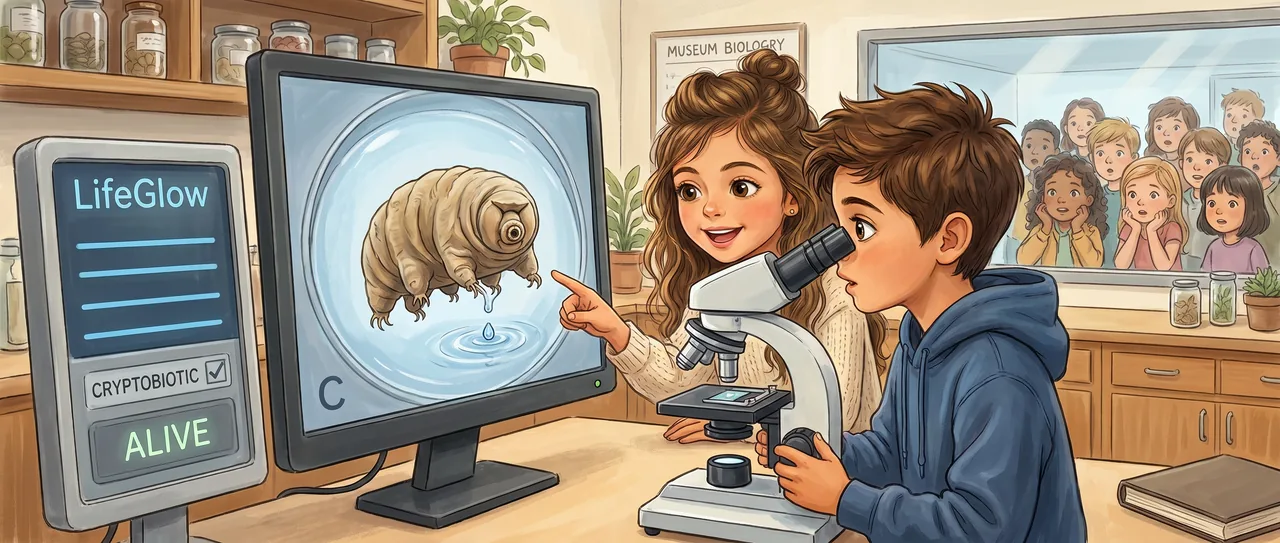
The Animal That Waited
The animal was dead on every screen except the one Soren refused to stop looking through.
On the microscope monitor, it looked like a crumb with wrinkles. Smaller than a comma. Smaller than the dot over an i, if the dot had folded legs and claws tucked against its body.
Above the monitor, the LifeGlow panel showed three flat blue lines.
Heat, zero.
Oxygen use, zero.
Carbon dioxide, zero.
Dr. Ibarra slapped the side of the panel as if the machine had bad manners.
"That's not possible," she said. "The ground sample woke yesterday in nine minutes. Nine. I timed it twice. We have reporters in the hall and a mayor who thinks a tardigrade is a kind of pastry."
Maya was standing on the foot rail of the lab stool, chin almost touching the screen. "It isn't messy."
"Dead can be neat," Dr. Ibarra said. She rubbed both eyes with the heels of her hands. Her lab coat had a smear of blue marker on the pocket where she had written LIVE SPACE BEARS at some point and then tried to scrub it off. "Dead can be extremely neat when I have promised a live demonstration."
The returned CubeSat sat under glass at the end of the bench, no bigger than a lunchbox, one corner darkened from reentry. Its tiny tray had spent sixteen days in low Earth orbit. A shutter had opened. The dried tardigrades inside had faced vacuum, space radiation, and cold darker than any freezer in the museum.
Beside the CubeSat was a second display, a silver vial inside a nest of foam. Its label said that tardigrades of the same kind had survived laboratory temperatures close to absolute zero, colder than the space between most stars.
Soren had read that label six times.
Now he looked from the label to the blue lines and back through the microscope. "The screen says no metabolism."
"Correct," said Dr. Ibarra. "Which is how we know the flight sample failed."
Maya's fingers tapped once on the bench. "No. That's what it was supposed to do."
Dr. Ibarra stopped rubbing her eyes.
Soren opened his notebook, not to write at the end of anything, but because the inside of his head had become crowded. He had copied one sentence from the museum card before the ceremony started.
"In cryptobiosis," he read, "all measurable metabolism stops."
The LifeGlow panel continued to shine its three zeros with great confidence.
Dr. Ibarra stared at the panel. Then at Soren. Then at the door, where the sound of a microphone squealed in the hallway.
"The machine detects heat, gas exchange, and movement," she said. "Those are the signs we use because they are fast and clean."
"Fast and clean for things that are busy," Maya said.
Soren looked into the microscope again. The wrinkled crumb did not move. It did not breathe. It did not glow. If it was alive, it was alive in a way the machine had no place to put.
The LifeGlow panel had two status lights. Green for living. Black for not living. There was no color for a creature that had folded itself so completely out of ordinary time that all the ordinary tests came back empty.
From the hallway came applause for something that had not happened yet.
Dr. Ibarra grabbed a tablet from the counter. "I can use yesterday's video. I'll tell them the flight sample is inconclusive. No, I'll say delayed. No, inconclusive sounds more scientific. I hate saying inconclusive to a mayor."
"Don't seal the tray," Soren said.
"I have to protect it from contamination."
"It has an injection port," he said. "For rehydration without opening the well. The protocol is clipped to the stand."
Dr. Ibarra blinked. "You read the protocol?"
"It was clipped to the stand," Soren said.
Maya was already reaching for the rack of sterile droppers. "We don't need the whole tray. Just well C."
"You are not authorized to run the museum's first returned space animal demonstration," Dr. Ibarra said.
A voice in the hall called, "Doctor? We're ready for the children!"
Dr. Ibarra looked at the door. She looked at the flat blue lines. She looked at the two of them as if they were another instrument she had not calibrated.
"Do not touch anything orange," she said. "Orange means I have to fill out forms."
Then she hurried into the hallway, already saying, much too brightly, "Before we begin, does anyone know what a vacuum is?"
Maya held up two droppers. One had a blue stripe. One had a clear stripe.
Soren checked the protocol. "Clear is sterile water. Blue is stain. No stain."
"Because stain asks a different question," Maya said.
"Because stain might change the answer," Soren said.
Maya grinned. "Same thing, slower."
She fitted the clear dropper to the tiny rubber port over well C. Soren set the timer. Not because he thought time would hurry, but because if something impossible happened, he wanted to know how long impossible had taken.
Maya squeezed.
A bead of water entered the well and spread around the wrinkled animal. Dust lifted. A bubble slid across the glass like a small planet. The tardigrade did nothing.
The timer counted.
One minute.
Two.
The hallway filled with Dr. Ibarra's voice, huge through the speakers.
"Tardigrades are microscopic animals, not insects, not bacteria, actual animals. When water disappears, some species curl into a tun. That is the barrel shape you will see on the screen."
On the lab screen, the barrel shape remained a barrel.
Maya leaned closer. "The left side is darker."
"Shadow," Soren said.
"Maybe."
He adjusted the focus by the smallest turn he could manage. The claws sharpened. Four pairs of legs, tucked close. A face that was not a face exactly, but the front of a creature that had crossed vacuum as a speck.
Five minutes.
Nothing.
A group of younger children pressed their noses against the observation glass. One boy held up a plush tardigrade with button eyes. Another child mouthed, Is it dead?
Maya did not look at them. "What if the water has to get inside slowly?"
"Then we wait."
"What if the radiation broke too much?"
"Then we still wait enough to know that."
At nine minutes, the time from Dr. Ibarra's ground sample, nothing happened.
At twelve minutes, the LifeGlow panel remained black.
At fifteen minutes, Dr. Ibarra slipped back into the lab, smiling with all her teeth for the people behind the glass and whispering without any teeth at all.
"Please tell me there is a leg. A twitch. A dignified wobble. I will accept a wobble."
"No movement yet," Soren said.
"But not failed," Maya said.
Dr. Ibarra started to speak, then stopped. On the tablet in her hand, the status menu showed only two choices.
ALIVE.
NOT ALIVE.
Her thumb hovered between them.
Soren shook his head.
Maya pointed to the blank space under the choices. "Make a third one."
"The program doesn't have a third one."
"Then the program is behind the animal," Maya said.
Dr. Ibarra made a sound that was almost a laugh and almost a groan. She opened the settings panel.
At eighteen minutes, she added a gray status box and typed CRYPTOBIOTIC.
The crowd outside went quiet when the new word appeared on the big display. Not green. Not black. Gray, like a pebble in a river that had not decided whether to be stone or story.
Soren kept his eye on the microscope. His own reflection floated faintly in the glass, one eye huge, one hand on the focus knob, notebook closed beside his elbow.
The blue lines stayed flat.
At twenty-three minutes, Maya said, "There."
Soren did not answer. He adjusted the focus, then adjusted it back.
A claw had moved.
Not much. Not enough for the LifeGlow panel. A single hooked tip had separated from the body and rested in the water.
Maya's smile arrived all at once, but she did not shout. "Again?"
They watched.
The claw pulled inward. Then outward.
Soren's mouth went dry. He had seen animals run, breathe, blink, hatch, eat. He had never seen one return from being unreadable.
The LifeGlow movement line gave one tiny green spark and disappeared.
Outside the glass, the child with the plush tardigrade pressed both hands to his mouth.
Dr. Ibarra whispered, "I need a status."
"Wait," said Soren.
The animal unfolded one leg. Then another. Its body lengthened from a wrinkled grain into something with direction.
Maya touched the edge of the screen, not on the animal, just beside it. "Now."
Dr. Ibarra changed the display.
The gray box did not vanish. It stayed under the green one.
ALIVE.
CRYPTOBIOTIC RECOVERY OBSERVED.
The crowd outside made a sound that began as applause and turned into questions.
Read the interactive version, listen to the narration, and earn a gold star →
A science-verified short story for curious kids · Curiosity Land