The Things That Stayed
The robot failed by asking about the ceiling.
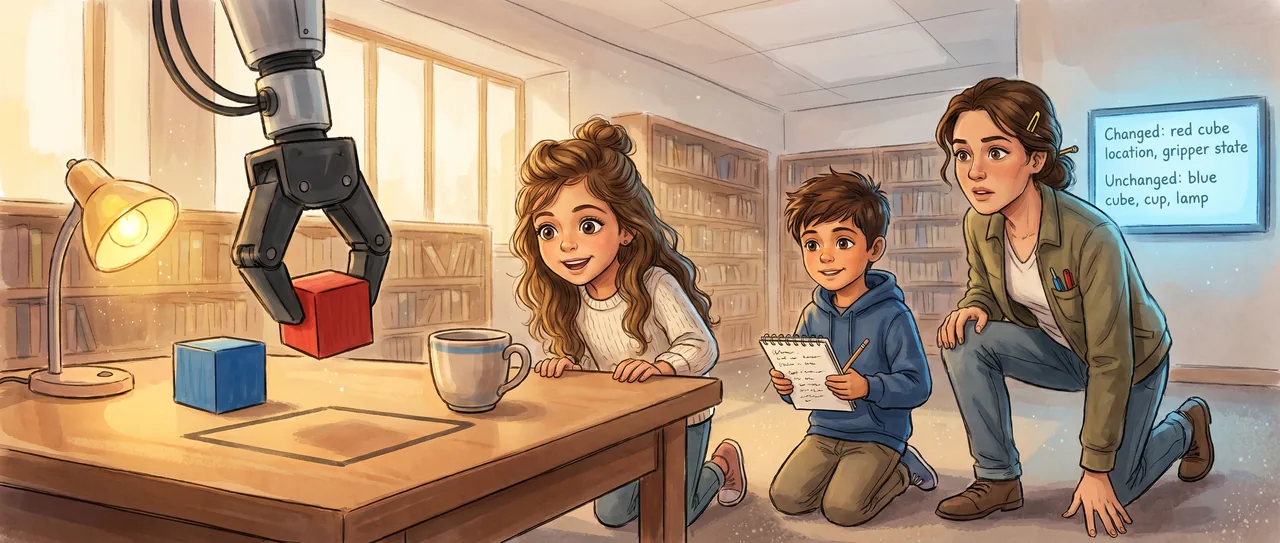
Its metal hand hovered above a red wooden cube. The cube sat on a square marked pantry. Another square was marked table. The job was simple. Pick up the cube. Move it to the table. Put it down.
On the wall screen, the robot printed its question in calm blue letters.
If I lift the red cube, will the ceiling remain white?
Maya leaned forward so fast her braid swung over her shoulder.
Soren looked up from his notebook. He had written, red cube in pantry, robot hand empty, ceiling white, lamp on, door closed, blue cube not moving. The engineer had said the notes were optional. Soren had not believed her.
The engineer made a sound like she had swallowed a hiccup.
"It was working ten minutes ago," she said.
She wore a jacket with tiny screwdrivers in three pockets and a sandwich wrapper sticking out of the fourth. Her hair was pinned with what looked like a charging cable. The library sign behind her said, Artificial Intelligence Open Lab, Come Meet Tomorrow.
The robot waited.
Maya said, "Why does it care about the ceiling?"
"It shouldn't," the engineer said. "That is the problem. It has to update what changes after an action. Somehow it has decided it needs proof about everything else too. Ceiling. Lamp. Door. Probably the sandwich in my pocket. Give me a second."
She grabbed the tablet and began tapping.
Soren read the screen again. "It isn't asking if the ceiling changes. It's asking if the ceiling stays."
Maya's eyes moved over the table. Red cube. Blue cube. Tiny paper cup. Plastic lamp. A little cardboard door taped upright at the edge.
"It's not careless," she said. "It's too careful."
The engineer stopped tapping. "That is a generous way to describe a public failure."
The robot printed another line.
If I lift the red cube, will the lamp remain on?
A boy from the audience giggled. A younger kid whispered, "Bad robot."
Maya turned around. "It isn't bad."
The whispering stopped.
The engineer checked the clock on the wall. "The demo starts in four minutes. I can switch to the dancing program. Everyone likes the dancing program."
"Don't," Soren said.
His voice came out smaller than he wanted, but the engineer heard him.
"You have a better program in that paper museum?" she asked.
Soren held the notebook against his chest. "No. But I wrote down all the things that didn't happen."
Maya smiled at him. Not a polite smile. A bright one, like he had just handed her a key.
"Show me," she said.
Soren opened the notebook on the floor beside the table. His list was boring in the way pavement is boring until a plant comes through it.
Red cube in pantry.
Blue cube on counter.
Lamp on.
Door closed.
Robot hand empty.
Ceiling white.
Cup upright.
Engineer sandwich still in pocket.
Maya tapped the line about the sandwich. "Good."
"It seemed relevant after she said it," Soren said.
The engineer laughed once, then looked ashamed of laughing. "This is an old problem," she said. "Not the sandwich. The rest. In artificial intelligence, it is called the frame problem. Humans know that moving a cube does not repaint the ceiling. A reasoning system has to know what changes and what does not. That sounds easy until you try to write it down."
"So write it down," Maya said.
"People have been trying for decades," the engineer said. "In small worlds, yes. In the whole messy world, not finished."
Maya did not look discouraged. She looked hungry.
The robot printed a third question.
If I lift the red cube, will the door remain closed?
Soren put his pencil between his teeth and stared at the table. Then he took the pencil out.
"We don't need the whole world," he said. "Not for this."
Maya was already reaching for the tablet. "We need a box."
"A frame," Soren said.
The engineer squinted. "Careful. That word is already overloaded."
"Good," Maya said. "Then it belongs here."
The engineer handed over the tablet, but she kept one finger on its corner. "You can change the task labels, not the safety code. If the arm moves wrong, I stop it."
"The arm won't," Maya said.
Soren added, "Probably."
Maya made the tabletop camera ignore everything outside the marked squares. Soren named only five things the little world was allowed to care about: red cube, blue cube, cup, lamp, gripper. Maya deleted the cardboard door.
"I liked the door," the engineer said.
"The door is making trouble for no reason," Maya said.
Soren drew a rectangle around his list. Inside it he wrote, pantry, counter, table, floor. Then he drew arrows.
"Pick up changes two facts," he said. "Cube location changes from pantry to gripper. Gripper changes from empty to holding red cube."
"Lamp stays," Maya said.
"Blue cube stays. Cup stays."
"But not because we wrote a special rule for each one," Maya said. "Because nothing touched them."
Soren typed carefully. His paper notebook looked strange beside the glowing tablet. People at school said he wrote like electricity had not been invented. But the robot's trouble was sitting exactly where his pencil always went: the quiet places, the blank spaces, the facts too ordinary to mention.
The wall screen cleared.
The engineer whispered, "Please do not make me dance in front of librarians."
Maya pressed run.
The robot lowered its hand. Its rubber fingers closed around the red cube.
The wall screen printed:
Changed: red cube location, gripper state.
Unchanged by this action: blue cube, cup, lamp.
The robot lifted the cube.
Nobody clapped yet. It was too small a motion for clapping. It was also too large.
The cube traveled through the air, slow and steady. The ceiling stayed white. The lamp stayed on. The engineer's sandwich stayed in her pocket. The robot did not ask about any of them.
It placed the red cube on the table square.
The younger kid whispered, "Oh."
That was better than clapping.
The engineer sat down on the floor, right there in front of the library audience. "You made a tiny world," she said.
"A world with edges," Soren said.
"And the rule is not magic," Maya said. "It only works inside the edges."
The engineer nodded slowly. Her face had changed. Before, she had looked like someone late for a train. Now she looked like someone who had missed the train because a comet landed on the tracks.
"Do you want to see why this is hard?" she asked.
"Yes," Maya said.
"Yes," Soren said, at the same time.
The engineer picked up the little camera and turned it away from the toy squares. Now it faced the room.
The library appeared on the wall screen. Chairs. Coats. Dusty sunlight. A crooked poster about summer reading. A cart of returned books. The younger kid's untied shoelace. Soren's notebook. Maya's braid. The engineer's cable-pinned hair. A clock with a second hand that refused to hold still.
"Same action," the engineer said. "Move one object. Tell the system what did not change."
Maya took a silver paper clip from the table and set it on the carpet.
The screen drew a green box around it.
Paper clip at carpet position.
Then the cursor blinked.
Soren looked at the room, and the room did not behave like a room anymore. It behaved like a list that had no bottom. The poster had not fallen. The books had not traded places. The shoelace was still untied. The dust had moved, probably. The clock hand had moved, definitely. Air had shifted around Maya's wrist. Somewhere inside the wall, wires were carrying signals. Somewhere inside his own chest, his heart had changed its count.
Maya did not speak for once.
The engineer said softly, "The trick is knowing which facts matter, and which facts stay true, without writing down the universe every time you move a paper clip."
Soren put his pencil against the page, then lifted it again. His notebook was too small. For once, that was not a problem with the notebook.
The robot printed:
Please specify unchanged facts.
Maya crouched beside the paper clip. "Can we give it one?"
"One is honest," Soren said.
Maya picked up the paper clip and placed it back on the table, beside the red cube. Soren typed the sentence with two fingers.
The blue cube remained on the counter.
The system accepted it.
Please specify another unchanged fact.
Maya slid the paper clip two centimeters to the left. On the wall screen, beneath the live picture of the room, the cursor blinked after the word Another.
Read the interactive version, listen to the narration, and earn a gold star →
A science-verified short story for curious kids · Curiosity Land