The Sky That Would Not Stay Put
The sky was losing weight.
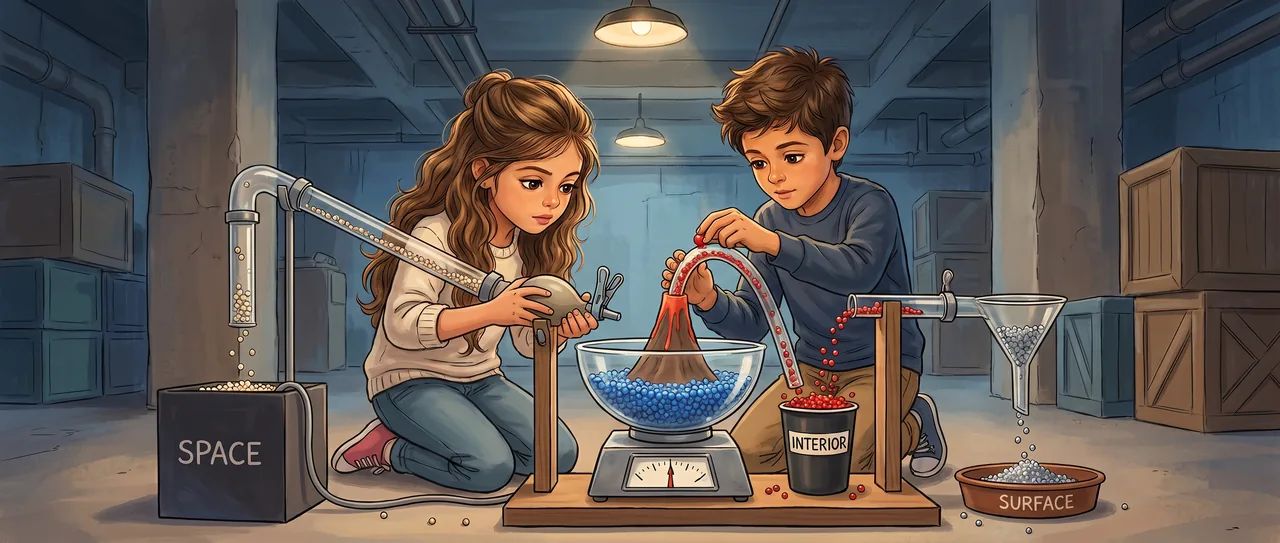
It sat in a glass bowl on one side of a scale in the museum basement, clear beads piled inside it like frozen rain. Every few seconds, a bead clicked through a tiny tube labeled SPACE and dropped into a dark box under the table.
Click.
Click.
Click.
The bowl rose higher each time.
Maya leaned so close her breath fogged the glass. "It's wrong."
Soren had both hands flat on the table, watching the pointer drift away from the center mark. "It's doing exactly what the label says."
The label said EARTH'S ATMOSPHERE LEAKS.
Dr. Keene, who was tying cable cords with the speed of a person already late, called over her shoulder, "Mostly hydrogen and helium. Very light gases. Top of the atmosphere. A little escapes to space all the time. Fifty thousand tons a year, give or take."
Click.
A bead fell into the dark.
Maya frowned. "Then why is there still sky?"
Dr. Keene stopped with a cord between her teeth. She took it out. "Because the atmosphere is huge. Enormous. Fifty thousand tons is tiny compared with all of it. The exhibit is dramatic because dramatic donors fund working elevators. Please do not break anything."
She hurried toward the stairs, then turned back. "The morning group comes in twenty minutes. If the pointer sticks, tap the left leg. Gently."
The door banged shut.
The pointer kept moving.
Soren read the side cards stacked beside the model. He did not write anything down, which meant he was trying to hold too much in his head and did not like it.
"Card one," he said. "Earth loses about fifty thousand tons of atmosphere to space every year, mostly hydrogen and helium. Card two, Earth gains about forty thousand tons of material from space every year, mostly dust and meteorites. Card three, volcanoes add gases from the inside of Earth to the atmosphere."
Maya picked up the second card. Tiny silver beads had been glued around its edge. "So put the meteorites in."
Soren slid a drawer open. Inside were silver beads, red beads, blue beads, three funnels, and a rubber volcano with a tube in its bottom.
"Meteorites don't replace hydrogen," he said.
"I didn't say they did."
"If we put silver beads in the air bowl, people will think meteorites become air."
Maya reached past him and took the whole glass bowl off the scale.
The pointer sprang down with a clack.
Soren stared at her. "That was not gentle."
"The bowl is the problem," Maya said.
She set it on the table. The blue beads inside slid and chimed. "It says atmosphere like it's a jar. It's not a jar. It has doors."
"Space door," Soren said.
"Ground door."
"Volcano door."
"Rock-from-space door," Maya said.
"That one goes to Earth, not straight to air."
"So we need more than one place."
Soren looked under the table. There were spare parts in museum bins, all neatly labeled by someone who believed labels could prevent chaos. He found a shallow brown dish marked SURFACE, a smaller black cup marked INTERIOR, and a clear tube with a cracked suction bulb.
Maya found a second scale.
It was missing one pan.
"Good," she said.
"That is not the usual meaning of good."
"One pan means it can't pretend to be finished."
They worked on the floor because the table was too crowded. Soren set the glass atmosphere bowl back on the first scale. He attached the blue-bead escape tube to its rim, but pinched the opening so only the smallest beads could pass.
"Hydrogen and helium are light," he said. "We shouldn't send the big blue ones."
Maya sorted beads with two fingers, fast. The tiny pale ones went into the top layer of the bowl.
"They leave from the edge," she said. "Not from the middle."
Soren paused, then moved the tube higher. "Top of the atmosphere. Yes."
The first pale bead slipped out.
Click.
The scale pointer lifted.
Maya placed the brown surface dish beneath a silver funnel. She poured in silver beads, forty of them, counting in a whisper. They pattered into the dish like hard rain.
"Forty thousand tons a year," she said. "Space dust and meteorites. Not air. Earth still gets them."
Soren set the rubber volcano between the black interior cup and the atmosphere bowl. The tube from the volcano ran upward into the bowl. He squeezed the cracked bulb. Nothing happened.
Maya took it from him, turned it over, and found the split. "It only leaks if you squeeze it the way it wants."
"That sentence is suspicious."
She pinched the split shut with a binder clip from Dr. Keene's cable pile and squeezed again.
Red beads rose through the tube and popped into the glass bowl.
Soren's mouth opened.
Not wide. Just enough for the air to change.
The pointer moved down, then up, then steadied near the center as pale beads left through the space tube and red beads entered from below.
Silver beads continued falling into the surface dish.
For a few seconds, no one spoke.
The model made three sounds at once: the soft click of escaping beads, the dull patter of incoming dust, and the tiny burp of the rubber volcano.
Maya whispered, "It's not holding still."
Soren nodded. "But it's not emptying."
The basement door opened. Dr. Keene came in carrying a roll of blue tape and a banana she had forgotten to eat. She stopped on the third stair.
"Why is my atmosphere on the floor?" she asked.
"Because it had too few doors," Maya said.
Dr. Keene came down slowly. Her eyes went from the space tube, to the volcano tube, to the silver funnel, to the pointer hovering near the center mark.
"Oh," she said.
The red beads burped again.
"Oh, that's annoying," Dr. Keene said.
Soren stiffened.
She came closer. "Annoying because it's better. I spent three weeks making one clean story, and you made it messier in eleven minutes."
"Twenty," Soren said.
"Much worse." Dr. Keene crouched, her knees cracking. "Children like simple."
Maya tipped her head. "Do they?"
From above came the thunder of school feet crossing the lobby.
Dr. Keene looked at the stairs. She looked at the model. She looked at the banana as if it had betrayed her.
"Fine," she said. "Messy version. But you two run it. If a parent asks whether the meteorites become air, you answer before I make a face."
The first class crowded into the basement gallery with damp coats and loud shoes. A boy in a green hat pointed at the glass bowl.
"Is that all the air?"
"No," Soren said. "It's a model. Each bead stands for a lot of tons."
Maya lifted the space tube so the children could see the pale beads. "The lightest gases can escape from way up high. Hydrogen. Helium. About fifty thousand tons of atmosphere every year."
A girl with two missing front teeth watched a bead fall into the dark box. "So Earth is leaking?"
"Yes," Soren said.
Several children took a step back from the bowl.
Maya squeezed the volcano bulb. Red beads climbed from the black interior cup and popped into the atmosphere.
"Earth also breathes out from inside," she said. "Volcanoes and vents add gases. Not politely. Not on a schedule. But they add them."
Soren poured silver beads into the funnel. They rang into the brown dish.
"And space is not only taking," he said. "Dust and meteorites fall in all the time. Around forty thousand tons of material in a year. Most of it is tiny."
The green-hat boy put his face close to the surface dish. "Space dirt."
"Space dirt," Maya said.
The pointer trembled near the middle. It never froze. It shivered with every bead.
The girl with missing teeth smiled slowly. "It's still going."
Soren looked at the pointer. He did not answer right away. Then he moved one red bead that had jammed at the volcano's mouth, and the model burped again.
After the class left, Dr. Keene stuck a new strip of tape over the old title. The old title had said THE CLOSED EARTH.
On the new tape, in Dr. Keene's square black letters, it said THE EARTH HAS DOORS.
Maya made a face. "Too tidy."
Dr. Keene handed her the marker.
Maya added three small arrows after the words, one pointing out, one pointing in, and one pointing up from below.
Then Soren added a fourth arrow that pointed to the side and did not touch anything.
Dr. Keene stared at it. "What is that one?"
"For later," Soren said.
Dr. Keene did not remove it.
On the roof, Soren lifted the shallow tray from beside the rain gutter. Maya held the magnet under the plastic. In the gray grit, one black bead rolled sideways and stuck.
Read the interactive version, listen to the narration, and earn a gold star →
A science-verified short story for curious kids · Curiosity Land