The Same Leaving
The first rehearsal failed in the most embarrassing possible way.
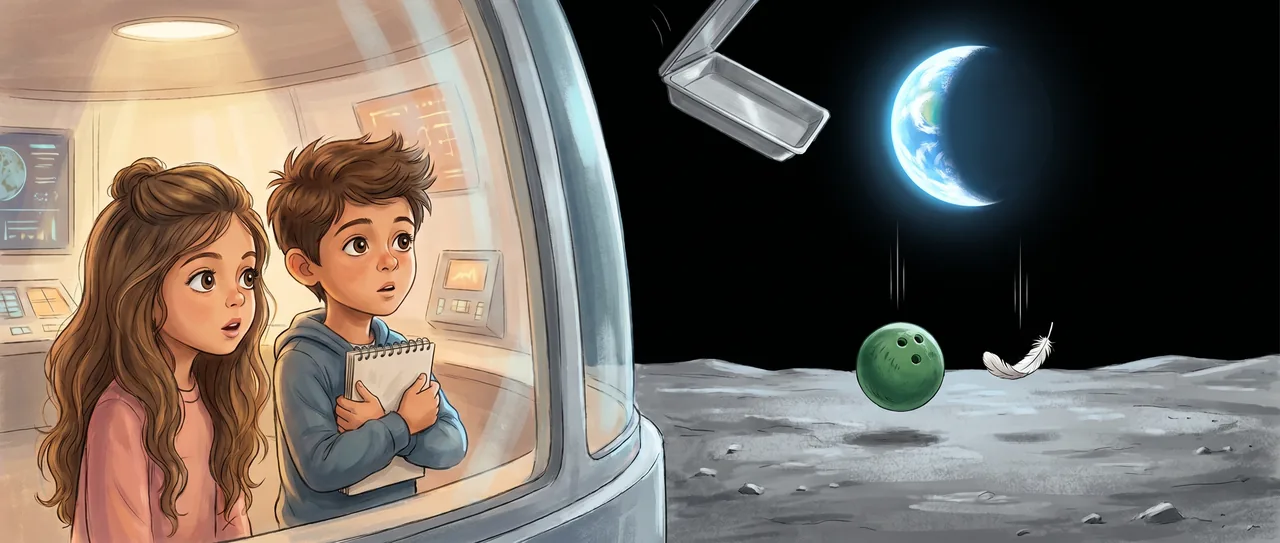
On the screen above the museum floor, the bowling ball fell beautifully. It dropped from the silver frame outside the dome, round and green and enormous against the black sky. It struck the gray dust below and bounced once in the Moon’s lazy gravity.
The feather stayed at the top.
It hung from the little plastic fingers of the release clamp, crooked and white, while the bowling ball rolled away by itself.
Maya said, “That’s wrong.”
The exhibit director rubbed both hands over her face. She had silver dust on one sleeve and a microphone clipped upside down to her collar. “Yes. Thank you. Very wrong. The opening is in three hours.”
Soren stood close to the screen, notebook tucked under one arm. Paper notebooks were rare enough on the Moon that people looked at his like it might shed crumbs into the air filters.
“The ball didn’t prove anything alone,” he said.
“It proved gravity still works,” the exhibit director said. “Which is nice, but not worth the ribbon cutting.”
Maya watched the replay again. The clamp opened. The bowling ball fell. The feather shivered, bent sideways, and remained caught by one barbed bit of plastic.
“It didn’t fall late,” Maya said. “It didn’t fall.”
“I know,” the director said. “The clamp was designed for dramatic objects. Tools. Rocks. A bowling ball, apparently. Not poultry decoration.”
“It has to be a feather,” Soren said.
The director gave him a tired smile. “The plaque says Galileo. The school groups will survive if I use a foam cutout.”
Maya turned from the screen. “No.”
The director blinked.
Soren said, “A foam cutout is just another heavy thing shaped like a feather.”
“It is also an object that will actually leave the clamp,” the director said. She checked the upside-down microphone, frowned at it, and clipped it the right way. “I have a cracked rover windshield in Theater Two, six missing mooncakes in the cafe printer, and a mayor who wants to drop the ball herself. If you two can make truth behave by noon, station three is yours. If not, I am committing historical nonsense with confidence.”
She hurried away across the springy museum floor.
Maya was already moving.
“Where?” Soren asked.
“Not the control panel.”
“That was my first where.”
“The problem isn’t the button.”
They went through the maintenance hatch into the exhibit prep bay. Beyond the thick glass, outside the dome, the drop frame stood in vacuum on three spidery legs. Earth hung above it, blue and white and too bright to look at for long.
Inside the bay were spare clamps, aluminum rods, tool trays, camera drones, and one extra bowling ball labeled PLEASE DO NOT ROLL.
Maya picked up the feather from the failed test. It had a kink near the quill where the clamp had pinched it.
“Feathers are too complicated for fingers,” she said.
Soren opened his notebook, then shut it again without writing. “So don’t use fingers.”
Maya smiled. “Exactly.”
They tried a loop of thread first. The feather caught. They tried a flat magnet for the ball and a tiny hook for the feather, then both stared at the hook and said, at almost the same time, “No.”
“A magnet lets go of the ball,” Soren said. “The hook lets go of the feather differently.”
“Different leaving,” Maya said.
She picked up a tool tray. It was a rectangle of brushed aluminum with a low lip and two handles. She set the bowling ball on one side. The tray dipped.
Soren put the feather on the other side. It lay there, small and foolish and necessary.
“If the tray is the floor,” he said slowly, “and the floor goes away…”
“Same leaving,” Maya said.
They found a hinge rod and a release motor from a retired display about asteroid mining. The motor was overlarge, painted orange, and had a sticker that said I STILL WORK. Soren tested the hinge six times. Maya adjusted the tray so it would swing down fast without flicking upward. The first indoor test tossed the feather sideways. The second made the bowling ball roll into Soren’s shoe.
“Ow,” he said.
“Gravity works,” Maya said.
“Noted.”
On the third test, the tray vanished downward and both objects began to drop at the same instant. They only fell the short distance to the padded floor, in air, so the bowling ball still won by a thump.
Maya looked at the feather drifting after it.
“That’s air being loud,” she said.
Soren nodded. “Outside, air shuts up.”
They mounted the tray assembly to the exterior frame using the waldo arms, working from the warm side of the glass. The robotic hands outside moved with tiny delays, clumsy but obedient. Maya guided the hinge into place. Soren tightened bolts in a star pattern because he said corners liked fairness.
The exhibit director returned with a mooncake in one hand and panic in both eyes.
“That,” she said, “is not the approved release device.”
“The approved release device holds feathers hostage,” Maya said.
Soren pointed to the control readout. “One shelf. One hinge. One motor. No clamp. Same height.”
The director looked through the glass at the bowling ball and feather resting together on the metal tray outside. The white feather was almost invisible against the glare until the camera zoomed in.
“It looks ridiculous,” she said.
“Yes,” Soren said.
Maya said, “That’s why it works.”
The director almost laughed. Then she looked at the countdown clock and did laugh, once, sharply. “Test it.”
The museum lights dimmed by themselves because the opening program had already begun. Somewhere beyond the prep bay, a recorded voice welcomed visitors to the Hall of Falling Things.
Maya placed her finger above the release button but did not press it.
Soren checked the camera feed. “Frame rate ready. Height markers ready. Dust pad clear.”
Maya asked, “You think they’ll see it?”
“The ball, yes.”
“The feather.”
Soren looked at the screen. The feather was bent at the tip. It looked like it had no business being part of a machine, or a law, or anything important.
“They have to,” he said. “Without it, the ball is just showing off.”
Maya pressed the button.
Outside, the orange motor turned. The tray snapped down out of the way.
The bowling ball fell.
The feather fell.
For one breath, Maya’s eyes tried to make the ball win. It was bigger. It was heavier. It was the kind of thing that should have arrived first because everything about it looked like first.
It did not.
The feather did not flutter. It did not drift. It did not ask the air for permission, because there was no air to ask. It kept beside the bowling ball, falling through the black lunar morning as if the two of them had agreed on a secret before anyone was born.
They struck the dust together.
Not almost together.
Together.
A puff of gray rose around the bowling ball. The feather lay on the dust beside it, absurd and exact.
The director whispered a word Maya was probably not supposed to hear.
Soren had stopped holding his notebook. It was pressed flat against his chest with both hands.
On the screen, the replay began. Height marker after height marker flashed past. Ball. Feather. Ball. Feather. Neither pulled ahead.
The exhibit director stared at the image. “Galileo would have adored the Moon.”
“Einstein too,” Soren said.
She glanced at him. “That’s the elevator one, right? Falling rooms?”
Soren nodded, but he was still looking at the feather.
Maya said, “If the floor falls with you, you don’t feel the floor.”
The director’s eyes sharpened for half a second, then her wrist alarm chirped. “I have to stop the mayor from carrying scissors into an airlock. Can your falling shelf survive an audience?”
“Yes,” Maya and Soren said together.
“Wonderful. Terrifying. Continue.”
She ran.
The public program began ten minutes later. Maya and Soren stayed in the prep bay behind the glass, where they could see the audience only as dim shapes reflected over the black sky. The director spoke into her microphone. Her voice came through the wall speaker, bright and breathless.
“On Earth, a feather loses the race because it must push through air. Here, outside our dome, there is no air for the feather to fight.”
Maya leaned toward Soren. “She kept the feather.”
Soren said, “She kept the truth.”
The countdown reached zero. The tray vanished. The bowling ball and feather fell together again.
This time, the sound came from inside the museum.
It started as one gasp. Then another. Then a whole room full of people making the same small noise, as if the dome itself had taken a breath.
Maya did not look at the audience. She watched the feather on the screen, lying beside the bowling ball in the dust. The smallest, strangest part of the exhibit had made the heavy thing tell the truth.
Soren touched the glass with one fingertip. “The elevator cabin is behind station four.”
Maya turned.
“It only drops four meters,” he said. “For the Einstein part. They use a camera and a foam cube.”
“Does it work?”
“It worked yesterday.”
Maya was already at the cabinet where the spare feathers were stored.
Soren opened the service panel beside station four. He read the instructions twice, then checked the green safety light. The cabin was made for visitors, padded and clear-fronted, with a sign that said LOCAL FREE FALL DEMONSTRATION. MAXIMUM TWO RIDERS.
Maya stepped in holding a feather on her open palm.
Soren stepped in beside her and pressed the start button.
The cabin clicked. The floor dropped away. The feather rose from Maya’s palm and hung level with Soren’s nose.
Read the interactive version, listen to the narration, and earn a gold star →
A science-verified short story for curious kids · Curiosity Land