The Missing A
The cell would not start.
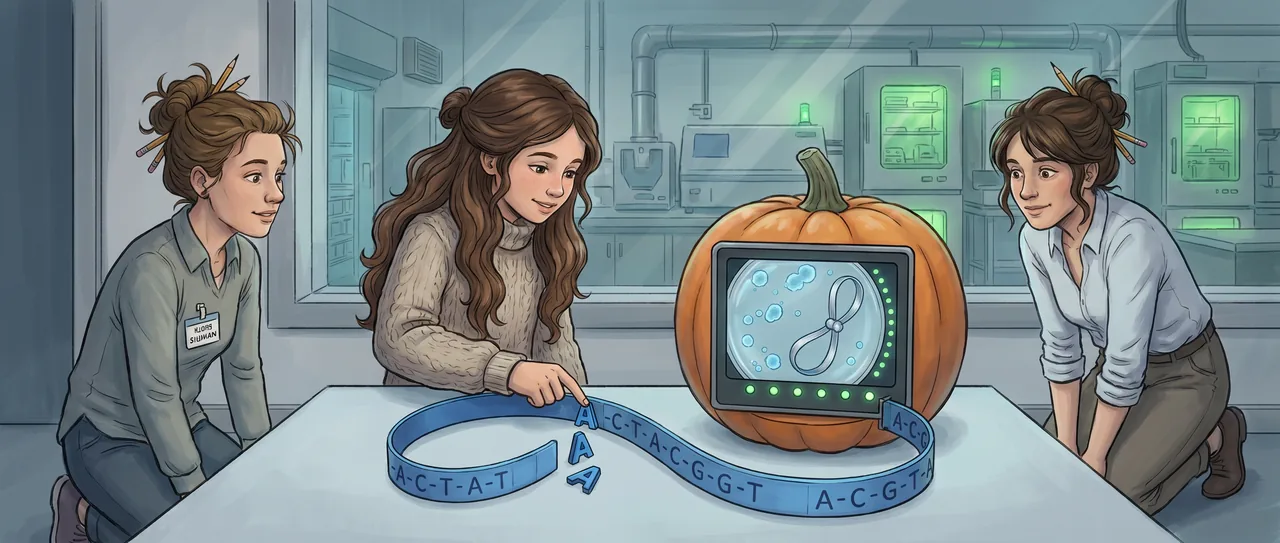
That was what the screen said, though the thing on the table was not a real cell. It was a clear plastic bubble the size of a pumpkin, full of colored tubes and tiny lights. Around it ran a long blue strip printed with letters.
A C G T. A C G T. A C G T.
Maya stood with her hands in her sleeves and watched the word on the screen blink.
NO BOOT.
The exhibit builder made a sound like a kettle trying not to boil.
“It worked yesterday,” she said. She had three pencils in her hair and a badge clipped on upside down. “Of course it worked yesterday. Opening morning is when machines develop opinions.”
Maya looked past the model cell, through the wide glass wall into the real lab. There were benches, gloved hands, silver freezers, and an incubator with a small green light. No one inside seemed worried about the plastic cell refusing to live.
The builder tapped the screen again.
NO BOOT.
“It’s only the children’s interactive,” she said. “The important part is the display text.”
Maya turned to the display text.
SCIENTISTS CREATE LIFE FROM SCRATCH.
She read it twice. The words sat wrong.
“Did they?” Maya asked.
The builder was on her knees now, pulling cables from under the table. “Did they what?”
“Create life from scratch.”
“Yes. Well. Close enough for a sign.”
Maya frowned at the model cell. Inside the clear shell, a little silver loop hung in the middle like a sleeping bracelet.
“If it was from scratch,” Maya said, “why is there a cell?”
The builder stopped tugging cables. “You are exactly the sort of child who makes signs difficult.”
Maya took that as permission to keep looking.
The viewing room smelled like new paint and warm electronics. Along one wall, a mural showed a chromosome being built from smaller pieces, then placed into a bacterium. The last picture showed many bacteria, all pale blue dots on a round plate.
Under the picture, smaller words said: Researchers chemically synthesized a complete bacterial chromosome, transplanted it into a bacterial cell, and the cell was controlled by the synthetic genome.
Maya liked those words better. They did not slide around.
“So the shell was already alive?” she asked.
“The cell machinery was there,” the builder said. She had disappeared up to her shoulder under the table. “The old genome was gone. The synthetic chromosome took over. Like booting a computer, except wetter and much fussier.”
Maya looked again at the blue strip of letters. It looped around the model cell, through a little reader, and back again. Most of it was printed in neat groups of three.
A C G. T T A. C A A. G G T.
Triplets. Codons. She had learned that word from a video she had watched when she was supposed to be choosing socks.
The strip entered the reader with a soft click, but near the left hinge the rhythm changed.
A C G. T T. C A A.
Maya leaned closer.
There was a tiny square of bare blue plastic between two letters. Not a tear. Not a smudge. A missing place.
“Something fell off,” Maya said.
“Probably decorative,” the builder said from under the table.
Maya put one finger on the bare square. It had a faint sticky edge.
“It has a sensor line under it.”
The builder backed out and bumped her head. “Please do not dismantle the genome before the mayor arrives.”
“I’m not dismantling it. It’s already dismantled.”
Maya crouched. The floor was gray and speckled, exactly the kind of floor that ate small things. She did not search everywhere. She followed the path the strip would have taken when someone cleaned the table. There was a scrape on the metal leg, then a dust line, then a place where the tablecloth folded inward.
She pinched the fold.
A small magnetic letter came out stuck to her thumb.
A.
The builder stared at it.
“That cannot be the problem,” she said.
Maya held the A beside the gap. It fit the empty square. Same blue backing. Same tiny metal dot.
The builder looked at the blinking screen. “It absolutely cannot be the problem.”
Maya put the A into the gap.
The strip clicked forward by itself.
Inside the plastic cell, the silver loop lifted. One light blinked, then three, then a circle of them, fast and green. The screen stopped saying NO BOOT.
It showed a sealed plate under a camera. At first the plate looked empty. Then the time-lapse began, and blue pinpoints appeared where there had been nothing but clear gel. More came. They gathered into tiny round colonies, each one made of cells too small to see alone.
Maya did not move.
The blue dots were not sparks. They were not pixels pretending. They were images from the real experiment, the caption said, cells whose only chromosome was the one people had built letter by letter. The cell had read it. The cell had copied it. The cell had become the instructions it was given.
On the wall, the sign still said from scratch.
Maya stepped to the spare caption cards stacked near the builder’s toolbox. There were markers there, thick black ones for adults who wrote too large.
She picked one up.
The builder said, “If you are about to correct my grammar, I should warn you that I have had very little coffee.”
Maya crossed out nothing. She wrote on a blank card instead.
A living cell, booted by a synthetic chromosome.
She taped it under the big sign.
The builder read it silently. Then she read the old sign. Then she took the old sign down.
“Better,” she said. “Less shiny. More true.”
Maya looked back at the missing A, now back in its place.
“One letter stopped it,” she said.
“In the model, yes.” The builder opened a drawer and pulled out a small laminated card. “And in the real project, something very much like that happened. The first synthetic genome would not boot because of a tiny error in an essential gene. One wrong place in more than a million letters.”
Maya took the card.
One base pair deletion in dnaA prevented viable transplantation.
She read the sentence three times, not because it was hard, but because the room changed shape around it.
At school, a missing letter was a red mark. At dinner, a tiny correction made people sigh. Here, a missing letter was the difference between a silent plate and blue colonies blooming under glass.
The builder was watching her now, not impatiently.
“The annoying detail people,” the builder said, “are often the ones who keep the universe from lying to us.”
Maya did not answer. She was looking through the glass wall.
A gloved researcher carried a rack of tubes past the incubator. Each tube was no bigger than Maya’s thumb. Inside one of them, maybe, were cells reading molecules arranged by human hands. Not thinking. Not deciding. Reading, copying, dividing.
The builder pressed another button on the exhibit.
A new panel lit up: WATERMARKS.
“Here is the strange part,” the builder said. “The scientists put watermark sequences into the chromosome. Names. An email address. Messages encoded in DNA, so anyone sequencing the genome could tell it had been made.”
Maya turned around slowly.
“In the cell?”
“In the chromosome.”
“In the thing it copies.”
“Yes.”
Maya looked at the four letters on the blue strip. A, C, G, and T. Four letters, and a bacterium could be written. Four letters, and a return address could be hidden inside something alive.
The builder gave a small laugh. “We do not let visitors type messages into genomes, before you ask.”
“I wasn’t asking that,” Maya said.
She was, a little.
On the table beside the model cell was a tray of spare magnetic letters. The builder had sorted them into piles, but the piles had slumped into one another. Maya began separating them. A with A. C with C. G with G. T with T.
The exhibit hummed. Behind the glass, the incubator light stayed green.
Maya laid the four magnetic letters on the metal ledge, A, C, G, T, and left her hand hovering over the next empty square.
Read the interactive version, listen to the narration, and earn a gold star →
A science-verified short story for curious kids · Curiosity Land