The Knee That Changed Its Mind
The gray liquid would not pour.
Maya held the little clear cup sideways over the tray and watched the liquid lean out, heavy and glossy, then stop with its nose hanging in the air.
Under the tray, the lab engineer held up a black magnet the size of a cookie.
"See?" he said to the visitors. "Liquid to solid. Almost instant. Magnetorheological fluid. Very dramatic. Please do not drink it."
Everyone laughed because grown-ups liked signs that said things they were already not going to do.
Maya did not laugh. She lowered one eye until it was level with the tray. The gray nose of liquid kept its shape. It looked like a puddle that had suddenly remembered a rule.
The engineer pulled the magnet away.
The gray nose fell with a plop.
Maya said, "Again."
"We have a schedule," the engineer said. He was already looking past her at a tablet clipped to his belt. "Today we are showing smart materials. This fluid has tiny iron particles in oil. A magnetic field makes it resist motion. Cars use dampers like this so the suspension can stiffen during turns. Prosthetic knees use the same idea to change resistance while someone walks. Wonderful stuff. Next table has a shape-memory wire."
Maya stayed at the first table.
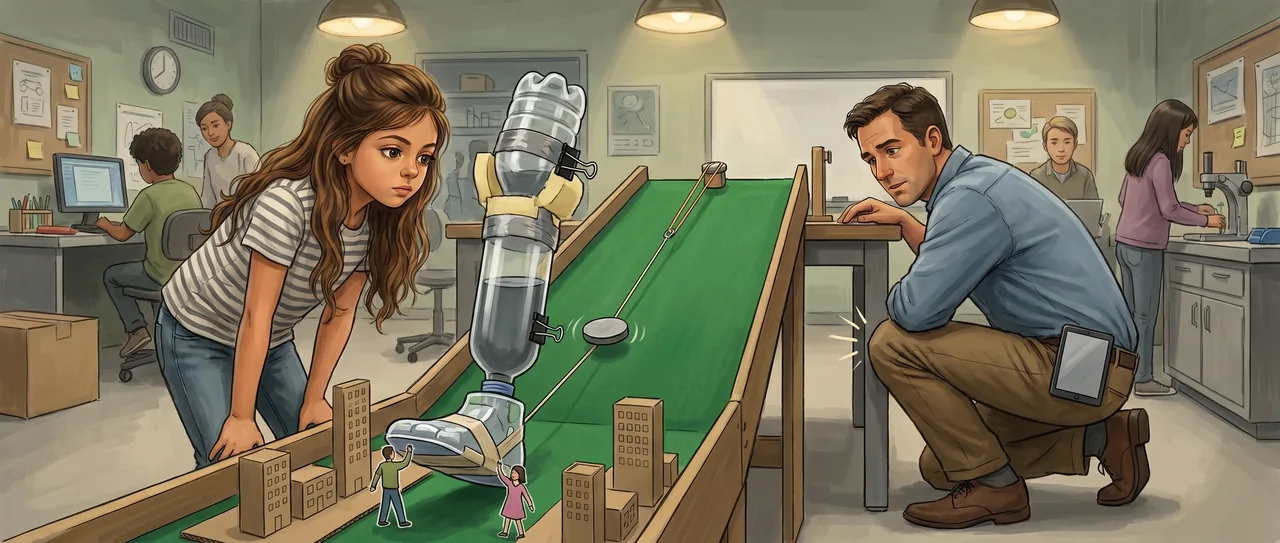
There were three model legs on stands. Each had a plastic thigh, a plastic shin, and a fat clear cylinder at the knee with dark fluid inside. A small paddle sat in each cylinder, connected to the hinge. When the knee bent, the paddle had to push through the fluid.
There was also a ramp covered in green felt. At the bottom of the ramp was a cardboard city with tiny paper people who had no knees at all.
A sign said, Make the model knee walk down the hill.
The engineer glanced over. "That station is being fussy. The knee either collapses or refuses to bend. We are waiting for the software people. You can try the dial, but do not force anything."
He turned to greet a man carrying a camera.
Maya turned the dial on the first model to zero and set the leg at the top of the ramp.
The knee folded immediately. The plastic shin kicked backward. The whole model slid down on its thigh and knocked over a paper person.
"Too soft," Maya said.
She turned the dial all the way up.
This time the knee stayed straight. The model tipped forward like a tree and slapped the ramp face-first.
"Too stiff."
A girl passing by said, "It has to pick one."
Maya kept her hand on the dial.
Pick one was what people said when they wanted her to slow down or stop changing answers. Pick one book. Pick one question. Pick one place to stand in line. But the gray liquid had not picked one. It had been runny until something invisible told all the hidden bits where to face, and then it had held itself together.
Maya set the model upright again.
Soft was good when the leg needed to swing. Stiff was good when it needed to hold weight. The wrong part was not the fluid. The wrong part was asking it to be one thing for the whole walk.
She turned the dial low, nudged the shin forward with two fingers, then twisted the dial high just as the foot touched the felt.
The knee held.
She twisted the dial low again and pushed the thigh.
The shin swung.
High, low. Hold, swing. Hold, swing.
The model took three ugly steps and stopped sideways, leaning against a paper tree.
Maya looked at the dial. It was too far from the knee. A person could not walk by having an engineer run beside them turning a knob.
She dug through the parts bin. Foam, string, binder clips, craft sticks, tape, rubber bands, round magnets, square magnets, copper wire, a battery holder she did not touch because she had not asked, and three paper cups full of screws.
The model did not need software for the first try. It needed the knee to tell the magnet when the foot was on the ground.
Maya took a flat round magnet and held it near the clear cylinder. The paddle inside the fluid resisted her fingers at once. She pulled the magnet away. The paddle loosened.
"Fast," she said.
She held the magnet close, away, close, away, moving it quicker each time. The fluid answered every time. No pause she could catch. No thinking face. No warming up.
The engineer came back with the camera man. "Careful with that magnet. It is strong enough to pinch."
"It listens fast," Maya said.
"The particles line up in the field very quickly," he said. "Milliseconds. But the controller is the hard part."
He smiled at the camera. "Children love the magic."
Maya did not look up.
She taped the magnet to the end of a craft stick. She hinged the craft stick to the plastic thigh with a binder clip so the magnet could swing toward and away from the fluid cylinder. A rubber band pulled it away. A string tied the other end to a little cardboard foot plate under the model's foot.
When the foot pressed down, the string tugged the magnet close.
When the foot lifted, the rubber band pulled it away.
The first test snapped the magnet too hard against the cylinder.
"Bad," Maya said, and moved the binder clip higher.
The second test did nothing.
"Too far."
She shifted the magnet inward until it hovered beside the fluid with a sliver of air between them.
The third test made the model stand without falling.
Maya put it at the top of the ramp.
The foot touched felt. The magnet swung close. The knee stiffened.
The body rolled forward. The foot lifted. The magnet sprang away. The knee bent.
Touch, close, stiff.
Lift, away, loose.
The model walked like a nervous bird. One step. Two. Three. At the fourth step it stumbled, recovered, and clicked onward. At the bottom of the ramp it stopped in the cardboard city with one plastic foot planted between two paper people.
The engineer's mouth stayed open for a second.
The camera man lowered his camera.
"It is not picking," Maya said. "It is answering."
The engineer crouched beside the ramp. His tablet slipped sideways on his belt and bonked his knee, but he ignored it.
"You made a mechanical gait switch," he said.
Maya pressed the foot plate with one finger. The magnet swung in. She lifted her finger. The magnet swung out.
"It only has one question," she said. "Foot down or foot up."
The engineer laughed once, quietly, not like the visitors had laughed. "That is a very good question."
He carried the model to the workbench and set it beside a real prosthetic knee joint, silver and smooth, with wires tucked into its side and a label that said Demonstration Unit. Maya had thought the model was the important thing because it had moved. Now the real knee sat there without moving at all, and somehow it seemed busier than everything else in the room.
The engineer opened a drawer and took out a sealed clear puck half full of the same dark gray fluid. He placed it in Maya's palm.
"This one is for visitors to test," he said. "No spilling."
It was heavier than it looked.
Maya tipped the puck. The fluid slid slowly to one side.
She held a magnet under it.
The gray surface stopped at a slant, holding the shape of a hill inside the plastic.
Read the interactive version, listen to the narration, and earn a gold star →
A science-verified short story for curious kids · Curiosity Land