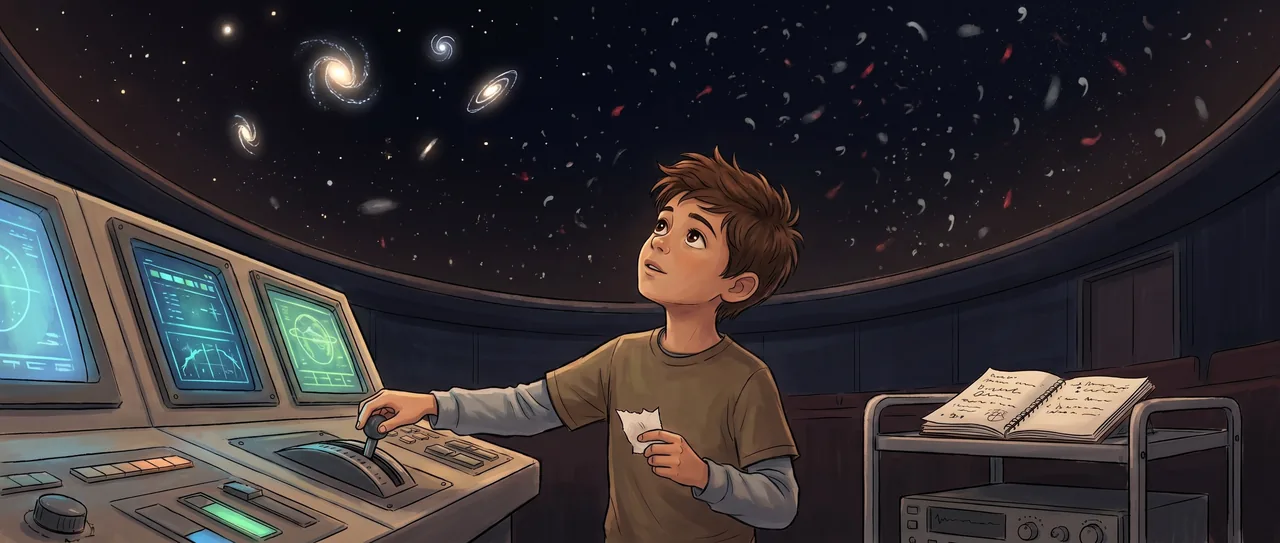
The Galaxies That Did Not Fit
The first thing Soren broke was the universe.
It was not the real universe. It was the planetarium's new wall display, which was supposed to open in forty-three minutes. Still, the exhibit manager made the same sound she might have made if Soren had cracked Saturn.
"No," she said. "No, no, no. Put it back."
On the control screen, the sentence glowed in calm white letters.
The observable universe contains about two trillion galaxies.
Before Soren had touched it, the sentence had said one hundred billion.
The exhibit manager rubbed her forehead with the heel of her hand. She had a pencil behind one ear, two visitor badges clipped to her sweater, and a strip of blue tape stuck to her sleeve that she had not noticed for at least an hour.
"Soren," she said, "we approved the sign last month."
"It's old," Soren said.
"The vinyl is new."
"The number is old."
She looked at the ceiling, where the planetarium dome waited, blank and huge. "The doors open at seven. I need clean. I need readable. I need people not asking why the sign changed while they are holding juice boxes."
Soren had his paper notebook open on the equipment cart. The exhibit manager had already asked if it was a prop. It was not a prop. It had three pages about galaxies, one page about why black printer ink smelled different when warm, and a corner folded over on a sentence he had copied from an article.
In twenty sixteen, astronomers reanalyzed deep field images and estimated that the observable universe may contain roughly two trillion galaxies, about twenty times more than earlier estimates.
Soren had written the sentence because it had made the inside of his head feel crowded.
"Two trillion is the estimate," he said. "Not one hundred billion."
"Fine," the exhibit manager said. "Make it say two trillion. But make it make sense."
Then she hurried away to argue with a projector that was making Mars look peach.
Soren looked at the words on the screen.
Two trillion.
The number sat there like a very large password. It did not look bigger than one hundred billion. It had more letters. That was all.
He tried the next display mode. The computer spilled dots across the wall, each dot meant to stand for a galaxy. The dots were white, cheerful, and useless. At one dot per billion galaxies, two thousand dots made the wall look like somebody had sneezed stars on it.
He changed the scale.
At one dot per million galaxies, the program froze.
The cursor became a spinning blue circle.
Soren waited.
The blue circle spun.
"That seems fair," he said to the computer. "I also cannot picture it."
He restarted the display before the exhibit manager could see. Then he opened the folder marked Deep Field Assets.
There were pretty images first. Black space, golden spirals, red smudges, blue chips of light. He skipped those. Pretty images were sometimes too clean. He opened the public archive file the planetarium used for the interactive station, the one with sliders for brightness, contrast, and stretch.
A square of sky appeared on the monitor.
It did not look like much. A few bright galaxies. A few little streaks. Specks. Scratches. Things someone might wipe off if the universe were glass.
A label below the image said the patch of sky was small enough to hide behind a grain of sand held at arm's length.
Soren tore a tiny corner from a scrap of paper and held it out in front of the monitor. Too big. He pinched it smaller. Still too big. At last he used the dot over a printed letter i on the scrap, holding it at arm's length until it covered the deep field square.
The whole image vanished behind a crumb of ink.
He lowered the scrap.
Thousands of galaxies came back.
The exhibit manager rushed past carrying a coil of cable.
"Please tell me the wall no longer says two trillion in giant letters," she said.
"It doesn't," Soren said.
That was true. He had hidden the words.
He dragged the brightness slider down until only the loudest galaxies remained. Big spirals. Sharp ovals. The kinds of galaxies people meant when they said galaxy. He pressed count.
The software outlined the brightest objects in green.
Not many.
He nudged the stretch control. The black between the bright galaxies softened. Pale marks rose out of it. Gray commas. Red pinches. Blue grains. Some were barely different from the darkness around them.
He pressed count again.
More green outlines appeared.
He moved the slider again.
More.
Again.
More.
The image became messy, then crowded, then almost furry with light. Some of the faint things were noise, and the software warned him about that in a red box. Soren did not close the warning. He liked warnings that were honest. Astronomers had to separate signal from noise. They had to account for what the telescope could not see clearly. They had to build models from the deep fields, not pretend every hidden galaxy had marched onto the screen and introduced itself.
But the important part was not hiding.
If the display only counted the easy galaxies, the universe came out small.
Soren made a new sequence.
First, the approved sentence appeared.
Earlier estimates counted about one hundred billion galaxies.
Then the deep field patch appeared, with only the brightest galaxies outlined.
Then a slider moved by itself.
Fainter galaxies emerged.
A new line appeared.
Deep images showed many more small, faint galaxies than earlier counts could include.
Then the number returned, not alone this time.
About two trillion galaxies may fill the observable universe.
He watched it once.
It was still wrong.
Not scientifically wrong. Worse. It ended too neatly. It made two trillion look like a replacement tile. Pull up one number. Put down another. Sweep away the dust.
Soren opened the sequence again and removed the final fade-out.
The exhibit manager came back at a fast walk. Mars was no longer peach. Her hair had escaped its clip on one side.
"Doors in twelve minutes," she said. "Show me."
Soren played the sequence.
At the first sentence, she nodded.
At the deep field patch, she leaned closer.
When the faint galaxies began to appear, she stopped moving.
The little green outlines multiplied in the dark.
"Those are all galaxies?" she asked.
"Some are uncertain," Soren said. "Some are too faint to count one by one. The twenty sixteen estimate used deep field images and models. But yes. The small faint ones matter. If you leave them out, you get the small number."
The exhibit manager looked at the old approved sentence still sitting in the corner of the screen. One hundred billion seemed suddenly tidy in an embarrassing way, like shoes lined up before a flood.
"People are going to ask questions," she said.
"Good," Soren said.
She glanced at him.
He did not take it back.
For a moment, the planetarium was quiet except for the air system breathing through the vents and the soft click of the cooling projector. Soren could hear visitors in the lobby, a rising murmur beyond the doors.
The exhibit manager pulled the blue tape from her sleeve and stuck it across the old printed sign.
"Run it on the dome," she said. "If the trustees complain, I will say an eleven-year-old broke the universe and I had no time to fix it."
"I didn't break it," Soren said.
"You made it larger five minutes before opening. That is close."
Soren sent the image to the dome.
The square of deep sky appeared overhead. It was no longer a square on a monitor. It was a window cut into the dark above every seat. The bright galaxies showed first, proud and countable.
Visitors began to enter below it. Their footsteps softened on the carpet. Coats whispered. Someone dropped a program. A little rain of paper sound.
Soren stood at the control panel, one hand on the slider.
The old count glowed for a moment and then dimmed.
The patch of sky waited above him, small enough to hide behind a grain of sand, large enough to make the dome feel thin.
Soren moved the slider one notch farther. On the dome, between the galaxies everyone had already seen, hundreds of pale gray commas appeared.
Read the interactive version, listen to the narration, and earn a gold star →
A science-verified short story for curious kids · Curiosity Land