The Forest That Breathed Out
The forest was supposed to be breathing in.
That was what forests did on sunny days. Leaves opened. Needles drank light. Carbon dioxide went down into wood and root and bark. Soren knew this because he had written it in his notebook three days ago, beside a careful drawing of the silver tower that stood above the pines.
The tower did not agree.
Its screen, bolted inside the field station beside the boot rack, showed a red line climbing all morning.
The station chief stared at it with her hair still wet from a rushed shower and a radio clipped upside down to her belt.
“No,” she said. “Absolutely not.”
Maya leaned so close her breath fogged the screen.
The station chief waved her back with a granola bar. “If the tower says this stand is giving off more carbon dioxide than it takes in, then something chewed a cable. Or the intake clogged. Or a bear used my tower as a back scratcher.”
Soren looked out the window.
The pines stood shoulder to shoulder up the slope. They had trunks. They had branches. They had needles. From far away they were a forest.
From close up, the needles were the wrong color.
Not autumn gold. Not living green. A dry rusty red, all the way up the hill.
Maya said, “It is not the bear.”
The station chief was already stuffing papers into a waterproof folder. “Great. Then it is squirrels, ghosts, or my least favorite option, expensive electronics. I have a satellite call in six minutes. You two can walk the flagged line to the tower and look for damage. Do not climb anything. Do not lick anything. If you find bear hair, do not collect it in your pockets.”
“We were not going to lick the tower,” Soren said.
Maya was still looking at the red trees.
The station chief opened the door with her elbow. “And if the beetles come up, yes, I know. Mountain pine beetles made this place a disaster. Warmer winters let too many survive. They killed more trees in this province than people ever cut down. But beetles do not make my sensor lie by lunchtime.”
The door banged shut behind her.
Maya said, “She put the wrong sentence at the end.”
Soren picked up the small repair kit. “Which sentence?”
“But beetles do not make my sensor lie.”
Outside, the air smelled like warm dust and old Christmas trees.
They followed orange flags through trunks that looked alive until they did not. The red needles made almost no sound. No soft rubbing. No whisper. When wind crossed the slope, the forest clicked.
Soren checked the first cable box. Tight screws. No chew marks. No bear hair. He wrote, Box one intact.
Maya had stopped at a pine.
“Look,” she said.
The bark was sprinkled with little pale lumps, as if the tree had tried to push out popcorn.
Soren touched one. It was hard resin.
“Pitch tubes,” he said. “The tree tried to drown something.”
“At every hole,” Maya said.
There were many holes.
Soren took out the hand lens from the kit. Maya pried at a loose plate of bark with the flat screwdriver, not enough to strip the tree, just enough to lift a flap already cracked away.
Under the bark, the wood was written on.
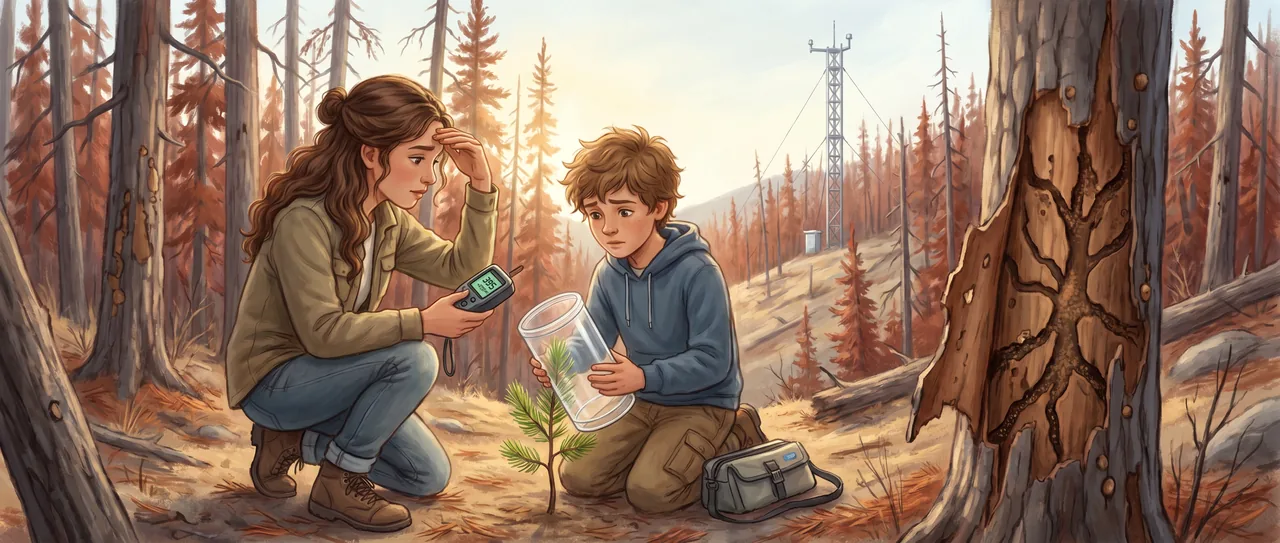
A dark central line ran up the trunk. Smaller lines curled away from it, each one packed with brown dust. The pattern looked like a map of rivers made by something that had never seen the sky.
Soren forgot to write.
Maya put one finger beside the tracks but did not touch them.
“Not one beetle,” she said.
“No,” Soren said.
He held the lens closer. The tunnels were not random scratches. They were rooms and roads, eggs and larvae, a whole hidden plan pressed between bark and wood.
Maya had once been told to stop making giant answers from tiny dots. Here were the dots. The giant answer had teeth.
Soren counted entrance holes in a patch of bark as wide as his hand. He got to twenty-seven and stopped because the bark curved away and the holes kept going.
“A healthy pine can push out some beetles with resin,” he said. “Not this many.”
Maya looked uphill. Every trunk had freckles.
The tower came into view above them, metal legs and spinning cups and small white instruments pointed at the air. Nothing was chewed. Nothing was bent. A chickadee sat on one brace and scolded them as if they had arrived late.
Soren checked the intake tube. Clear.
Maya checked the cable where it entered the data box. Smooth.
“No bear,” Soren said.
“No lie,” Maya said.
The repair kit included a clear plastic chamber, a rubber gasket, and a handheld carbon dioxide meter for testing leaks. Soren had read the instructions twice because the station chief had said the kit was fussy, and fussy things usually became unfussy if you let them tell you how.
He set the chamber over a patch of moss.
The number on the meter drifted down.
Maya smiled. “Still breathing in.”
He set it over a fallen log where the bark slipped off in damp red sheets.
The number climbed.
Soren waited, because one climb could be a mistake. It climbed again. Faster.
Maya crouched beside the log. The wood was soft enough for her finger to dent. Inside it, threads of fungus laced the grain, pale and fine. Beetles had carried blue-stain fungi into living trees. Other fungi had arrived after death. Things too small to see clearly were eating what the trees had made from air.
Soren moved the chamber to bare soil under the dead pines.
The number climbed there too.
He moved it to a green huckleberry shrub growing in a sun patch where a pine crown had thinned.
The number fell.
Maya held out both hands, one toward the dead trunks, one toward the shrub. “Parts in. Parts out.”
“The tower sees all of it,” Soren said.
They both looked up.
The silver tower was not watching one tree. It was tasting the air above thousands. Needles that no longer pulled carbon down. Wood and roots and fallen branches feeding microbes that breathed carbon out. Beetles small enough to hide under bark had changed the answer of the whole hill.
The world got too large for Soren’s ribs.
Not because the forest was dead. It was not only dead. It was busy. It was full of mouths without faces, chemistry without footsteps, weather from winters that had not been cold enough, summers that had given beetles time, larvae that had survived beneath bark because the old deep killing cold had missed them.
He thought of minus forty, the kind of cold that could stop a beetle under bark. He thought of a winter that warmed by just enough. Not warm like summer. Not dramatic. Just enough.
Maya stood very still.
Then she ran.
“Maya,” Soren called.
“Seedling,” she called back.
He grabbed the chamber and followed.
She had found it behind a fallen trunk, so small the flags had missed it. A young pine, no taller than Maya’s knee, with green needles bunched at the tips like little brushes. Around it, the old forest stood red and gray. Above it, sunlight poured through a hole where dead branches had fallen away.
Soren lowered the chamber, then stopped. “If we cover it too long, it will heat up.”
“Short test,” Maya said.
He nodded.
They settled the gasket gently around the seedling without bending its needles. Soren plugged in the meter. Maya shaded the screen with her hand.
The station chief’s voice crackled faintly from the radio far below, sharp and busy, asking somebody why the satellite link hated her.
Soren did not answer. He watched the screen.
The number paused.
Maya did not blink.
The number fell.
Not much. Not enough to change the hill. Not today.
Maya lifted one finger from the edge of the chamber, letting a thread of outside air slip in.
Soren loosened the seal.
The seedling sprang upright inside the clear dome.
Maya set the chamber over the seedling. Soren crouched beside her, and the tiny screen on the cable changed from rising numbers to falling ones.
Read the interactive version, listen to the narration, and earn a gold star →
A science-verified short story for curious kids · Curiosity Land