The Direction No One Colored
The first thing the bee did was get lost.
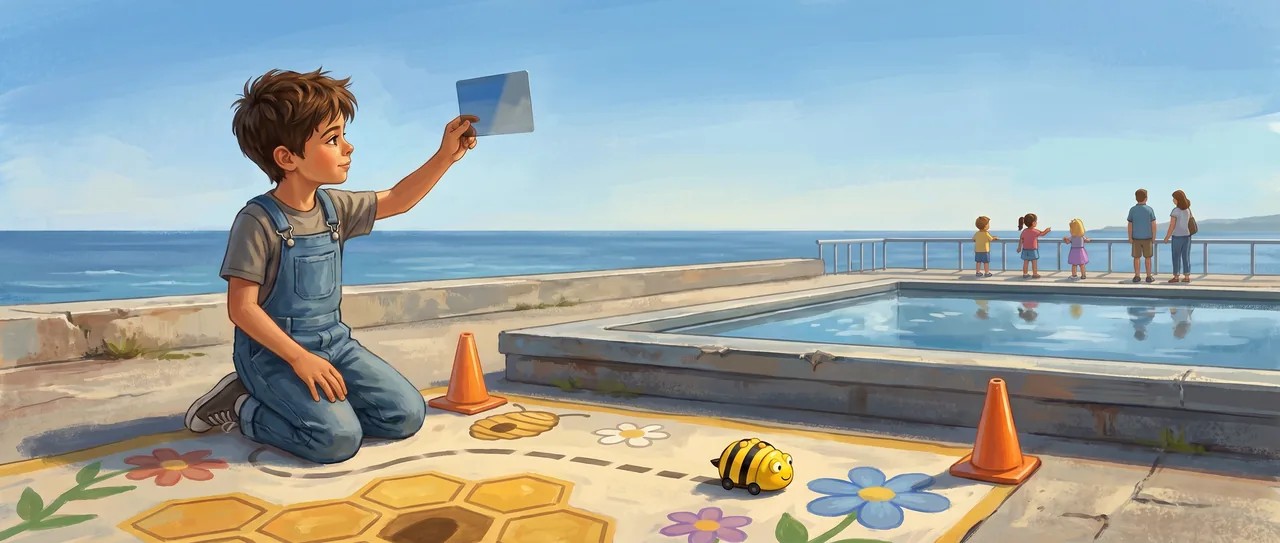
It was not a real bee. It was yellow, the size of a lunchbox, with clear wings that did not move and two black windows for eyes. It was supposed to crawl across the aquarium roof from a painted hive to a painted flower without following a line, a magnet, or a remote control.
It went three careful inches, turned in a circle, and bumped into a coil of hose.
The exhibit maker made a sound like a kettle beginning to boil.
“It worked yesterday,” she said. She had a strip of copper tape stuck to her sleeve and a pencil behind each ear. “Please tell me it is the left wheel.”
Soren crouched beside the bee. The roof smelled like salt, wet rope, and hot plastic. Below the glass railing, school buses were unloading. Above it, the sun was hidden behind a thin white smear of cloud, but the rest of the sky was hard blue.
“You told me to try to make it fail,” Soren said.
“I meant gently.”
“It failed gently.”
The exhibit maker looked toward the stair door, where someone was calling for more extension cords. “I have seven minutes before visitors. If you find the problem, shout. If anything catches fire, shout louder.”
She ran away with the copper tape still on her sleeve.
Soren pushed the bee backward to the hive. He did not press start. First he rolled it forward with one finger. Both wheels turned. He set it on a different patch of roof. It still made the same circle.
Not wheel, he wrote in his notebook.
Then he stopped writing, because the bee’s eyes were stranger than its wheels.
Each eye had a little square of smoky plastic behind it. The left square had a tiny white mark along its top edge. The right square had the same mark along its top edge. Like two eyebrows.
Soren looked at the sign propped against a chair.
BEES READ THE SKY.
Under the words, someone had painted a happy bee wearing aviator goggles.
Soren took the smoky card hanging from the sign by a string. It looked like dark cellophane. He held it up to the sky. Nothing much happened. He turned it.
The blue over the elevator shaft deepened. The blue over the glass railing paled. He turned it again. The dark part moved without any cloud moving at all.
Soren lowered the card.
The roof was the same roof. The sky was the same sky. But it had not been blank a moment ago, and it was not blank now.
He held the card up again and turned slowly. Dark, bright, dark. Not color. Not shadow. A direction that his eyes could not keep unless the little square helped.
From inside the stairwell, the exhibit maker shouted, “Wheel?”
“Not wheel,” Soren called.
“Battery?”
“Maybe sky.”
There was a pause.
“I hate when it’s maybe sky,” she said.
On the worktable sat a tray labeled TOUCHABLE PHYSICS. There were magnets, lenses, a spring, and a clear lump of crystal shaped like a squashed block of ice. A card beside it said CALCITE.
Soren put the calcite on top of the painted sign. The B in BEES doubled. One B sat where it belonged. Another floated beside it, pale and ghostly.
He moved his head. The two letters stayed two.
He laid the smoky card over the crystal and turned it. One B faded. The other sharpened. He turned more, and they traded places.
The crystal was not making secret letters. It was splitting the light into two different directions, and the smoky plastic was choosing between them.
Soren’s hand went very still.
The bee’s two eyes both had their little white marks pointing the same way.
Both eyes were choosing the same B.
He looked from the crystal to the sky. Then to the bee. Then to the aquarium hatch in the roof, where a small tank of silver fish flashed beneath the glass. It was there for visitors waiting in line, a piece of ocean brought upstairs.
The fish turned together. Their sides winked bright, then dull, then bright. Soren held the smoky card between his eye and the tank and rotated it.
The flashes changed. Some scales disappeared into gray water. Others sparked as if someone had struck matches under the surface.
A little kid at the railing stared at him. “What are you looking at?”
“Directions,” Soren said.
The little kid squinted at the tank. “I don’t see directions.”
“Me neither,” Soren said. “Not without cheating.”
He ran down one flight to the mantis shrimp display because he had seen it on the map by the stairs. The mantis shrimp sat in its tunnel like a painted thumb with eyes on stalks. Its eyes did not look like bee eyes, or fish eyes, or human eyes. They looked like tiny machines built by somebody who had refused to stop adding parts.
The label on the glass said mantis shrimp can see kinds of polarized light people cannot.
Soren did not write that down. The inside of his head felt too small, but his hands were busy.
He held the smoky card to the glass. The shrimp did not perform. It did not reveal a message. It just watched with its impossible eyes while the reflection of the roof sky darkened and brightened across the pane.
“Soren!” the exhibit maker shouted from above. “We have actual children now.”
“I am an actual child,” Soren called, already running up the stairs.
“Then hurry up authentically.”
On the roof, visitors had begun to gather. The exhibit maker had placed traffic cones around the bee as if it were dangerous instead of embarrassed.
Soren knelt and lifted the clear cover over the bee’s eyes. The smoky squares sat in tiny slots. He touched the right one. It wiggled.
“Careful,” the exhibit maker said. “Those are the polarizing filters. They cut glare.”
“They cut more than glare.”
“Yes, yes, invisible science magic. Please do not break my invisible science magic.”
Soren slid the right square out and held it over the left square. When the white marks matched, the two pieces looked like one piece of dim plastic. When he turned one a quarter turn, they went almost black.
A girl in the front row said, “Whoa.”
The exhibit maker leaned closer. The pencil behind her left ear fell off.
Soren put the right square back with its white mark turned sideways.
“That looks uneven,” the exhibit maker said.
“It needs to.”
He set the bee on the painted hive and pressed start.
The bee paused. Its tiny motor clicked once, twice, as if sniffing. Then it crawled forward. It did not go to the hose. It crossed the roof in a slow, wavering line, passed between two cones, and touched the painted flower with its front wheel.
The visitors clapped.
The exhibit maker put both hands on top of her head. “It was the sky.”
“It was both eyes asking the same question,” Soren said.
The little kid from the railing pointed upward. “But the sun is covered.”
Soren handed over the smoky card. “Turn it when you look at the blue part.”
The kid lifted it, turned it, and stopped talking.
For a while nobody said anything. The buses hissed below. A gull stepped along the roof edge. The yellow bee waited on its painted flower, aimed at a map no one had painted.
The little kid gave the card back very carefully. “Do bees see that all the time?”
“Some of it,” Soren said. “Bees. Some fish. Mantis shrimp see more.”
“What else sees things we don’t?”
The exhibit maker opened her mouth, then shut it.
Soren looked at the card in his hand. “I don’t know.”
Soren held the smoky square between the mantis shrimp tank below and the pale sky reflected in the glass, and turned it one careful quarter of a circle.
Read the interactive version, listen to the narration, and earn a gold star →
A science-verified short story for curious kids · Curiosity Land