The Desert That Remembered Rain
The floor of the desert turned green twelve minutes before the museum opened.
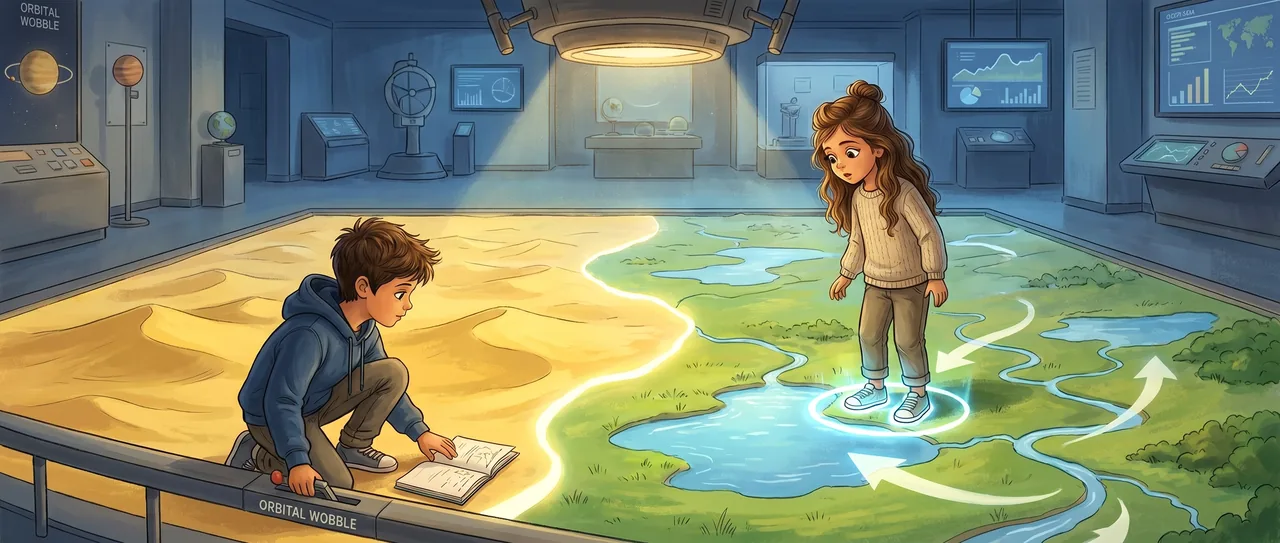
Maya was standing on North Africa when it happened. One second there were dunes under her sneakers, wrinkled gold from the Red Sea to the Atlantic. The next second, grass spilled across the Sahara like someone had tipped over a bucket of spring.
Blue spots opened everywhere.
Lakes.
Soren stopped with one hand inside the control cabinet. He had been trying to make the wind speaker stop coughing. The speaker gave one last sad puff and went quiet.
“That is not sand,” he said.
“No,” Maya said. “Don’t fix it yet.”
Across the hall, the exhibit manager made a noise that was almost a groan. She wore a jacket with six pockets and had something in every one of them. Museum keys. Plastic tags. A banana with one bite gone. She had been saying “opening sequence” every few minutes since they arrived.
“No green Sahara,” she said, crossing the hall fast. “This is the desert room. Children understand desert. Sand, heat, camels if we must. Soren, reboot the map. Maya, do not stand on the error.”
Maya looked down. A bright lake had formed around her shoes.
“It has edges,” she said.
“All errors have edges if the projector is expensive enough,” the exhibit manager said. “I have to find out why the Mars dust devil is spinning backward.”
She hurried away, talking into her wristband.
Soren did not reboot the map.
Maya crouched. The lake around her shoes was not a random splash. It filled a low place, curled around a dark ridge, and narrowed into channels that ran north and east.
“Try the date,” she said.
Soren turned the small wheel beside the control panel. The label above it read YEARS BEFORE PRESENT. He turned it carefully because he turned everything carefully.
At “now,” the green vanished. Dunes came back.
At five thousand years, the sand broke into patches. Grass clung to the south. A few blue marks blinked and disappeared.
At seven thousand years, the blue marks stayed.
At nine thousand years, the Sahara bloomed.
Maya stood very still.
Soren turned the wheel to ten thousand years.
The whole floor changed.
Not a garden. Not a little oasis with three palm trees and a camel looking bored. The Sahara became a country of grasslands and lakes so wide that the museum ceiling seemed too low to hold them. Rivers shone where no river shone on the present-day map. The desert was still shaped like the desert, but it was dressed in rain.
“That’s the size of the United States,” Soren said, though he said it softly, as if loud numbers might scare the map away.
Maya stepped from one lake to another.
“How does a place stop being this?” she asked.
Soren opened his notebook.
At school, people asked why he used paper when walls, tables, and sleeves could all remember things for you. In the climate hall, the drawers under the glass were full of paper. Field sketches. Core labels. Pencil lines made by people kneeling in dust, writing down things that should not have been there.
He read the card in the nearest drawer.
“Freshwater snail shells,” he said. “Collected in what is now desert.”
Maya was already at the next drawer.
“Fish bones,” she said.
The drawer after that held a brown tube sliced open lengthwise.
“Lake sediment core,” Soren read. “Pollen grains show grasses and shrubs.”
Maya pressed her nose close to the glass. The sediment looked like nothing. Just stripes of old mud.
“Tiny things,” she said. “All saying no.”
“No to what?” Soren asked.
“No to the label.”
The tall label beside the doorway still said SAHARA DESERT. OLDEST HOT DESERT ON EARTH. It had a photograph of dunes at sunset. It was beautiful. It was not enough.
The exhibit manager shouted from the Mars corner, “Please tell me North Africa is beige again.”
“Not yet,” Soren called.
“That sounded like a no.”
“It was a not yet,” he said.
Maya moved to the other side of the control rail. There were three sliders besides the date wheel. CARBON DIOXIDE. ICE. EARTH’S ORBIT.
She put her finger on the last one.
The projection trembled.
Soren came beside her.
“Careful,” he said.
“I am being careful.”
“You are being Maya careful.”
“That counts.”
“It counts after I know what it means.”
She moved the orbital slider a little.
The green Sahara shrank.
She moved it back.
The rain returned.
Soren bent over the panel. “It says Earth’s axis wobbles slowly. The season when the Northern Hemisphere gets the strongest sun changes over thousands of years.”
“Sun moves rain?” Maya asked.
“Warm land pulls monsoon air inland,” Soren said. He looked up at the ceiling map, where pale arrows breathed north from the ocean. “More summer heating, farther north rain. Less, and the rain stays south.”
Maya pushed the date wheel forward.
The floor did not dry all at once.
That was worse.
At eight thousand years, lakes glittered.
At seven thousand, grass thinned.
At six thousand, yellow opened like holes in cloth.
At five thousand, the lakes broke apart.
Then the monsoon arrows slipped south.
The Sahara emptied.
Maya stepped back as sand covered the place where her lake had been.
“That’s too small a thing,” she said.
Soren watched the orbital slider. It had barely moved.
“It isn’t small if a planet is doing it for thousands of years.”
From the entrance came the rumble of children arriving in the lobby. The museum was opening.
The exhibit manager returned at a half run, with a red Mars filter stuck in her hair.
“Status,” she said.
“The map is not broken,” Soren said.
The exhibit manager looked at the green Sahara, the open evidence drawers, and the orbital slider under Maya’s hand.
Her mouth made the shape of another instruction, then stopped.
Maya pointed at the snail shells. Then the fish bones. Then the pollen core. Then the floor.
“Desert now,” she said. “Not always.”
Soren turned the date wheel from now to ten thousand years and back again. Sand. Grass. Sand. Grass.
The exhibit manager took the red filter out of her hair.
“The sign is already printed,” she said.
Maya looked at the big label. Soren looked at the small blank magnetic tiles stacked near the cabinet, the ones meant for quick repairs.
“We don’t need a new sign,” he said.
Maya picked up two tiles. On one she wrote NOW. On the other she wrote TEN THOUSAND YEARS AGO.
Soren did not write anything else. He clipped NOW beside the dune photograph. Maya clipped TEN THOUSAND YEARS AGO beside the evidence drawers.
The first group entered the hall in a rush of wet shoes and loud whispers. They stopped when they saw two Saharas on the floor at once, one yellow, one green, divided by a glowing line.
A small voice near the front said, “Is that the same place?”
The exhibit manager looked at Maya and Soren.
“Show them,” she said.
Maya set one finger on the time rail. Soren held the evidence drawer open beside her. Together they slid the Sahara backward, and the yellow dunes under their shoes filled with grass and water.
Read the interactive version, listen to the narration, and earn a gold star →
A science-verified short story for curious kids · Curiosity Land