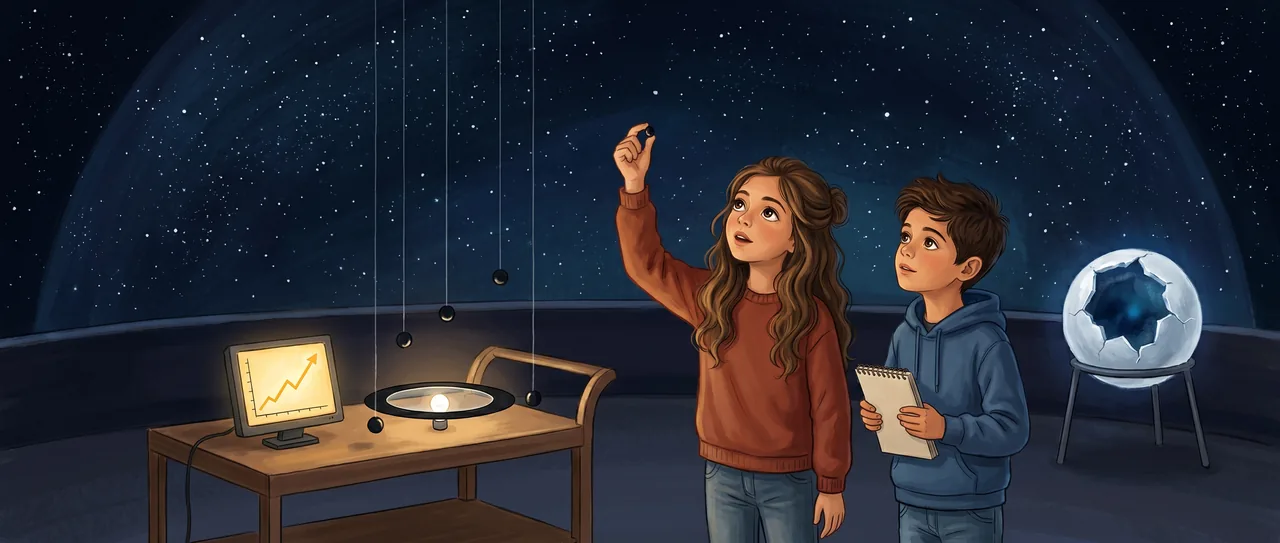
The Dark Between the Stars
The first planet fell off before the stars came on.
It was a black bead, no bigger than Maya’s thumbnail, and it bounced twice across the planetarium floor before rolling under the front row.
Soren dropped to his knees. “That was Kepler four fifty-two b.”
“No,” Maya said, already crawling after it. “It’s not anymore.”
Above them, the unfinished exhibit hung from fishing line and tiny magnets. Bright suns. Painted planets. Rings made from clear plastic. Everything was supposed to orbit something. Everything had a place.
Except the black bead, which had found the dust under seat A twelve.
Ms. Vale stood in the aisle with a tablet under one arm and three pencils in her hair. She designed exhibits the way other people folded fitted sheets, with force and irritation.
“We open in forty minutes,” she said. “Please tell me the universe is not coming apart.”
“It came apart a long time ago,” Soren said from under the seat.
Maya grinned into the dark. She could see the bead against a gum wrapper because it did not shine at all.
Soren backed out, holding it between two fingers. “This one shouldn’t go back on the wire.”
Ms. Vale blinked. “All planets go on wires today.”
“Not all planets go around stars,” Soren said.
Maya sat up so fast she bumped the seat. “Right. The thrown-out ones.”
“Ejected,” Soren said. “By gravity. If big planets pull on each other, or a star passes too close, a planet can get flung out.”
Ms. Vale closed her eyes. “We cut that panel.”
“Why?” Maya asked.
“Because this show is called Worlds Around Stars. Families of planets. Nice circles. Children like circles.”
Maya looked at the dangling mobile. The circles were neat. Too neat. Like a class photo where everyone had been told where to stand.
Soren rolled the black bead across his palm. “There may be more rogue planets in the Milky Way than stars.”
Ms. Vale opened one eye.
Maya said, “Then your show is missing most of the planets.”
“It is missing a difficult sentence,” Ms. Vale said. “Also a way to show a thing that reflects almost no starlight because it has no star.”
She marched toward the control booth, pencils wobbling in her hair.
Maya looked up at the hanging planets. “A planet nobody can see.”
“Not nobody,” Soren said.
He did not say anything else. He had that look he got when a thought had not become words yet.
They tried making the bead visible first. Maya taped a tiny silver star to it. Soren stared until she peeled it off.
“Wrong,” she said.
“Very wrong,” he said.
They tried placing it under a blue spotlight. It looked dramatic and completely fake.
“Also wrong,” Maya said.
“Unless there is a nearby star,” Soren said, “which is the thing we are saying there isn’t.”
Maya put the bead in the very center of the black dome floor. It disappeared so perfectly that even knowing where it was made no difference.
Ms. Vale called from the booth, “If you have invented invisible paint, please apply it after opening day.”
Soren had wandered to a cart marked Optics. He lifted a clear acrylic lens from a tray and held it in front of a paper star chart. The printed stars bulged and slid sideways.
Maya stopped with the tape stuck to her finger.
“Do that again,” she said.
Soren moved the lens. A tiny white dot on the chart stretched, brightened, then snapped back.
“That,” Maya said.
“It’s not gravity,” Soren said quickly. “It’s plastic.”
“But it bends light.”
“Like a model.”
“Like enough.”
They dragged the cart beneath the dome and raided the demonstration drawers. Soren found a light sensor, a strip of small white bulbs, and a graph screen that made a line when brightness changed. Maya found black paper, scissors, and a round glass cabochon from the geology table.
“This can be the mass,” Soren said, setting the glass over one bulb.
The graph line jumped.
Maya leaned closer. “Again.”
He moved the glass slowly across the bulb. The light on the screen rose and fell like a hill.
Maya’s hands flew before her words did. Black paper around the glass. A little round shadow. A hidden clear middle. The object looked dark, but when Soren moved it across the fake star, the star brightened anyway.
Ms. Vale came down the aisle, still carrying her tablet. “Why is my test graph having a heartbeat?”
Soren pushed the black circle across the bulb. The line climbed and dipped.
“Microlensing,” he said.
Maya pointed at the star. “The planet doesn’t shine. It bends the background star’s light for a little while. So the star changes.”
Ms. Vale crouched despite the tablet, the pencils, and the forty minutes. “A dark planet makes a bright signal.”
“Not because it is bright,” Soren said.
“Because it is there,” Maya said.
For once Ms. Vale did not answer immediately.
The planetarium lights dimmed by accident or by someone in the booth leaning on the wrong switch. The ceiling filled with stars, thousands of them, sharp and cold and waiting.
Maya held the black bead up between herself and the dome. It vanished.
Soren whispered, “If there are more of them than stars...”
He did not finish.
Maya lowered her hand. The ceiling had always looked crowded to her. Now it looked unfinished. Between every point of light there was room for other worlds, unlit, unnamed, crossing the dark without sunrise or sunset. Not empty space. Hidden space.
Soren went very still. At school, people asked why he used paper when his desk screen could save everything. They said notebook like it was a fossil. He kept writing anyway because some thoughts needed friction. Now he looked up at a galaxy where the things not attached to the bright centers might be the greater number.
Maya did not say anything about that. She only handed him another black bead.
“More,” she said.
They made the exhibit ugly at first. Then less ugly. Then strange.
They took down three perfect orbit wires from the mobile and let the black beads hang on long, slanting paths that did not circle any lamp. Ms. Vale flinched, then started cutting fishing line herself.
“No sad music,” Maya said.
“I had no sad music,” Ms. Vale said.
“You were thinking it.”
Ms. Vale removed a pencil from her hair and pointed it at Maya. “Possibly.”
Soren found a hollow display sphere from an old ocean-moons exhibit. Its outside was white and cracked like ice. Inside was a sealed layer of blue.
Maya turned it in her hands. “Can we use this?”
“For a rogue planet?” Ms. Vale asked.
“For maybe.”
Soren nodded. “If a rocky planet has enough ice over it, and heat still coming from inside. Radioactive decay in the rock can make heat for a long time.”
“Not sunlight,” Maya said.
“Inside heat.”
Ms. Vale’s mouth made the shape of an argument. Then she looked at the blue under the white shell.
“Maybe,” she said.
They placed the ice sphere beside the microlensing model, not as a promise, not as a picture from a telescope, but as a question with a blue center.
Visitors began rustling outside the doors.
Ms. Vale hurried to the control booth. “If anyone asks, this was always in the plan.”
“No,” Maya called. “It fell off.”
The doors opened.
Families poured in, smelling like raincoats and popcorn. Small children ran to the glowing stars. Older children pretended not to. A boy in a yellow hoodie stopped at the new black circles cutting across the neat model.
“Those are broken,” he said.
Soren held out the microlensing slider. “Try it.”
The boy pushed the dark circle across the little star.
On the graph screen, the line rose.
The boy frowned and pushed it back.
The line rose again.
“It makes the star brighter,” he said.
Maya crouched beside the display. “The star is behind it. The dark thing bends the light.”
“But it’s a planet?”
“Maybe a planet,” Soren said. “Alone.”
The boy looked up at the dome, then at the black beads hanging where no lamp held them. “How many?”
Maya reached into the tray Ms. Vale had left beside the model. It was full of black beads.
The theater waited.
Maya lifted one black bead from the tray, then another, then another, until her palm was full.
Read the interactive version, listen to the narration, and earn a gold star →
A science-verified short story for curious kids · Curiosity Land