The Crowd Called Soren
The screen asked, HOW MANY OF YOU ARE YOU?
Soren did not like questions that pretended to be easy.
The microbiome theater was round and white and smelled faintly of clean plastic. Last month, everyone in Soren’s class had mailed a pea-sized sample in a blue tube to the Children’s Microbiome Atlas. The tube had come with gloves, a scoop, three stickers, and instructions so careful that Soren had read them twice before touching anything.
Now the lab had turned their samples into portraits.
The other kids were already choosing answers on their wrist screens. One, because obviously. Billions, because cells. Too many, because someone always picked the funny one.
Soren looked at the choices and did not tap.
The researcher at the front bounced on her toes as if she had swallowed a spring. She wore silver shoes and had three pens tucked into her hair. She wanted the presentation to go perfectly. Soren could tell because she kept smiling at the wall controls when they did not need smiling at.
“Quick guesses,” she said. “No wrong answers yet.”
Yet was a dangerous word.
Soren tapped, ABOUT THE SAME NUMBER AS SOMETHING ELSE.
His wrist screen flashed, UNUSUAL ANSWER.
That was not the same as wrong.
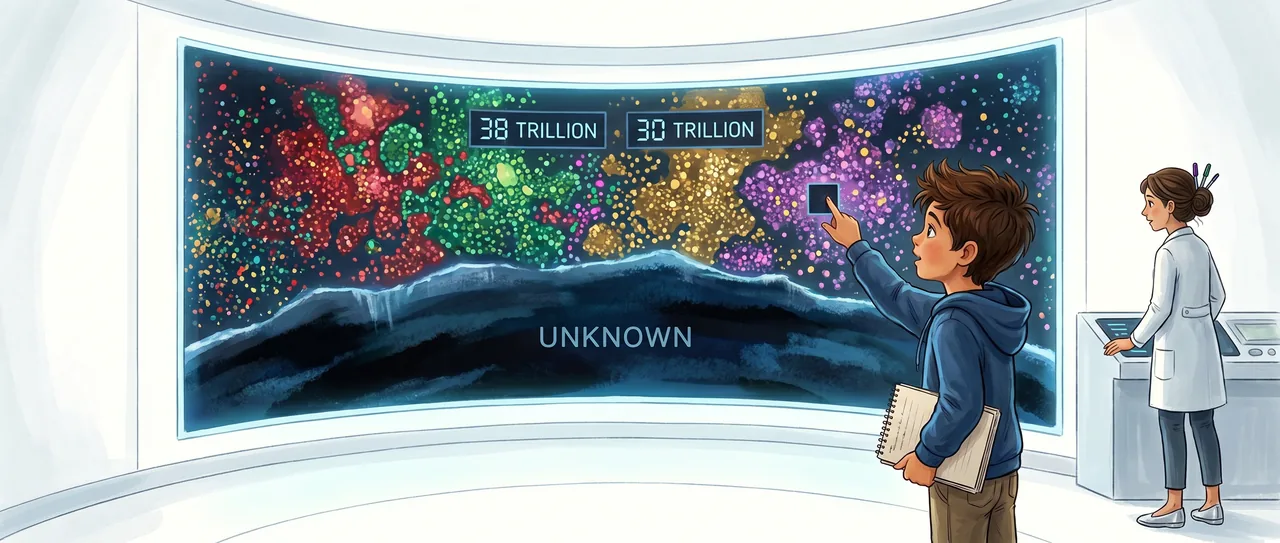
The lights dimmed. A human outline appeared on the wall, blue and ordinary, head, arms, ribs, legs. Then the outline filled with specks. At first they looked like dust in sunlight. Then there were more. Red, green, gold, violet. They gathered thickly in the belly and lower down, a glowing city where Soren had expected a diagram.
“Your body has roughly thirty trillion human cells,” the researcher said. “And in and on you, mostly in the gut, live roughly thirty-eight trillion bacteria.”
The room went quiet in the way rooms go quiet when everyone has been standing on a trapdoor and just heard it click.
“They help digest food your body cannot break down alone,” she said. “They train parts of your immune system. They make signals. Some of those signals are linked to mood and thinking, though we are still learning how. They are not little pilots. They are not magic. They are an ecosystem.”
Soren’s wrist screen tried to load his portrait.
It failed.
The blue outline disappeared. In its place appeared a gray square.
CONTEXT MISSING.
The researcher’s smile slipped, then stuck itself back on.
“Sometimes the app drops a check-in,” she said. “That is fine. You can watch the class average.”
Soren did not move.
The class average bloomed on the wall. It was beautiful, but it was beautiful the way a weather map of the whole planet was beautiful when you wanted to know if you needed a coat.
Soren looked down at his wrist screen.
CONTEXT MISSING.
Under it, smaller words said, TIMELINE INCOMPLETE. DIET, SLEEP, ILLNESS, MEDICATION, MOOD.
“I have those,” Soren said.
The researcher was already touching the wall controls with two fingers at a time. “The app records them automatically if the reminders are answered.”
“I did not use the app.”
She blinked at him.
“I wrote them down,” Soren said.
The silver-shoed researcher looked at the paper notebook under his arm the way some people looked at moths in kitchens.
“Oh,” she said. “That is very careful, but the system reads formatted entries.”
“Where does it read them?” Soren asked.
“From the upload table.”
“Can I get to the table?”
“We are in the middle of a presentation.”
“The presentation is the part that is broken.”
The researcher opened her mouth, closed it, and looked toward the back window where two adults in lab coats were watching. Then one of the wall panels chimed because another portrait had frozen.
“Three minutes,” she said. “Do not change anyone else’s record.”
Soren sat at the side console.
The upload table was not friendly, but it was honest. It had columns with names like FIBER RANGE, FERMENTED FOODS, ANTIBIOTICS, SLEEP HOURS, RECENT FEVER, STOOL DATE, SELF-REPORTED MOOD. The app had left his rows blank because he had ignored its cheerful reminders and used the notebook instead.
He opened to the first page with a blue sticker.
No antibiotics in the last three months.
Cold, mild, two weeks before sample.
Slept six hours the night before sample because rain hit the window in a pattern that almost repeated but not quite.
Oatmeal. Apple. Lentil soup. Yogurt. Popcorn. Carrots. Crackers shaped like fish.
Mood, quiet, not sad. Brain noisy.
He typed exactly what the table asked for, not more. The system did not need the part about the rain almost repeating. He kept that.
The researcher hovered behind him, trying not to hover.
“Why would mood be in the same table as yogurt?” Soren asked.
“Because the gut and brain send signals both ways,” she said. “Nerves. Immune chemicals. Molecules made when microbes ferment fiber. We do not reduce a person to bacteria. We look for patterns.”
“Patterns need the boring columns,” Soren said.
The researcher made a sound that might have been a laugh if she had not been so tense.
The last blank box asked, CONSENT TO CONTRIBUTE DE-IDENTIFIED CONTEXT TO ATLAS?
Soren read it twice.
De-identified meant his name would not travel with it. Context meant the boring columns would.
He selected YES.
The gray square vanished.
The theater went dark all at once.
Then Soren appeared on the wall, except not his face, not his hair that never lay flat, not his elbows or his scuffed shoe. He was a landscape with no sky. A long folded tunnel lit itself from within. Species names drifted past like labels in an aquarium. Bacteroides. Bifidobacterium. Faecalibacterium. Others slid by too fast to catch.
The number counter climbed until it stopped near thirty-eight trillion.
Beside it, another counter showed human cells, close enough that the two numbers looked like twins who had grown up in different houses.
Soren put one hand on his stomach.
The map changed when his context arrived. Not the bacteria themselves, the researcher had said quickly. The model. The way the atlas could ask better questions.
His oatmeal and lentils became pale threads marked FIBER. The yogurt became a small gold dot marked FERMENTED FOOD. The cold from two weeks before appeared as a blue wash near IMMUNE ACTIVITY REPORTED. The quiet day at lunch appeared too, a small gray square floating beside SLEEP, ILLNESS, AND SELF-REPORT.
Not because.
Beside.
The gray square did not look like a complaint. It did not look like a teacher asking what was wrong. It hung in the model like weather over a forest.
The researcher stopped bouncing.
“Huh,” she said softly.
Soren looked up.
“What?” he asked.
“You had enough context to unlock the comparison layer.”
“I thought you said it was missing.”
“It was. Then it wasn’t.”
The wall widened the picture. The class average returned, but now it did not cover Soren’s map. It stood beside it. None of the portraits matched. Some were dense in one color, some in another. Some had recent antibiotics marked, some did not. Some had fever, some had more plants, some had less sleep. Every body in the room was carrying a different forest through the same morning.
At the bottom of Soren’s map, a black band appeared.
UNKNOWN GENES DETECTED IN SAMPLE. FUNCTION NOT YET ASSIGNED.
The band was not small.
It spread under the colored city like deep water under ice.
The researcher whispered, “Most microbial genes are not well understood yet.”
Soren leaned closer to the wall. The black band divided into thousands of tiny dark squares, each one with a number instead of a name.
The screen asked, OPEN UNKNOWN LAYER?
Soren lifted his finger and touched the dark square labeled UNKNOWN.
Read the interactive version, listen to the narration, and earn a gold star →
A science-verified short story for curious kids · Curiosity Land